


Magazine Archive
Home -> Magazines -> Issues -> Articles in this issue -> View
From Britain With Love: Gear | |
Article from International Musician & Recording World, July 1985 | |
While Paul Bacon looks at the UK companies that have received worldwide acclaim
British craftsmanship has considerable Stateside status — and many homegrown companies have not been slow to capitalise. Here's a few that have...
At a time when Ms Brittania's rule over the proverbial waves of commerce is falling increasingly into question, you might be refreshed to know that, within the realms of music and sound equipment, she can still thrust a tolerably insistent trident or two.
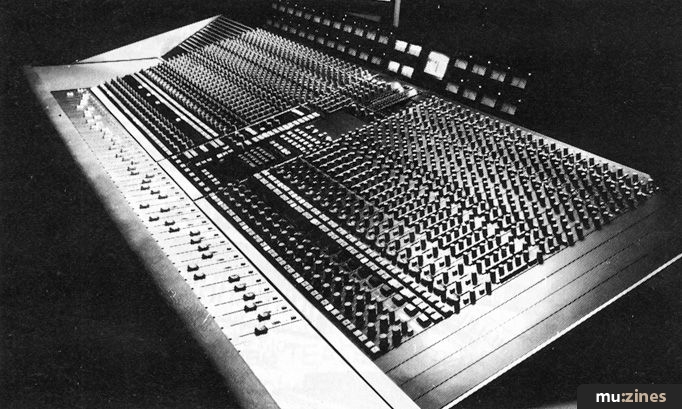
The King of the studio — SSL's 4000 desk
Yes, there is undoubtedly still some life in the old girl yet, and in some areas we are still very much world leaders. One particularly impressive prong of attack is that concerning mixing consoles. Here the name Solid State Logic arguably carries more respect and admiration amongst professional studio users world wide than any other analogue console manufacturer. Over the last year orders have increased quite dramatically and notice, if you will, that this popularity has not been won by pandering to a mass market, but rather by simply producing the very best money can buy — ideals in action, and all that.
With the inclusion of a dynamics section in each input channel and then later with the introduction of their unprecedentedly powerful 'Total Recall System', SSL were undoubtedly re-stating the art of making mixers, bringing a new dimension to console design which is yet to be practically superceded... unless you prefer your processing to be all-digital, of course, in which case you'll have to steer your craft away from the delights of Oxford's dreamy spires and set a course for the equally picturesque shores of Royston, Hertfordshire. There you will find Neve Electronics and the wonders of the digital domain.
In addition to being one of the most respected analogue mixing console manufacturers in the world, Neve also own the very considerable distinction of being the only company in the world producing a commercially available, all-digital, full production console: the DSP. This desk is almost entirely 'soft' (virtually all of its functions are software based) and thus its settings and basic configurations can be stored onto disk or reset from disk in a matter of seconds, thereby obviating much of the need for lock-out bookings. Once the signal has been digitally quantised on entering the desk, it need not return to the uncertainties of the analogue world until it leaves the consumer's own Compact Disc player. The project might appear to be unlikely to immediately reap vast financial rewards for the company but the four years of R&D that they put into the whole digital question before the eventual installation of the first DSP multitrack console at CTS Studios in Wembley has given them a substantial lead on the competition in terms of practical understanding. And who on Earth can doubt that digital is the future of audio? Meanwhile their overall penetration abroad continues apace, and orders have never been better.
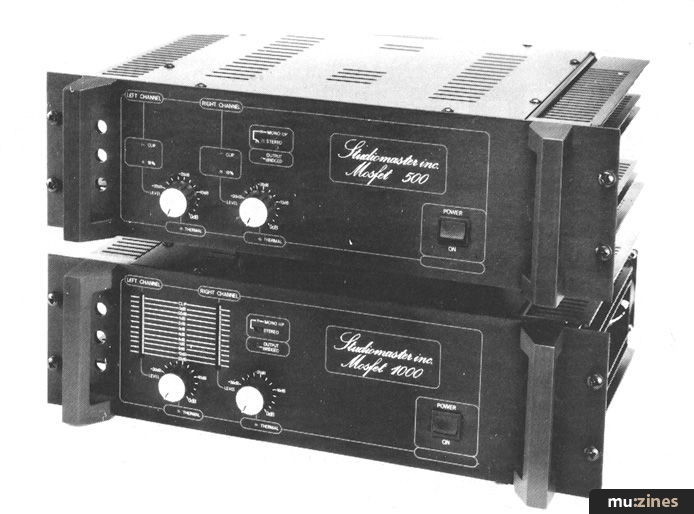
Studiomaster power amps — a Stateside studio standard
Among a long list of other unspeakably successful British console manufacturers are to be found such studio-household names as AHB, Alice, Amek/TAC, Audix, Calrec, Soundtracs, Trident, Studiomaster and of course the ever expanding Soundcraft Electronics, whose world-conquering exploits also include the creation of tape recorders and power amplifiers.
A name to be found on the 1984 Queen's Award for Export Achievement, and commonly used synonymously to suggest the very best of a whole area of sound processing hardware within multitrack, radio and TV worldwide, is that of AMS. In search of the right sound recording environment the less well versed client will almost undoubtedly have on his list of questions,'Do you have an AMS?'. The more experienced hand will probably appreciate the huge range and variety of the world-beating AMS digital processor range, and the constant software updating process that goes on at the AMS factory, keeping all current models at the very leading edge of professional audio. At this year's APRS exhibition they will be releasing onto the market their 'Audiofile'. This is a hard disk-based 16-bit, stereo digital audio recording system with advanced editing and lock-to-picture capabilities and a maximum record time of many hours. Could this be the beginning of the end for magnetic recording tape?
Of course, it's all very well making the best, without compromise, etc, but the average struggling musician isn't up to squeezing tens of hundreds of thousands out of his piggy bank, and so a source of reliable, low budget equipment is also very necessary. In this area MTR have to take some kind of prize for producing a very useable 12:8:2, in-line mixing console with balanced mike inputs (XLR) auxiliary sends and return, ideal for the home recordist and all for under £500.00. It means that 'normal' people can seriously consider setting up a proper eight-track system without burying themselves in debt, and that fact has encouraged a high and constantly increasing demand in Europe.
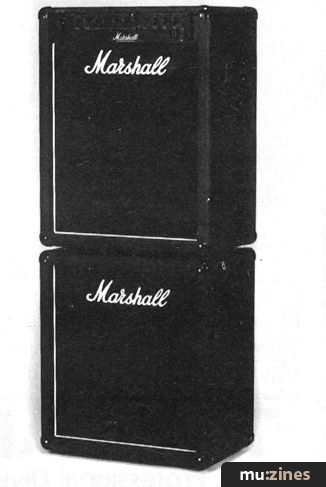
The latest living legend, Marshall's new modular system
Talking of the musician, one of the great living legends of Rock and Roll musicians's hardware has to be the Marshall stack. The name has long been to beefy backline gear what Hoover is to vacuum cleaners; and indeed they are continuing to clean up pretty convincingly both in the UK and abroad. Orders have never been greater and it was only last year that they saw fit to move to a new and more expansive building, trebling their size and construction capabilities. Few companies could have sustained such a central position in the business internationally over such a long period of time, and this fact was reflected in the fact that Marshall were also awarded the Queen's Award for Export Achievement last year. The Marshall Sound lives on — with a vengeance.
Turning to the area of musical instruments, nowhere are we more innovative than in the area of guitar technology. Bond Guitars, for instance, have seen fit to bravely do away with the time-honoured fret, preferring in its place a form that preexisted it by some considerable period — the step. This new design creates an unprecedentedly fast playing action and with its carbon fibre construction, its tuning is virtually impervious to humidity and changes in temperature. On the newer models yet to be released, volume, tone and choice of pickup are all programmable and 16 different settings can be logged in an on-board memory. Also built-in is a digital tuner. Bond understandably have high hopes for the future.

British ingenuity triumphs with the Synthaxe
In the same way that the electric instrument came as a natural development from the acoustic, so the Synthaxe might now be seen as the obvious next to the electric. The Synthaxe brings the world of music synthesis to the guitarist.
It's basically a MIDI controller, and has no internal sound generation system of its own. In theory it can be used to control any MIDI instrument, although at present its full potential can only be realised in conjunction with the excellent Oberheim Synth Expander unit. In practical terms it offers many of the facilities of any ordinary guitar such as dynamics and note bend plus a host of other capabilities such as instant capo, instant tuning to a chord and a set of six keys (one per note) to be played with the right hand, which allow it to be played in a similar fashion to a keyboard, using the left hand on the fretboard to determine the notes played. It's no instrument for the lazy player or anyone who's rigidly stuck in their old guitar technique, but for those are willing to learn a new range of skills in addition to the old ones, the rewards are very substantial. Numbering among such heroic types are Synthaxe owners Steve Levine, Gary Moore who used the instrument on the latest Beach Boys' album; Alan Holdsworth, one of a handful of British musicians who have really managed to crack the American session circuit, will be using his Synthaxe on sessions and on his next album; and finally Lee Ritenour (one of the Daddies of them all) is also a proud owner.
Sticking with guitars but looking more towards maintenance of the high standards of more traditional craftsmanship and design, Britain is equally rich in talent. Such companies as Ashley Pangborn, Manson, Staccato, Status and Wal continue to make a very good impression at home and abroad. Wal for instance, only put out around 250 bass guitars a year to satisfy an eager British, American and European market. But this allows a high level of control, and a few examples of existing clients reflects the care taken: Dire Straits, Elvis Costello, Eurythmics, Rush and Simple Minds.
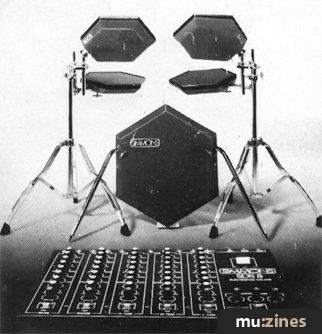
Simmons' SDS8, a best-seller abroad and at home
As an ever growing wave of electronic drums sweeps across the known worlds, let us not forget the origin of the species. Back in the early 80's Dave Simmons started the revolution with the first non-acoustic kit and, predictably there have since been endless imitations. With the SDS-9 Simmons seem poised to take the lead again with a five-drum MIDI interfaceable kit using both digitally recorded and synthesized sounds. This new kit features newly designed injection moulded pads, greatly improved dynamic range, 20 factory-programmed drum kit memories, 20 user-programmable options and tape dumping of programmes. It's among the most sophisticated and musical electronic kits on the market.
Rule Brittania — we're still bursting with talent.
Publisher: International Musician & Recording World - Cover Publications Ltd, Northern & Shell Ltd.
The current copyright owner/s of this content may differ from the originally published copyright notice.
More details on copyright ownership...

International Musician - Jul 1985
Feature by Paul Bacon
Help Support The Things You Love
mu:zines is the result of thousands of hours of effort, and will require many thousands more going forward to reach our goals of getting all this content online.
If you value this resource, you can support this project - it really helps!
Donations for May 2026
Issues donated this month: 0
New issues that have been donated or scanned for us this month.
Funds donated this month: £0.00
All donations and support are gratefully appreciated - thank you.
Magazines Needed - Can You Help?
Do you have any of these magazine issues?
If so, and you can donate, lend or scan them to help complete our archive, please get in touch via the Contribute page - thanks!
Please Contribute to mu:zines by supplying magazines, scanning or donating funds. Thanks!
Monetary donations go towards site running costs, and the occasional coffee for me if there's anything left over!

 @mu_zines
 RSS Feed
 Blog
Blog