


Magazine Archive
Home -> Magazines -> Issues -> Articles in this issue -> View
Article Group: | |
Genius Mini Music Scanner and Mini Music Round lights | |
Article from Music Technology, September 1993 | |
It's easy to be impressed by Genius.
John Wright discovers that simplicity and effectiveness are the hallmarks of true Genius
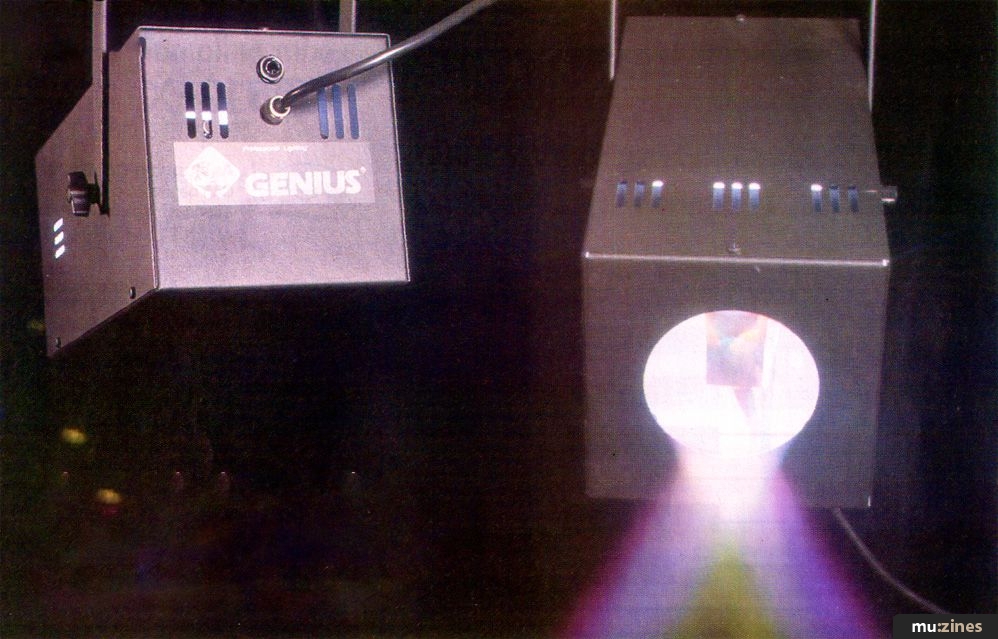
Image credit: James Cumpsty
When was the last time you watched Top of the Pops? Or rather, when was the last time you admitted watching Top of the Pops? It's true that this former pillar of the British music industry has become something of a millstone around the BBC's neck of late (misguided production, appalling presentation and a tedious format are a few of its lesser flaws), but to this day the programme still has a profound impact on the way bands are presented on stage. A group performing at a club PA will tend to mirror their contemporaries' showcase on the small screen - the form these days tends to be two keyboard players (connecting leads optional), a lead vocalist (connection with original recording optional), a DJ with two decks (connecting leads optional), and an assortment of lycra-clad choreographed dancers (connecting leads optional).
The TOTP team realised long ago that viewers quickly become bored with this formulaic approach to entertainment, and decided that it was up to the show's designers to create some form of background interest, to engage the eye and keep the finger from zapping the remote control. And now the current fashion seems to be draping a massive parachute silk curtain right across the back of the stage and throwing visuals onto that, either from projectors or specially-designed automated lighting. Which is exactly where Genius' new range of lamps come into play.

Image credit: James Cumpsty
The Mini Music Scanner and Mini Music Rounds are Genius' answer to creating complex visual effects on a tight budget. As usual, the lights are suitable for a whole range of applications; general club installation 'fillers', mobile DJ rigs, and over-audience effects at PAs. But when I first connected up the three models and switched them on, I was immediately reminded of those TOTP-style 'projected' effects. If you have access to a backdrop cloth - or indeed, any form of flat back 'wall' - then the Genius range could well help liven up what's happening on your stage. Of course, the nature of these lights means they could be used over-stage or over-audience as well - but I personally recommend setting them up so that their beams are focused on a vertical surface, rather than the floor.
All three lamps in the Mini series incorporate fixed gobos and colour filters - you can't actually change the pattern of beam they produce (unless you rip the casing apart to gain access to the inside, presumably). However, this is to be expected from lanterns in this price bracket; the inclusion of remotely selectable filters would seriously bump up the price. Similarly, the Mini series operate from sound-to-light only, syncing the beam pattern in time with bass downbeats; the lights aren't DMX-controllable, and need only to be plugged into the mains to work.

Image credit: James Cumpsty

Image credit: James Cumpsty
Incidentally, it's worth noting that each lamp is available in two configurations; you can choose between a master unit, with all the sound-to-light circuitry built in, or a slave, which lacks the control circuitry, but which takes its cues from the master unit (via a proprietary interface). The idea is that you buy one master unit and then chain up to three slaves from it, using a standard 1/4" to 1/4" jack connection cable.
The most senior member of the range at present is the Mini Music Scanner, which incorporates a servo-controlled mirror in front of the lens to bounce the beam around in a 'robot-style' pattern. The beam itself comprises a circle of yellow and blue spots - which spin in time with the music - and when this is reflected off the mirror, quite an impressive effect is achieved. However, as the lamp itself remains on even when no sound is being picked up (although the beam is stationary), the Mini range really needs to be fed by a remote mains switching-pack, in order to afford the user some modicum of control.

Image credit: James Cumpsty
The remaining models are basically two variations of the same light - the Mini Music Round - which projects a beam of coloured spots in Moonflower formation, and again spins them in time with your music. The beam of the first model has the dots arranged in circles; the beam of the second arranges them in a simple line. Interestingly, the silhouette of the high-power bulb can be seen in the 'dots' themselves, which makes for a far more interesting pattern - strangely reminiscent of valves formation-dancing.
As I said, the best way of employing the Geniuses on stage is to arrange a number of them to 'project' their beams onto a rear drape; you might choose to hook four of one type together, or two of each. When all of them are belting away in unison, the effect is quite mind-blowing and is perhaps best used in moderation. I wouldn't go so far to say that they can lift your entire performance into a new dimension on their own - the general idea is to employ them as an extension to your existing lighting rig. Nevertheless, the interest they can add to a gig could prove invaluable; they're also simple to set up, and extremely good value for money. The hallmarks of Genius?
THE LAST WORD
| Ease of use | No knobs, no switches, no nonsense |
| Originality | Derivative |
| Value for money | Pretty reasonable |
| Star Quality | Add shine to a lacklustre venue |
| Price | Scanner master £177 +VAT, slave £154 +VAT; Round master £149.50 +VAT, slave £128 +VAT |
| More from | Batmink, (Contact Details) |
Publisher: Music Technology - Music Maker Publications (UK), Future Publishing.
The current copyright owner/s of this content may differ from the originally published copyright notice.
More details on copyright ownership...

Music Technology - Sep 1993
Quality Control
Gear in this article:
Review by John Wright
Help Support The Things You Love
mu:zines is the result of thousands of hours of effort, and will require many thousands more going forward to reach our goals of getting all this content online.
If you value this resource, you can support this project - it really helps!
Donations for August 2026
Issues donated this month: 0
New issues that have been donated or scanned for us this month.
Funds donated this month: £0.00
All donations and support are gratefully appreciated - thank you.
Magazines Needed - Can You Help?
Do you have any of these magazine issues?
If so, and you can donate, lend or scan them to help complete our archive, please get in touch via the Contribute page - thanks!
If you're enjoying the site, please consider supporting me to help build this archive...
...with a one time Donation, or a recurring Donation of just £2 a month. It really helps - thank you!

 @mu_zines
 RSS Feed
 Blog
Blog