


Magazine Archive
Home -> Magazines -> Issues -> Articles in this issue -> View
Guitar Guru | |
Article from Making Music, November 1987 | |
The Guru, he is as one with the guitar wisdom of the gathered universe. "One what?" Eh? "I said one what?" Well, er, y'know, just 'one' — all seeing, all wise, all .. em .. sort of thingy. Anyway he knows an awful lot about weird old guitars, and he's prepared to answer any question you throw at him regarding the identity of such peculiar instruments. In print, or by personal reply. But, there are some rules.
Only the best and most interesting queries will be published, though everyone who writes in will receive details of their guitar's identity on a specially printed form, However, there are two things you MUST do to avail yourself of this service.
Thing One: A STAMPED ADDRESSED ENVELOPE. No SAE, no reply.
Thing Two: A DETAILED DESCRIPTION.
Make it as accurate and revealing as you can, and remember it's electrics only, no acoustic guitars. Supply a clear, colour pic if possible, or failing that, a sketch can be useful.
You should write to: GUITAR GURU, Making Music, (Contact Details).

Jake Auker, of King's Lynn, Norfolk writes: "Please could you give me any info about my Gibson Marauder, purchased in 1976 for £270, serial 551870. Why did they discontinue this guitar, and is it worth much now?"
Yours is the earliest variant of the Marauder, from about 1974 — later types feature a rotary blend control in place of the toggle selector. Many Gibson models from the 1970s proved unpopular, including the Marauder, the S1 and various basses such as the Grabber, Ripper, and G3. Despite this relative lack of success, most continued in production until the 1980s.
Gibson were aware that the majority of sales were concentrated on a handful of models (Les Paul, ES335 etc), and during the 1970s they vainly tried to come up with successors to compete with other companies in both price and variety. But many of these had bolt-on necks, laminated section bodies and necks, cheap hardware and satin finishes — akin to sacrilege to Gibson diehards. I'm sure this downmarket air, allied to non-downmarket prices, contributed greatly to their failure. Quality control was also a problem around this time — yet another negative factor. All of which means that the Marauder and co are yet more of those undesirable Gibson instruments. I do think the Marauder is a good instrument, basically, but then I don't like 'normal' Gibsons anyway. In view of all this, current value is around £150.

John Leslie Hogg of Runcorn, Ches, says: "I bought a Fender/Squier Telecaster for £175; mustard body and black fingerplate, with 'Fender Telecaster' on the headstock and 'Squier' in the top corner, the serial number is JV07576. Could you tell me age and value?"
The JV of the serial number stands for Japanese Vintage; this and the large Fender logo indicates that this is one of the first batch of Japanese-made '52 Tele reissues to reach these shores in 1982. Changes were soon effected and later examples had SQ-prefix serial numbers, together with large Squier logo headstocks. Yours should have the original style circuitry, too, unless it's been modified to the later and better one-two-or-both pickup arrangement. Original retail on this model was £230; current value is around £195. This will rise in the future, I'm sure, as Teles are creeping back into fashion. Also yours is not that common and in my opinion has to be one of the best Teles produced in recent years, regardless of origin.

David Brown from Ashton-under-Lyne, Manchester, says: "I own a Vox Phantom XII Stereo 12-string, serial 283080, a transfer on the back reads 'Made In England by Vox', could you tell me when it was made and the current value?"
David's letter and blurred photo intrigued me so much I had to know more — my thanks to him for supplying additional info and improved pix which enabled me to learn more about this fascinating instrument. It's quite a rarity, especially in the UK — and how I envy you (writes a Green Guru).
The Vox Phantom XII Stereo appeared in USA literature in 1966 but I've no record of it being available in the UK. I wonder if there was ever a six-string version? The USA model was an Italian Eko-made instrument and despite the fact that Mr Brown's proudly states the contrary I'm sure it is of the same origin.
The neck is certainly pure later-style Eko, as indicated by the bound fingerboard and truss rod adjustment method. The control knobs and bridge are also characteristically Eko. However the selector switch panel, those knobs, and the various control legends all differ from the catalogue version and from actual examples I've seen, leading me to suspect that this is quite a late version, possibly from 1969. An approximate original retail price would have been around £175, but current value has to be about £500 — maybe more, as this is quite a collector's item. Vox Phantoms and teardrop Mk models are very much in vogue just now, and the normal versions command unrealistically high prices. But this one has to be a must for the true Vox enthusiast; I'd love it, but it's way beyond my miserly budget. I'd advocate that you keep it and care for it — you could end up regretting selling. Thanks for making my day.
K C Jobsz of Mildenhall, Suffolk, writes: "In the March issue you wrote about the Baldwin Baby Bison bass. I'm not sure whether I have one of the true Burns basses that you said are virtually impossible to find. I enclose a photo; it has serial 20803. Perhaps you could give me an estimate of its value?"
Sorry to disappoint you (and me) but what you actually have is a Jim Burns Bison bass — very different and much more recent than that fabled original Burns Baby Bison bass. You have a 1982 example as indicated by the serial number, and it originated from the factory of the last ill-fated Burns concern, located near Ely in Cambs. Production started in 1979, struggled on for four years, finally petering out in '83 — a great potential wasted by bad management, poor quality control and a general lack of know-how. Original retail for this model was £390 and current value is around £150. These "re-issues" are not sought-after as they lack the character and quality of the originals, a sad fate for a once-proud name.
Paul Kelly, of Lacey Green, Bucks, says: "Following on from when I came to see you at the BMF show in August, I'm enclosing details of my Grimshaw bass, which my girlfriend picked up for £40 in High Wycombe. What is it actually called and can you give me more info?"
It was good to learn of your Grimshaw during question time on the stand at the BMF. Certainly your enquiry was very different from the majority. What you have in fact is a very rare instrument — it's the first Grimshaw bass I've ever come across. The six-string equivalent was known as the Short Scale Electric Deluxe, and was one of the mainstays of the UK music scene in the late 1950s. This was a time when very few quality instruments were available, especially from UK-based makers.
The Grimshaw design was quite advanced and "modern" for the era, and many artists sported this model, including a young Joe Brown, Alvin Lee, and Bruce Welch of the Shadows (then the Drifters). The bass version was certainly not as widely used, and yours has to be one of the first British-made electric basses. I would date it at around 1959. Original price would have been about £60; current value is about the same — such an oldie has no real collector or player appeal, despite the fact that it is a rare bird.
A couple of quickes to finish this month. Following on from September's Smoke snippet about renowned 1970s guitar-maker John Birch's new range of pickups, John informs me that if anyone would like to contact him about his instruments, past and possibly future, his number is (Contact Details). Get the word from the man himself.
And Jack Golder, a regularly-occurring name in this column, told me a sorry tale about some nasty, half-inching an original Baldwin Shadows Bass from his factory, where it came in for repair and renovations. Jack and the customer would naturally like to retrieve the instrument, or obtain a replacement. Any help would be appreciated — you can reach Jack on (Contact Details). Right — see you in festive December.
Publisher: Making Music - Track Record Publishing Ltd, Nexus Media Ltd.
The current copyright owner/s of this content may differ from the originally published copyright notice.
More details on copyright ownership...
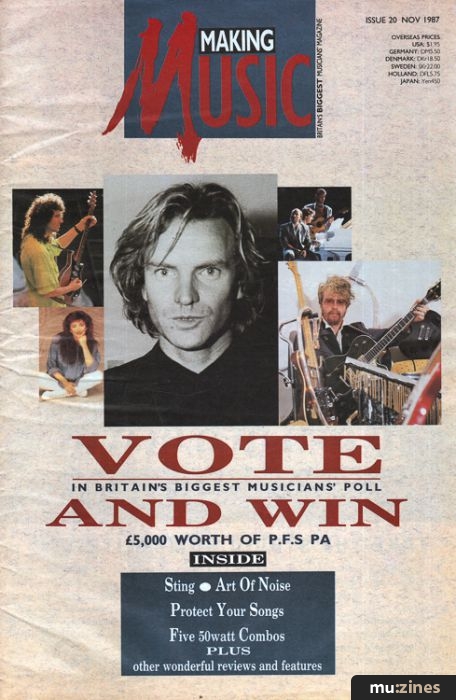
Making Music - Nov 1987
Feature by Paul Day
Help Support The Things You Love
mu:zines is the result of thousands of hours of effort, and will require many thousands more going forward to reach our goals of getting all this content online.
If you value this resource, you can support this project - it really helps!
Donations for May 2026
Issues donated this month: 0
New issues that have been donated or scanned for us this month.
Funds donated this month: £0.00
All donations and support are gratefully appreciated - thank you.
Magazines Needed - Can You Help?
Do you have any of these magazine issues?
If so, and you can donate, lend or scan them to help complete our archive, please get in touch via the Contribute page - thanks!
If you're enjoying the site, please consider supporting me to help build this archive...
...with a one time Donation, or a recurring Donation of just £2 a month. It really helps - thank you!

 @mu_zines
 RSS Feed
 Blog
Blog