


Magazine Archive
Home -> Magazines -> Issues -> Articles in this issue -> View
Hard Times in Babylon | |
Peter ToshArticle from Sound International, March 1979 | |
The man fronting this month's top ranking and cover-appearing rhythm section is Peter Tosh. The ex-Wailer parts with some heavy words on Jamaica in this interview with Dave Saunders.
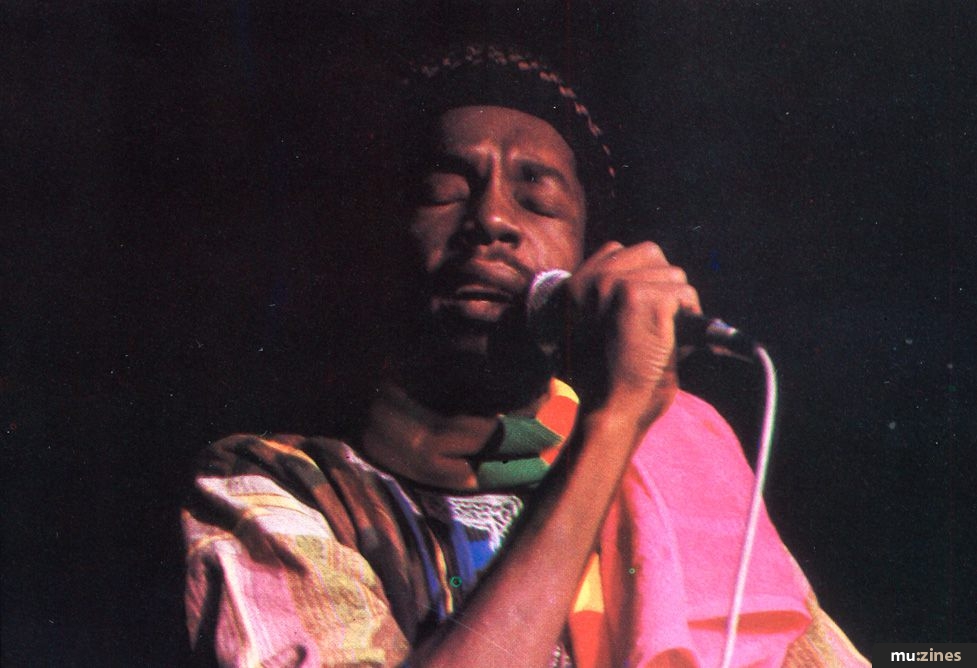
Ex-Wailer Peter Tosh sings out against oppression — 'I can't stand it no longer, the wicked get stronger.'
The words of his latest album Bush Doctor echo the sympathies of the earlier Legalise It and Equal Rights; he's just as resolute in his fight against Babylon, the oppressors. But who or what is Babylon? It seems to be anything that discriminates against people to keep them down. On the title track of Bush Doctor he sings 'No more disrespect for humanity... eliminate the slavish mentality.'
As a Rastafarian for whom smoking ganja is both a right and a religious ritual, Tosh (originally Mackintosh) has naturally had his fair share of run-ins with the establishment, in various forms. Naturally, he sees himself as being discriminated against, and his songs invite identification with the oppressed: among other things he was co-writer of Bob Marley's Get Up, Stand Up written during his time in the Wailers.
Reggae music, the life-pulse of Tosh's existence, is growing in popularity here, not just because of the increasing number of West Indians in this country, but because a lot of young people appreciate what it's all about. The rhythm and the words seep into the blood and the blood feeds the brain...
In an interview with Peter Tosh when he was in London in December, I asked him about the importance of music as the medium to put across his feelings. 'The words and music work together. The words without the music sounds too aggressive. With the music it dilutes the tempo and makes you think less of the aggression in the words, and dance to the music. To make people listen to what I have to say I decorate my words with music. As you hear it, you must feel it. When you feel it then you will listen.'
Was Tosh's split with Bob Marley and the Wailers connected with his desire to be heard? 'I am a writer, producer, director, everything it takes to make music. Being a background singer with the Wailers I never got the privileges to sing the songs that I write. There are millions of people that have never even heard my name, yet they've heard of Bob Marley. Bob Marley can get across to a certain sector, I can get across to a certain sector, so we cover a wider area.'
And how does Tosh view Marley's music? 'Well it's just a music. A mango tree bears mango, apple trees bears apple. There's a difference in my music from Bob Marley's music.'
Once Tosh had decided to make the break from the Wailers he discovered some of the pitfalls of going it alone in the market place. This led to his association with Mick Jagger and the Rolling Stones label.
'My first two albums were recorded for Tosh and given to Columbia, and Columbia gave them to Virgin. But Columbia can only promote and market pop music, jazz music — they knows nothing about reggae. To promote and to establish reggae you got to have some heart and soul inside of the music. So after my contract expired with Columbia I had to investigate to find someone else. One of my good friends in Columbia made a contact with a representative from the Rolling Stones. He brought me to Jamaica during the Peace Concert about last April. Mick was very interested in the performance and said he'd be interested to do some business.'
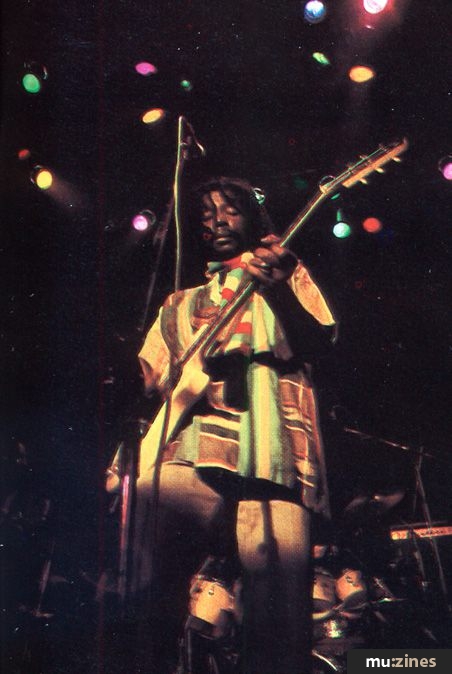
Image credit: Dave Saunders
As a result of the Tosh/Jagger liaison, the single Don't Look Back which featured Mick Jagger and Keith Richards doing backing vocals was a great success. Tosh sees Jagger as a necessary link between him and the public. 'That's a part of the psychological procedure to break down the barriers that try to say reggae isn't qualified enough to make it. Jagger has been in the business for a period of time and his love and interest in reggae music makes me think of doing something with him.'
Tosh is very conscious of the need for a bridge between the 'roots' of his music and the 'sophistication' of the audience he's aiming at. Correspondingly his commercial recordings are much smoother than his live performances. He explains: 'That's the way it has to be to get across to certain people. When they start to listen to my music they say that's different from reggae and they will even say that I am trying to split from the roots which I am not. It's just to paint the flowers very decorative so it can be acceptable in the garden.'
He wants to ease the harshness of his experiences gently into the consciousness of the public. But why such resentment against society, and especially against the police? 'Those guys, to get recognition, they have to do lots of dirty works. Well, they are very jealous to see someone get recognition without doing dirty, corrupted work. By humiliating and aggravating people so that people can have fear, and to say that they are great. That's why my hopes and aspirations are to eliminate humiliation, incrimination and slavery which still exists. Modern slavery — take off the chains from off your feet and your hands and put them on your mind. Well I come to break down these barriers.'
Strong words, 'humiliation,' 'incrimination'. How relevant are these to him personally? Well, Tosh had to return to Jamaica after his London concerts in December for the preliminary enquiry on a court case — ganja, of course! It's understandable then that he resents the cops for hauling him in. But whether or not you think it's fair, smoking ganja (the herb) is illegal, so surely the police were just doing their job?
This topic — theme of the Jamaican feature The Harder They Come — is close to his heart. His biting monologue tightened as he dug deeper into a story of the ganjarunners, a story which displays the type of hypocrisy that breeds resentment. 'Rich people buy the herb from the poor people for little and nothing, and export for bags, and get rich over night. One shipment of herb can get a guy rich as long as him want to be rich. And the system continues.
'You have certain places you travel, at night, you see plane coming to pick up herb. And if you should take a check down the road you see police down there blocking off traffics, diverting traffics so the people don't see what's happening. And the system continues.
'And when I am seen with a joint smoking for the healing of my mind, and to relieve the pressure, and to make me not think aggressive, because that's what herb is for — to lessen the aggressive thoughts of man — you have guys coming round try to brutalise me by breakin' up me hand, mashin' up me head, dislocating me ribs, punching me in abdominal with gun to show me that I mustn't smoke herb, and I am breaking the law. See, that is very aggressive. I fight against those kinda systems here, there or anywhere.
'If you are selling herb making millions (I don't sell herb. I love herb so much I know it's not to be sold) and you are coming to show me that you is the law, because you have three stripe, you is a sergeant, you can do me what you want to. No, I don't respect you for that. I will kill that kind of elements.'
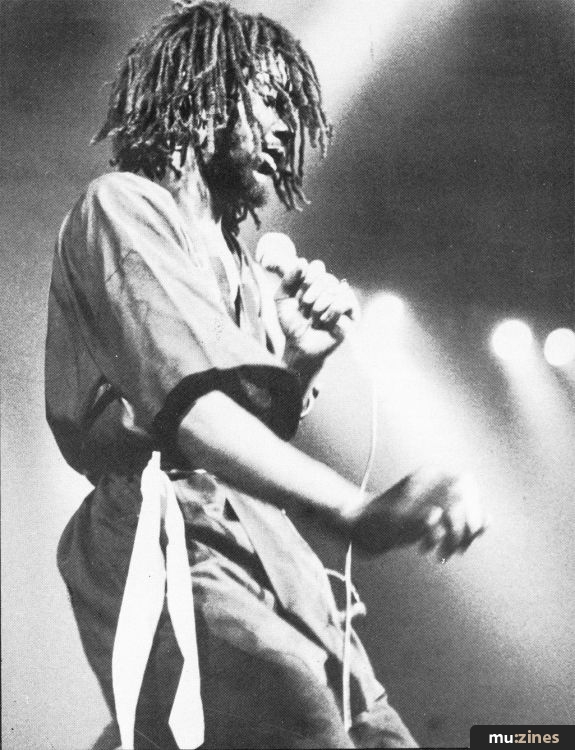
Image credit: Ralph Denyer
He took a long, slow drag when I asked him about doing another concert in Jamaica.
'If I keep a concert in Jamaica right now it may create something more than what they thought it would. Because my humiliation that I went through by the police, they are going to want to have police to protect and secure where I am going to perform. I will not want the police because the police don't want me. I will use my brothers and brethrens to do the security. They won't like that, so I don't know if I may perform in Jamaica. When I performed in Jamaica at the stadium, and talking about herb and all that, police block the road and interrogate everyone. People went to jail for a spliff. I hate them thing man.'
I asked about the Peace Concert last Spring when Tosh, Marley, Prime Minister Manley and opposition Leader Seaga got together on stage with the leaders of two rival ghetto gangs and spoke out for peace. Did the concert have a lasting influence?
'Yes, man. It's fear that cause the people not to say — they even fear to talk when they're hungry. Where there is exploitation there is victimisation, and I will always tell the people to get up, rise up and stand up for their rights. And when you rise, don't rise with fear, because fear will destroy you. Fear is death.'
Is this his main message on stage? 'My performance is not what you would call entertainment, it's an awakening, and at the same time you're enjoying yourself because the music makes you feel good. I hate the system; it has destroyed many, and many are still going down — you have to wake them from their slumbering mentality. And it's not only black men that's been oppressed, white man get same oppression too.'
We've heard views on the police, but what about the government? Prime Minister Michael Manley is a controversial figure in Jamaica; he has made several dramatic changes to level out the wealth in a country which drew its riches from the plantations exploiting the poor. So how does Tosh view Manley?
'Well, Manley is a great guy trying him best, but there are certain things, not even Manley, Seaga and all them can't do that. It's the people have to do that.
'There are certain things that should have been done that still isn't done. That means we are still living in an age of promises. And fools dance to comfortable promises. My parents have been dancing to promises from so long. There have to be some drastic move to eliminate certain systems, so that people can survive. But the force that keeps the system functioning don't want to be eliminated.'
Tosh is up against a society that despises the Rasta, a society that is trying to build for itself a national identity which excludes the Rasta, a society that still has-many problems to overcome and many paradoxes to come to terms with. The Rasta cry amidst the turmoil is seen on one hand as a thorn in the side of progress, and on the other as a move towards truth. And as this is a Tosh interview, he can have the last word: 'Every time the good open his mouth the bad say you musa mad.' (from Dem Ha Fe Get a Beating.)
More from related artists
 |
|
Publisher: Sound International - Link House Publications
The current copyright owner/s of this content may differ from the originally published copyright notice.
More details on copyright ownership...

Sound International - Mar 1979
Donated & scanned by: Mike Gorman
Interview by Dave Saunders
Previous article in this issue:
Next article in this issue:
Help Support The Things You Love
mu:zines is the result of thousands of hours of effort, and will require many thousands more going forward to reach our goals of getting all this content online.
If you value this resource, you can support this project - it really helps!
Donations for June 2026
Issues donated this month: 0
New issues that have been donated or scanned for us this month.
Funds donated this month: £0.00
All donations and support are gratefully appreciated - thank you.
Magazines Needed - Can You Help?
Do you have any of these magazine issues?
If so, and you can donate, lend or scan them to help complete our archive, please get in touch via the Contribute page - thanks!
If you're enjoying the site, please consider supporting me to help build this archive...
...with a one time Donation, or a recurring Donation of just £2 a month. It really helps - thank you!

 @mu_zines
 RSS Feed
 Blog
Blog