


Magazine Archive
Home -> Magazines -> Issues -> Articles in this issue -> View
Innovators | |
Mark ShreeveArticle from Electronic Soundmaker & Computer Music, June 1984 | |
Sean Rothman talks to Mark Shreeve about a major development on the British electronic music scene...

You might not have heard of Mark Shreeve or his music but just over three years since his first record was released, it looks like he is set to become Britain's leading electronic musician. Mark told me about his first LP 'Thoughts of War', released on the Norwegian independent label, Uniton. "It was originally going to be a cassette-only release and it was recorded on a Revox A77 reel-to-reel, low-speed but with Dolby — that was then my multi-tracking and mastering machine. I basically, say, put a sequencer line on channel two at the same time, bounced it across again, did some leadlines, sound effects or whatever, then used internal tape echo for the final section so that you got a dry channel on the left and an echo channel on the right and that was basically it."
The follow-up was 'Assassin' released on the same label towards the end of 1982. "Uniton pressed and sold about 2,500 in the period of time they were in operation. As you can imagine, Uniton's a small company, it's run by one guy and I was the first person on his label but it had limited marketing possibilities and when I left Uniton they owed me a considerable amount of money, so I said, 'Okay, you can keep the money if I can have the masters!'"
'Assassin' was a big step forward in recording techniques for Mark. With the help of the small advance he'd received from Uniton and a bank loan, he bought a Tascam 38 eight track and a Seck mixer. The LP was mastered onto a Tascam 32B.
Since his departure from Uniton, Mark has received the biggest break of his career. Jive Records, best known perhaps for their recording acts, A Flock Of Seagulls and Tight Fit, heard a copy of 'Assassin' and offered Mark a major recording contract. "They're setting up a subsidiary label called Jive Electro and this is going to be quite a major thing on the British electronic music scene. They're not going to sign up, say, just one electronic music act like Virgin did with Tangerine Dream, but they're intending to get about four to five acts to begin with, representing various different areas of electronic music, and they see me, probably, as the most commercially acceptable, with my current style of music, going through to what you might call avant-garde or even electro-jazz music.
"When I left Uniton they owed me a considerable amount of money, so I said 'Okay, you can keep the money if I can keep the masters!'"
I think this is the first time that a British record company have really gone into this area in a big way and Jive are dead serious about it. They're creating a dedicated electronic music studio. The guy who's overseeing everything — he's their A&R bloke, I guess — is called Roddy McKenna and he's been listening to just about every electronic music record he can lay his hands on, so I think it's his brainchild."

"Jive are setting up a subsidiary label called Jive Electro and they're not going to sign up just one electronic music act like Virgin did with Tangerine Dream."
Equipped For Action
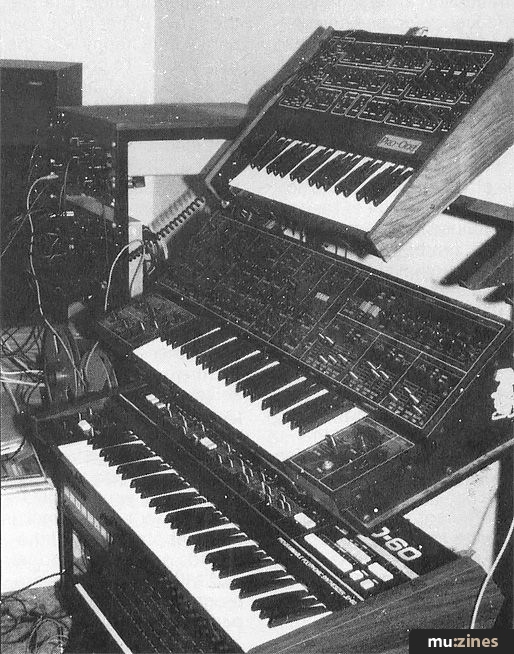
"My main polysynth is a Juno 60; I've two mono synth's — one's the Yamaha CS-30, which I've had for longest — a highly underrated synth in my opinion — and the other is the good ol' Pro-One. The advances I'm receiving from Jive will enable me to get some new equipment. I want to build up a MIDI system. I'm going to get the SCI Drumtraks, the DX7 — I'm trying to change the Juno 60 for a 106 — also the MSQ-700 poly-sequencer, to form an entire MIDI system for future recordings. I'll keep the Yamaha — it's got such an incredible vicious lead line sound that I've heard no other synth do." Battery Studios, the 24-track facility where Mark will record his future works, also have a Fairlight CMI and a PPG2.3 with the latest MIDI cards.
Live Performance
"I've only done one live performance — I use quite a lot of complicated sequencer and drum machine lines — and if we (Mark was assisted by his brother Julian and ES&CM contributor Mark Jenkins) had wanted to perform the rhythm lines live we would have needed a huge array of sequencers, so unfortunately we had to use a backing tape and that caused all kinds of problems. We had to play along to the backing tape but there's some pretty nasty chords to do on some of the themes so Mark Jenkins helped us out on those.
Roland very kindly lent us two Junos and two '808 drum machines and all I did was transfer my programs to the Junos. I'm not really interested in performing live and making it as different as possible — I could never hope to achieve an exact reproduction of a piece but the goal is to try and get there."
As if to emphasise the reliance modern musicians place on high technology, my cassette recorder decided this would be a good time to expire, and we called it a day. I liked Mark Shreeve — he even bought the drinks!
More with this artist
 Quest For Fire (Mark Shreeve) |
 Jive Talking (Mark Shreeve) |
Publisher: Electronic Soundmaker & Computer Music - Cover Publications Ltd, Northern & Shell Ltd.
The current copyright owner/s of this content may differ from the originally published copyright notice.
More details on copyright ownership...

Electronic Soundmaker - Jun 1984
Donated & scanned by: Mike Gorman
Interview by Sean Rothman
Help Support The Things You Love
mu:zines is the result of thousands of hours of effort, and will require many thousands more going forward to reach our goals of getting all this content online.
If you value this resource, you can support this project - it really helps!
Donations for May 2026
Issues donated this month: 0
New issues that have been donated or scanned for us this month.
Funds donated this month: £0.00
All donations and support are gratefully appreciated - thank you.
Magazines Needed - Can You Help?
Do you have any of these magazine issues?
If so, and you can donate, lend or scan them to help complete our archive, please get in touch via the Contribute page - thanks!
Please Contribute to mu:zines by supplying magazines, scanning or donating funds. Thanks!
Monetary donations go towards site running costs, and the occasional coffee for me if there's anything left over!

 @mu_zines
 RSS Feed
 Blog
Blog