


Magazine Archive
Home -> Magazines -> Issues -> Articles in this issue -> View
Interconnect - Jackfile (Part 2) | |
Article from Home & Studio Recording, January 1984 | |
Jackfile 2: a step-by-step guide to wiring jack plugs.
This month, a step-by-step guide to wiring a stereo A gauge jack plug.

1) Begin by applying a sleeve, or other identification to the cable, if required. If this job isn't done now, it's bound to be forgotten about later.
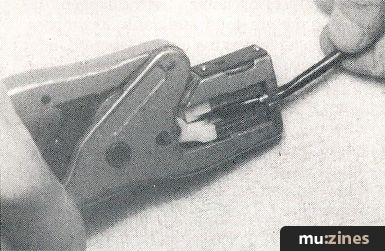
2) Now strip back the sheath about 19mm (¾"). If using automatic wire strippers, as illustrated, be sure to set the cut depth and pressure correctly, as it's easy to nick the screen wires.
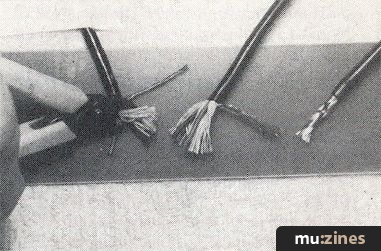
3) On the left, the cable is shown as it appears with the sheath freshly removed. In the centre, the lap screen wires have been separated out and twisted together, lightly at first, then neatly and more tightly - see the right hand cable. Also on the left, the cotton 'padding' has been gathered, and is about to be chopped off.
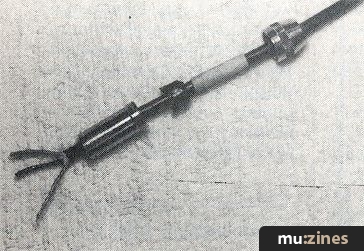
4) With the cable partly prepared, we now thread the plug's barrel and cable-clamping parts onto the cable.
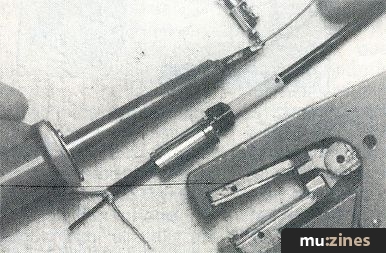
5) Next, we tin the terminals: simply apply the iron, and after a few seconds, feed in a small quantity of solder.
Twist the wires tightly before tinning, and chop off any whiskers.
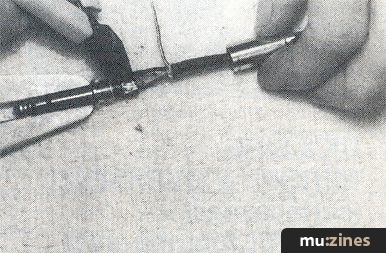
6) Now solder the red (or hot) wire to the tip terminal. Tolerances are tight on these plugs, and a slight excess of solder can cause the cover to snag. In this picture, wire cutters are used to shear off a slightly upright joint. Note also the American 'Lever-Wrench' tool. Unlike Mole grips, this one applies constant pressure, and can be set up to clamp jack plugs firmly whilst soldering, without biting into the delicate contact surface.
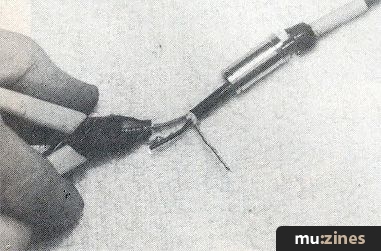
7) Moving onto the black (or cold) wire, the terminal for this one lies slightly below the hot terminals, so we turn the plug over, and measure up the black wire, chopping off any excess.
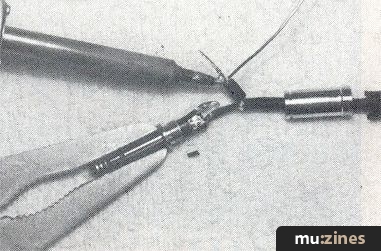
8) With both the inner wires connected, move on and tin the screen. Note that a piece of Hellerman (rubber) sleeving has been slipped over the short piece of exposed screen wire. This is principally to prevent any residual slivers of wire poking about. Check also the length of screen between the cable end and the terminal; for clamping purposes, the cable end should come within 10mm (⅜") of the (rear) screen terminal.
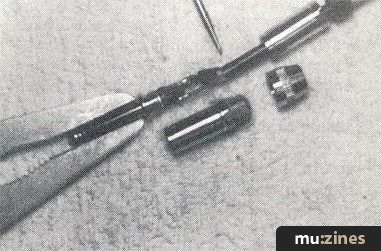
9) With all three connections now made, the plug is ready to close up. If you look carefully, you'll notice that the red and black (inner) conductors are slightly slack, so the stronger screen connection takes any strain if the cable clamping fails. On this latter topic, the part assembled plug immediately below gives you an idea of how the cable sheath will be placed relative to the cable clamping when the plug is assembled; a screwdriver tip arrows this point. In the photo, our cable sheath is at the maximum 10mm distance discussed above.
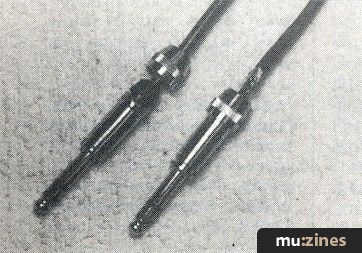
10) Before you screw on the cover, double check that the cable sheath is being gripped - this is one of the secrets of getting jack leads to stay in one place. A badly wired plug is shown right of our wired-up sample in the photo.
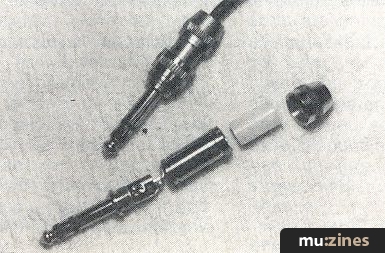
11) This picture shows the threaded assembly technique applied to Rendar jacks.
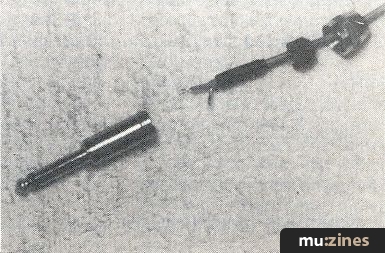
12) If you're using small diameter cables, the cable grip may not clamp adequately. If so, you can apply a couple of rubber sleeves to build up the cable diameter - as shown in the photo. Or failing this, wrap a few turns of good quality PVC tape around the sheath. Gaffer tape can also be used.
Series - "Jackfile"
This is the last part in this series. The first article in this series is:

Interconnect - Jackfile
(HSR Dec 83)
All parts in this series:
Part 1 | Part 2 (Viewing)
More with this topic
 Interfacing The Line - Line Level (Part 1) |
 Workbench |
 Sound Bites - Production Tips & Techniques |
 Studio Earthing Techniques - Interconnect (Part 1) |
 Modifying The Mu-Tron Bi-Phase - For Control Voltage Interfaces |
 Workbench - Modifying The Midiverb |
 Adding Fine Tuning To Standard Controls |
 Gnome Instrument Interface - Using the 2720-11 Envelope Follower |
 String Attention |
 Spotlight - SERVICING THE MIDWEST |
 Electro-Music Engineer - Tuning Up — A Review of VCO Calibration Methods (Part 1) |
 I Think We've Got A Lead, Holmes! - Get Connected: Reliability (Part 1) |
Browse by Topic:
Maintenance / Repair / Modification
Publisher: Home & Studio Recording - Music Maker Publications (UK), Future Publishing.
The current copyright owner/s of this content may differ from the originally published copyright notice.
More details on copyright ownership...

Home & Studio Recording - Jan 1984
Donated & scanned by: Mike Gorman
Feature by Ben Duncan
Previous article in this issue:
Next article in this issue:
Help Support The Things You Love
mu:zines is the result of thousands of hours of effort, and will require many thousands more going forward to reach our goals of getting all this content online.
If you value this resource, you can support this project - it really helps!
Donations for June 2026
Issues donated this month: 0
New issues that have been donated or scanned for us this month.
Funds donated this month: £0.00
All donations and support are gratefully appreciated - thank you.
Magazines Needed - Can You Help?
Do you have any of these magazine issues?
If so, and you can donate, lend or scan them to help complete our archive, please get in touch via the Contribute page - thanks!
Please Contribute to mu:zines by supplying magazines, scanning or donating funds. Thanks!
Monetary donations go towards site running costs, and the occasional coffee for me if there's anything left over!

 @mu_zines
 RSS Feed
 Blog
Blog