


Magazine Archive
Home -> Magazines -> Issues -> Articles in this issue -> View
JBL 4401 Monitors | |
Article from Home & Studio Recording, May 1984 | |
Before we begin this review, who are JBL?
In 1927, one of the original pro-audio companies, Western Electric, pioneered cinema sound with 'The Jazz Singer'. In the Wall Street crash of 1929, Western Electric was split up. From the ashes, came Westrex (who are today still involved in the movie/video side of the business) and Altec, short for 'All technicians', because the new company's bosses and founders were the technical people from Western Electric. Most notable of these was James Buoloh Lansing, and when he became president, Altec took on his surname, thus Altec-Lansing. Like Western Electric, Altec-Lansing's main business was in cinema sound, but along with RCA, this is where high-power, large-scale sound reinforcement was pioneered, horn speakers being their forte.
In 1940, Lansing sold his shares and later set up his own, competing company, with an emphasis on speakers. Lansing was subsequently killed in a plane crash in the late 40s, but the company he founded - James B. Lansing Inc. - or 'JBL' as it's better known, has gone from strength to strength.
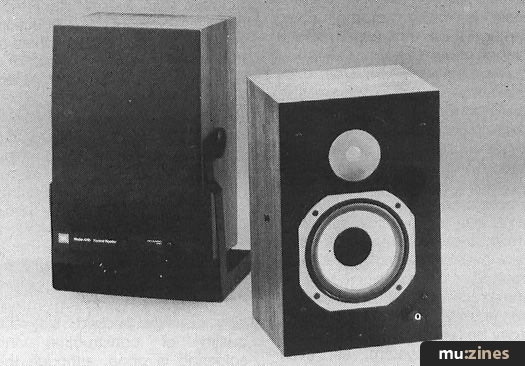
The bookshelf-sized 4401 is essentially a development of the 4301 broadcast monitor. Power capacity has been up rated to 60 watts, and the tweeter has been redesigned. A 2-way system, the bass and mid are handled by a 6½" driver, Thiele-loaded, with a laminated and specially treated paper cone. The idea here is to prevent breakup which could otherwise be held responsible for anomalies in the heart of the midrange. The tweeter comes in at 2-5 kHz.
Instead of a soft-dome of minimal radiating area JBL have chosen a larger and much harder diaphragm, made from wafer-thin phenolic (the thermosetting plastic that looks like fossilised oil-skin!). This is coated with a very thin layer of aluminium, although the effect here is almost certain to be predominantly cosmetic. The metallic layer will act to modify breakup behaviour in the phenolic and 'hold up' the response above 10 kHz. Hand-in-hand with the large dome area comes a large 1" voice coil, the raison d'etre for all this being high power-handling capacity. Phenolic, a hard material, becomes necessary in designs of this type as the soggy material used in soft-domes can't translate high frequency energy effectively over such a large area.
Compared with a conventional soft dome, top-end dispersion is theoretically narrower, the large driven-area ceasing to act as a point source at around 10 kHz. However, power-handling is markedly high, so overall, the JBL tweeter should be under considerably less stress than its relatives in domestic speakers of a similar size and design. At the same time, the PHC (power handling capacity) of the tweeter is unlikely to be much above 15 watts, and this supposition is reinforced, as JBL fail to mention the power handling. If it were anywhere near as high as the rating of the EV Sentry 100's tweeter (25 watts), it would surely hit the headlines!
Construction
The 4401's cosmetics are equal to other speakers in its price range, and for once, the quality of the terminations is way above average. Instead of binding posts connection is by quick-release terminals with powerful springs, these grip the wires tightly over a small area and provide the all-important secure connection. For best results make sure the wires are freshly stripped with the bright copper showing.
Like other top American monitor speakers, the 4401 has a tweeter attenuator which can be used to roughly match the top-end sound to your taste or compensate for room acoustics. Adjustable from the front panel (with or without the grille present), the usable range is -12 to +3 dB; going beyond -12 dB, the attentuation increases rapidly to minus infinity so you can shut off the tweeter altogether.
For their size the 4401's are unusually heavy, this is not just magnet weight, for the panels are unusually thick relative to the small dimensions of the enclosure. Despite some fairly obscure literature (the data sheet), the crossover elements turned out to be quite ordinary, with one exception - polypropylene capacitors are wired in parallel with the reversible electrolytics to improve the top-end response, or, in JBL's parlance, "reduce the hysterisis effects... this provides improved resolution of complex transient waveforms". This is all good stuff, but sadly, the value chosen for the polypropylene bypass, at 68 nF, is way too high to have much audible consequence, so the effect is presumably purely psychological. We covered the use of polypropylene capacitors in the March edition, albeit briefly.
The top-end attenuator control is tied in with the crossover wiring, it's a simple voltage divider, giving rise to impedance variations which are reflected in some fairly savage modifications in the treble response as the setting is adjusted. In particular, around the middle settings (say -4 dB), the high treble around 12 to 16 kHz is unduly emphasised. For review purposes, we set the attenuator at 0dB (normal). Another example of obscuration-cum-inaccuracies in JBL's data concerns the crossover inductors, "Carefully chosen for their... low DC characteristics". Presumably, low DC resistance is what they're discussing. The wire gauge is certainly thick, yet no more so than anyone else's in this price range. Moreover, an examination of the crossover network reveals a series resistor in the lower arm of the bass/mid crossover network to alter the Q of the system, ie. introduce losses, reduce speaker damping and swamp out the effects of long speaker leads on the Thiele parameters. Put simply, in speakers of this size, heavy gauge wire is mostly a cosmetic distraction.
As a mechanical assembly, the crossover components are securely mounted, but sadly, the terminal's fixing screws have been used to clamp together a number of solder tags which lead off to the crossover and attenuator components. The screws are very tight, but to be sure nothing will work loose in time, JBL should ideally lock these with paint or varnish.
Cradle mounts (MC4401) are available for the 4401s. With these, you can easily angle the drivers so they're on-axis with your ears. If mounting up high, it will also help to invert the speakers, so (a) the bass unit - rather than the tweeter - couples with the ceiling and (b) more important, the tweeter's axis can be lined-up with your ears without aiming at too steep an angle. Fixing is via a pair of thumb-wheel bolts, which screw into T-nuts in the cabinet sides. Our initial tests were bugged by strange whistlings and squeakings. These ghostly sounds were soon traced to violent turbulence in the air, leaking from these fixing points. Essentially, if you omit the cradle mounts, you must block-off the fixing holes (using a machine screw, say) or at least check for air tightness. JBL should really take steps to curtail the leakage internally.
Assessment
Testing was done with Bose and Pantechnic MOS-FET amplifiers. Considerable colouration across the audio range is evident on the 4401s. Vocals are sometimes apt to take on a boxy quality due to a surfeit in the 150 to 400 Hz region, whilst the centre-mid is a little lacking, eg. there's a -5 dB suck-out at 1 kHz, with a peak around 2-5 kHz.
The bass driver's Q is higher than average. As a result, the soft, springy, rounded qualities of synthesised bass (Moog type) are largely absent, or at best curtailed. To some extent this can be corrected by wall or corner mounting, this suggests a poor response in the low bass end. The 4401 is 5 dB down at 70 Hz. Trouble is, mounting like this excites resonant modes in the room, replacing a hard bass with a one note soft-bass. Moreover, wall or corner mounting all but erradicates the higher qualities of the stereo image, though at this juncture, I should stress that JBL recommend these speakers for console mounting.
Returning to the frequency response, the treble is readily swamped in 'sizzt' (instead of tsstt), which is all down to a 3 dB peak at 14 kHz. Summing up, there are no gross errors, but to refined English ears, the colouration, given that there's bound to be some - comes culturally in the wrong places.
With the two drivers sited unusually closely, and with the bass unit having a relatively shallow cone area, there's a good spacial coherence in both the vertical (X) and depth (Z) planes. In other words, the two drivers come fairly close to acting as a single point source at all frequencies; only a dual concentric driver (à la Tannoy) can do one better than this. The JBL data sheet stresses this, "Tight driver cluster", but omits to mention the contrary influence of the -12dB/octave crossover on coherence. Doubtless, by a judicious choice of electrical alignment, that's the crossover curve, this has been overcome. The imagery is indeed excellent, even in the reverberant field, and unusually stable. The latter is down to paying attention to beam width vs. frequency. Additionally, the 4401s proved themselves capable of imparting special textural and 3D qualities to the sound - listen out for highly focused, almost solid 'materialisations' of some percussive sounds, maracas for example.
The claimed sensitivity of 88dB @1W/1m seems somewhat understated. Even these tiny JBLs manage to sound "twice" as loud as equivalent UK speakers. At the same time, don't forget that the colouration, which is also above average, will serve to enhance subjective loudness. As regards power, the quoted rating is 60 watts, but providing you don't indulge in any clipping, a 150 to 200 watt amplifier will provide the best results. There's also unusually little thermal compression/distortion at high levels, this being one of JBL's strong areas. Indeed, mechanical excursion in the bass end is the main limit, with the onset of serious overload being almost invariably signalled by the "clek clek" of the bass/mid driver as its cone bottoms. Thermal overload of the tweeter seems most unlikely given a clean signal.
Conclusion
The 4401's exude character and imbue music with vitality. They're enjoyable to use, and undeniably addictive, but their idiosyncrasies make them a poor choice for a main monitor. Sound balance is likely to go astray without a more accurate reference, though with experience, it's possible that you'll learn how far to compensate. In common with other small speakers, the 4401s strengths come from imaging, in particular, these ones have a cherished ability to display the full colours, texture and spatial characteristics inherent in the stereo picture. The weak point is the hard bass sound and the very limited ability to handle low bass (below 100 Hz) at high levels. When auditioning, you should spend a long time before deciding to go into wedlock with these speakers, for whilst you'll find their qualities initially very attractive, you'll have to ask "can I live with these for X years?".
Shortform specification
| Frequency response | 70 Hz-18 kHz (±3 dB) |
| Power handling | 60 watts |
| Sensitivity | 88 dB SPL @1W/1 metre |
| Nominal impedance | 8 ohms |
| Crossover frequency | 2-5 kHz |
| Dimensions | 375 x 238 x 183 mm (h x w x d) 14¾" x 9½" x 7½" |
| Weight | 16 kg (pair) |
Publisher: Home & Studio Recording - Music Maker Publications (UK), Future Publishing.
The current copyright owner/s of this content may differ from the originally published copyright notice.
More details on copyright ownership...

Home & Studio Recording - May 1984
Donated & scanned by: Mike Gorman, Gab
Review by Ben Duncan
Help Support The Things You Love
mu:zines is the result of thousands of hours of effort, and will require many thousands more going forward to reach our goals of getting all this content online.
If you value this resource, you can support this project - it really helps!
Donations for June 2026
Issues donated this month: 0
New issues that have been donated or scanned for us this month.
Funds donated this month: £0.00
All donations and support are gratefully appreciated - thank you.
Magazines Needed - Can You Help?
Do you have any of these magazine issues?
If so, and you can donate, lend or scan them to help complete our archive, please get in touch via the Contribute page - thanks!
Please Contribute to mu:zines by supplying magazines, scanning or donating funds. Thanks!
Monetary donations go towards site running costs, and the occasional coffee for me if there's anything left over!

 @mu_zines
 RSS Feed
 Blog
Blog