


Magazine Archive
Home -> Magazines -> Issues -> Articles in this issue -> View
Keeping up with the Joneses | |
Gerry KitchinghamArticle from Home & Studio Recording, October 1986 | |
Simon Croft interviews the versatile Gerry Kitchingham whose track record includes work with A-Ha.
Gerry Kitchingham, the man behind the recording of A-Ha reveals all.
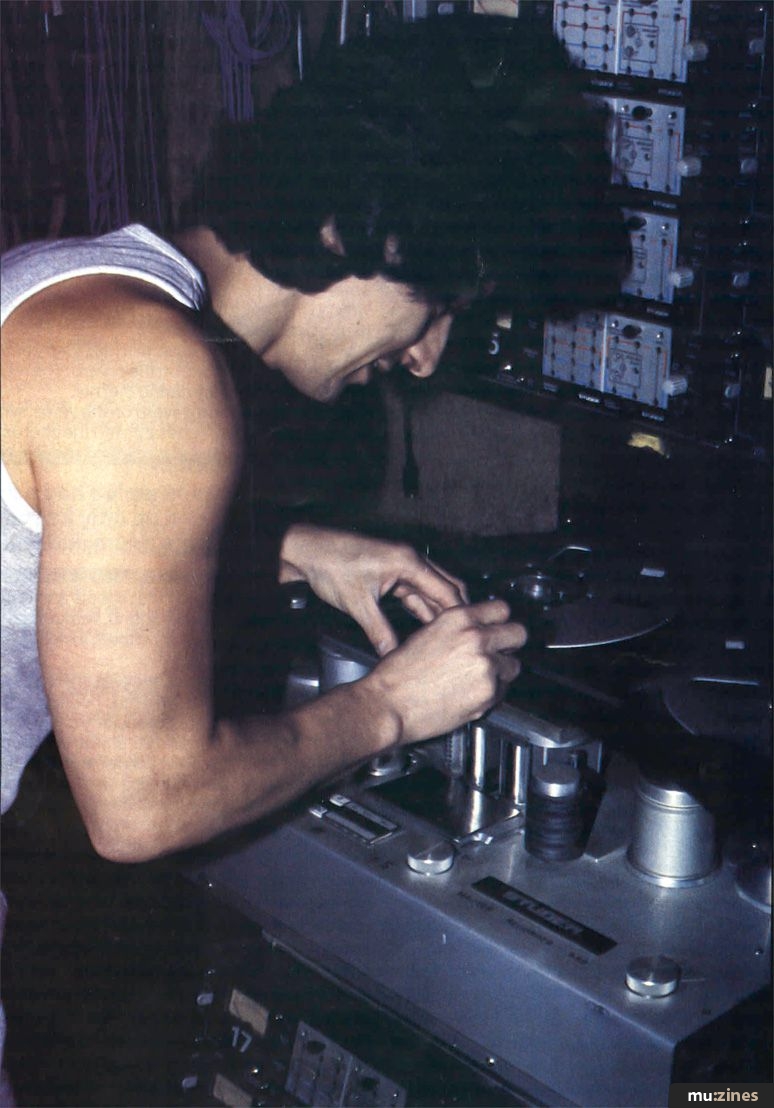
You've probably heard Gerry Kitchingham's work already, although you might have been asleep when A-Ha's 'Take On Me' hit the charts. Gerry is especially proud of that one because he engineered it and mixed it without even a tape-op for assistance. He also engineered 'The Sun always Shines on TV', their latest single 'Train of Thought', and the new A-Ha album.
As house engineer at RG Jones in London, Gerry has worked on a fair amount of hits in his time. 'My Coocachoo' went platinum for Alvin Stardust, recorded and mixed when RG Jones was an 8-track studio. He has also worked with Kate Robbins, Dollar, Marie Wilson, David Cassidy, David Grant and Jackie Graham.
Although Gerry has worked his way up from 4-track, RG Jones is now an SSL equipped 24-track. What's more, he reckons many engineers 'don't know how good it is.' In the session-man dominated 70s an engineer could spend a complete day doing nothing but drop-ins. He therefore knows all about being 'rooted to the spot for 12 hours' and jokes that his fingers were shorter in the old days because the drop-ins were so constant.
Probably as a reaction to those times, Gerry is well acquainted with sequencers and drum machines. In fact, he avoids recording drum kits as much as possible.
Kits are the Pits
'Live drums aren't really my cup of tea. I did a lot of live drums in the 70s and I was totally frustrated by the spill. I like to record bass drum and snare first, that way you can have as much ambience and put on as much EQ as you want without hi-hat and cymbal spill.' The trouble with heavy amounts of snare EQ is that the hi-hat and cymbals end up sounding 'cheap and nasty'. The Kitchingham solution is to record the hi-hat afterwards, although he does admit that not every drummer is able work in that fashion. 'I think more drummers are able to now, but in the 70s, your average sessionman wouldn't have been able to handle it.'
Gerry has used gates in the past but is quick to point out their limitations. 'They don't really work for me because the gate still opens every time the snare is hit. The result is a horrible snare sound because the hi-hat is still on top of the snare when the gate opens. Your stereo image sometimes shifts as well. The hi-hat's over one side and when the gate's on it suddenly moves. The same goes for cymbals if you 've gated the toms. You end up with this horrible cut-off sound.'
In Gerry's experience, if gates are absolutely necessary, it's better to have them dip the volume slightly, rather than cutting it off completely. He has also found expanders more effective than gates.
For snare drum, Gerry advocates a condenser mic, such as an AKG CK1/451 combination. The standard position for this is about 4 inches away, on top, although this tends not to pick up the full brightness of the snares themselves. For bass drum, Gerry usually sticks to an AKG D12.
Even nowadays, he still records drums because, as he explains, 'quite a few times we've had a drummer down here and finished up only keeping samples of his bass drum and snare'!
A-Ha
On an A-Ha recording, the first thing onto multitrack after SMPTE is normally a guide Linn track. This is a simple pattern using bass drum, snare and hi-hat. A bass part or a straightforward pad follows. So far, the structure is very much based on the band's pre-production demo.
Most of the overdubbed parts are worked out on a UMI-2B sequencer, running on a BBC computer. Linked to this are a Yamaha DX7 and a TX816 rack, which contains the equivalent of eight DX7s. Analogue sounds are provided by a Roland Juno.
'It's really easy to work. The graphics are clearly readable on the large TV screen. The UMI-2B isn't expensive and you can use the computer for many other things. If you get the SBX80, UMI-2B, DX7 and the Linn, you've got everything really!
'We didn't have the TX816 when we did 'The Sun Always Shines', only one DX7 and the Juno. I think we also hired a PPG Wave and an Emulator. I had to record about five pairs of MIDId synths playing different pads and then bounce it into stereo. Now you can do it in one go with the rack.'
The other advantage of the TX816 is that it allows different sound combinations to be tried while the UMI plays all the parts. The eight modules can each be used for different sounds, or else they can all play the same setting, with slight detuning for that 'mega sound'.
According to Gerry, about 50 per cent of the sequences are step time and 50 per cent real time. Producer Alan Tarney normally keys in step time sequences. If they don't feel right, he will get one of the band to play the part. Playing the parts into the UMI instead of overdubbing on the multitrack has the benefit of allowing a variable amount of quantisation to be applied on playback.
The final drum arrangement is a combination programmed Linn and overdubbed hi-hat and cymbal parts. These are done by Paul, of whom Gerry says, 'He's an absolute genius. Some of the drum patterns are very complex.'
Ambience
Although the band obviously spend a fair amount of time in the control room, electric guitar parts are usually done on the studio floor, with a close miked Mesa Boogie. Any ambience is added digitally, often with a Lexicon 224X.
'I think it's much better to add ambience digitally. Digital is so much cleaner and you can alter any parameter you want. There's also the matter of tying up tracks to consider. It's always a bit dodgy recording ambience at the same time because you never know to what degree you'll want to use it in a mix. You always tend to need more than you think you'll need, once everything is mixed in.'
For recording, as opposed to mixing, Gerry favours the Lexicon 224X, but does also use other units. These include the Yamaha REV1. Don't be too disheartened though, Gerry has a lot of time for the new generation of budget digital units.
'The last six months has been a real revelation in terms of good cheap reverb units. The Lexicon PCM70 is unbelievable. It does everything that the 224X does plus a bit more because they've even got a master control for the repeats. You do need the book because the parameters are not to hand but, once you get to know it, the quality is as good as the 224X. It's the same with the PCM60.'
Then there's the REV7 and Gerry's also used the Roland SRV2000, which he found good for non-linear settings. He says that there are many times when three of the less expensive units would be more useful on a mix than one state-of-the-art device.
Mix
'When you're in a mix and you've got four or five reverbs to hand, you don't always alter the parameters of some of them much. If you had to have only a couple of programmable parameters, they should be delay and pre-delay. There's nothing wrong with that. I think it's quite refreshing for an engineer not to think about anything else.'
When it comes to vocals in a mix, Gerry needs control of the repeats and reflections on the reverb. The reason is that he rides the controls manually during the mix.
'I tend to have more reverb on the verse, with just a bit of repeat on the voice. When it goes out into the chorus and you want a bigger sound, I often ride the repeats and reflections. That gives the voice a much broader sound, without having to turn the vocal up too loud. If the vocal's too loud, it makes the track sound smaller.'
"quite a few times we've had a drummer down here and finished up only keeping samples of his bass drum and snare!"
Of course, the balance between the vocal and the backing is one of utmost important in a mix. For riding the controls, Gerry finds the Yamaha REV1 particularly easy. As readers of the March 85 issue will know, the RCR1 remote has controls for Direct, Early Reflection, Reverberation and Master, among others. When it comes to drums, Gerry singles out the Klark Teknik DN780 for its tough, slightly cruder sound. For room sounds, he also likes the Eventide 2016, a unit seemingly overlooked by many.
The RG Jones plate still has its uses though. Gerry uses the AMS for pre-delay and aims for an in-time delay around 150-200mS. George Michael liked the monitor sound that Gerry got with the EMT plate so much that he made a point of recording the vocal ridiculously loud on the track. When you're doing backing vocals, they might want to hear one vocal when you're hearing eight.'
As you will have gathered from Gerry's comments on drum kits, sampling is one of his fortes and he keeps an extensive library of sounds to load into the Linn 9000 or the AMS delay. In fact, he may even have been the first person to use the AMS that way, as he explains. 'When we bought the SSL four years ago we decided that we needed a good delay. Stuart Nevison from AMS came down and I think he sold us the first one.'
Gerry was particularly struck with the unit's ability to store and trim drum sounds. Unfortunately, there was no trigger input.
'I phoned him and said 'If you can do this it will transform drum sounds.' Shortly thereafter the feature appeared on the units.'
Whether Gerry triggers samples from a drum machine or a real drummer depends on the particular session. Not surprisingly, some drummers feel a little disenfranchised by the process and insist that at least the samples should come from their own kit. The only technical problem with triggering from a kit occurs if the drummer uses a very wide range of playing dynamics and some of the quieter beats might not trigger.
Linn
Gerry finds the Linn 9000 useful for its ability to combine drum sounds and program writing with sampling. Although a software update for the 9000 is promised, the unit will not read SMPTE at present. That leaves two options. He could either use a SMPTE reader/generator like the one made by Roland or go from the top every time he wants to run the drums.
Running the drum parts in sync with the multitrack is important to Gerry, and not simply because it allows the drum parts to be written after much of the song has been recorded. It also means that the drums do not have to be committed to multitrack, thus saving on tracks used and preserving quality by eliminating a stage. This has caused some problems with the 9000.
'On a mix we did the other week, we ran out of tracks so I decided to put the drums down live. It's especially nice with the 9000 because everything's there and sounds good. The toms are fantastic. Because some of the samples were quite long, there wasn't enough memory on disc to run all the way through so we had to commit the toms to tape and run the rest of it live. It was a shame to have done that, so I hope they get the memory sorted out next time they update it.'
Gerry is a dab hand at this and explains precisely how it is done.
'Providing you stick to certain rules, you can normally get it right within half a dozen times. The simple rule is; put a mark on the (½-track) tape at the record head. When you put the ½-track into record, you do so with the multitrack already running. Rather than start the record when the vocal comes in, start dead on the first beat of the bar before. Gerry has the producer count him in. Having recorded your chorus, advance the multitrack to somewhere before the next chorus and then rewind the ½-track to the point where you started. 'You put the same mark you had over the record head, over the play head, on the count of four again, you hit the play button.' Although your ½-track will take some time to reach full speed, it should be the same time on every occasion. If your machine has a really slow start (or the bars are very short on this particular track) try the same trick two bars before.
'If it's really critical, you can record drums on the two bars before. On the pick-up you can see if the drums are phasing with the drums on multitrack. At 30ips our multitrack and ½ lock in for a good minute.'
The technique does not have to be limited to vocals but it will get very difficult if you try and spin in anything ultra-rhythmic. Percussion parts are not good candidates unless you merely wish to build up nerves of steel!
Edits
RG Jones runs at 30ips because it alleviates the need for noise reduction. It also has benefits when editing. 'Editing is dead easy at 30ips, you've naturally got twice the room for error you had at 15.
'Multitrack is easy because you can solo instruments. You've got to be careful of codes, of course. A lot of people thought if you edited over a Linn code, it wouldn't track properly.
Gerry knows differently. If you listen to 'The Sun always Shines', you will notice that there is a distinct change in mood and tempo. It could be the sort of edit that was done on the ½-track. Actually, though it wasn't.
'We didn't have the SBX80, so I suggested we edit the two tempo changes. We'd never done that before, it was an experiment. We programmed the intro at a certain tempo and put the code down. Then we did the rest of the song on a separate bit of tape. I did the edit and we checked to see if the Linn Drum would handle it. It was fine.'
There are definite benefits to a multitrack edit. In the case of 'The Sun always Shines' there are other parts that were recorded over the edit point. Even reverb on mixdown will create a continuity that cannot be achieved by post-mix editing.
On the subject of codes, Gerry has some advice. 'You have to treat codes with a bit of respect. You can record things next to them but you can't run something from a code and record it on the next track at the same time because you get bias breakthrough. SMPTE is much tougher than other codes, so if you run everything off SMPTE, you're much better off.' By the same token, don't edit a chunk out of a multitrack tape and expect to be able to read an existing SMPTE track. The discontinuous information will make the reader unit throw a complete wobbly. Every frame in SMPTE has a number, remember.
Using SMPTE will do more for you than provide an accurate lock. Gerry likes the Roland unit because it is easy to use, allows timing changes in the middle of the track and has an off-set function. This will allow you to advance a 'lazy' sound slightly, pulling it into time. Often, the sound was really in time to start with, but sounds late because the slow attack is not immediately heard in a mix. When it comes to using sampled snare, Gerry suggests mixing the drum machine sound with the sample, 'It doesn't contribute much to the sound but it gives it that little bit of front'.
One way or another, Gerry Kitchingham's hints should give you a few things to try out. If they don't come out right the first time, don't despair. After all, the man has had an awful lot of practice.
Sound Diving
Sound Diving #2 - Take On me
Ben@mu:zines
Publisher: Home & Studio Recording - Music Maker Publications (UK), Future Publishing.
The current copyright owner/s of this content may differ from the originally published copyright notice.
More details on copyright ownership...

Home & Studio Recording - Oct 1986
Donated & scanned by: Mike Gorman
Interview by Simon Croft
Help Support The Things You Love
mu:zines is the result of thousands of hours of effort, and will require many thousands more going forward to reach our goals of getting all this content online.
If you value this resource, you can support this project - it really helps!
Donations for May 2026
Issues donated this month: 0
New issues that have been donated or scanned for us this month.
Funds donated this month: £0.00
All donations and support are gratefully appreciated - thank you.
Magazines Needed - Can You Help?
Do you have any of these magazine issues?
If so, and you can donate, lend or scan them to help complete our archive, please get in touch via the Contribute page - thanks!
Please Contribute to mu:zines by supplying magazines, scanning or donating funds. Thanks!
Monetary donations go towards site running costs, and the occasional coffee for me if there's anything left over!

 @mu_zines
 RSS Feed
 Blog
Blog