Key Lines
Tuition / Technique, Music Theory
(PH Nov 88)


Magazine Archive
Home -> Magazines -> Issues -> Articles in this issue -> View
Article Group: | |
Key Lines | |
Article from Phaze 1, May 1989 | |
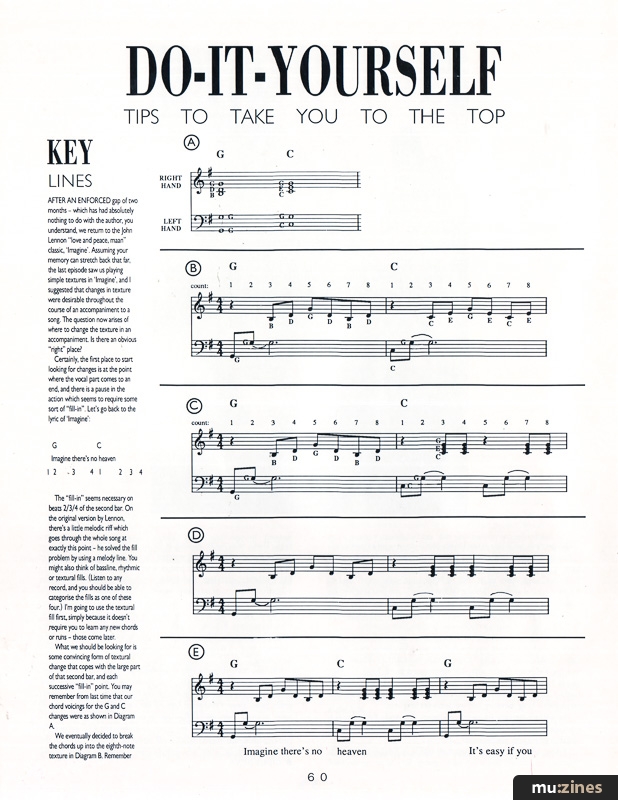
AFTER AN ENFORCED gap of two months - which has had absolutely nothing to do with the author, you understand, we return to the John Lennon "love and peace, maan" classic, 'Imagine'. Assuming your memory can stretch back that far, the last episode saw us playing simple textures in 'Imagine', and I suggested that changes in texture were desirable throughout the course of an accompaniment to a song. The question now arises of where to change the texture in an accompaniment. Is there an obvious "right" place?
Certainly, the first place to start looking for changes is at the point where the vocal part comes to an end, and there is a pause in the action which seems to require some sort of "fill-in". Let's go back to the lyric of'Imagine':
(G) Imagine there's no (C) heaven
12-3 41 234
The "fill-in" seems necessary on beats 2/3/4 of the second bar. On the original version by Lennon, there's a little melodic riff which goes through the whole song at exactly this point - he solved the fill problem by using a melody line. You might also think of bassline, rhythmic or textural fills. (Listen to any record, and you should be able to categorise the fills as one of these four.) I'm going to use the textural fill first, simply because it doesn't require you to learn any new chords or runs - those come later.
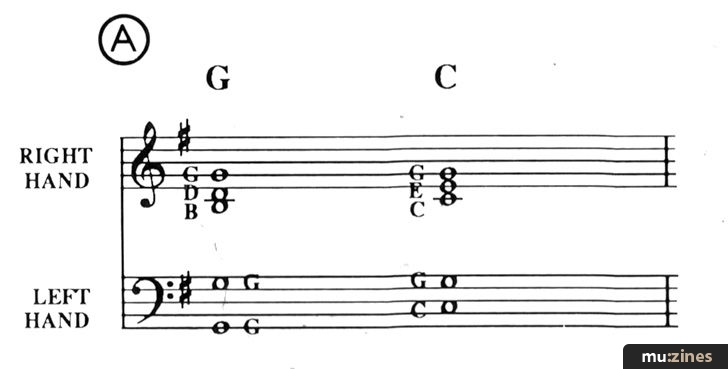
What we should be looking for is some convincing form of textural change that copes with the large part of that second bar, and each successive "fill-in" point. You may remember from last time that our chord voicings for the G and C changes were as shown in Diagram A.
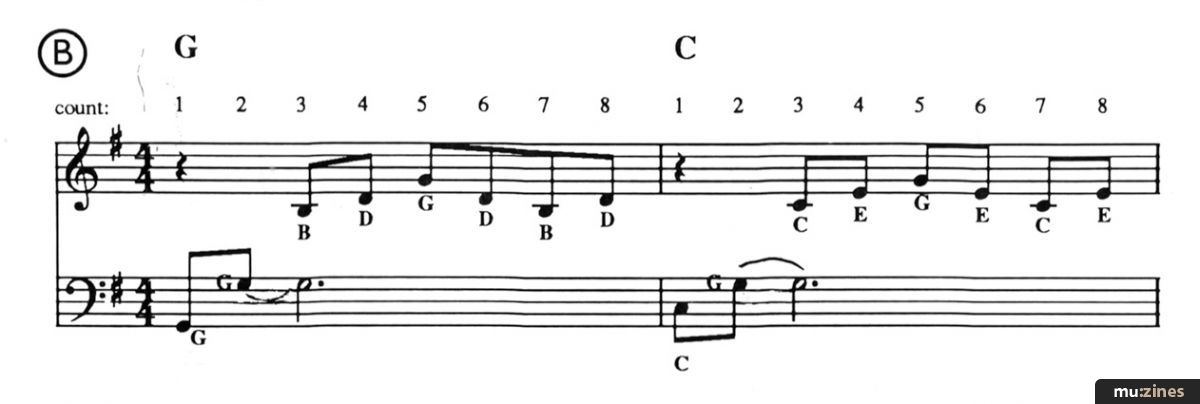
We eventually decided to break the chords up into the eighth-note texture in Diagram B. Remember these are eight consecutive events, evenly spaced over the pulse count of four to a bar - or two to a beat. Incidentally, the little line tying notes together on the second and third beats of the left-hand phrase means you play the note only once, but hold it down for the total duration shown.
Keeping to the eight-note format, let's try altering the texture, changing the number of notes played vertically in the C bar to the pattern shown in Diagram C.
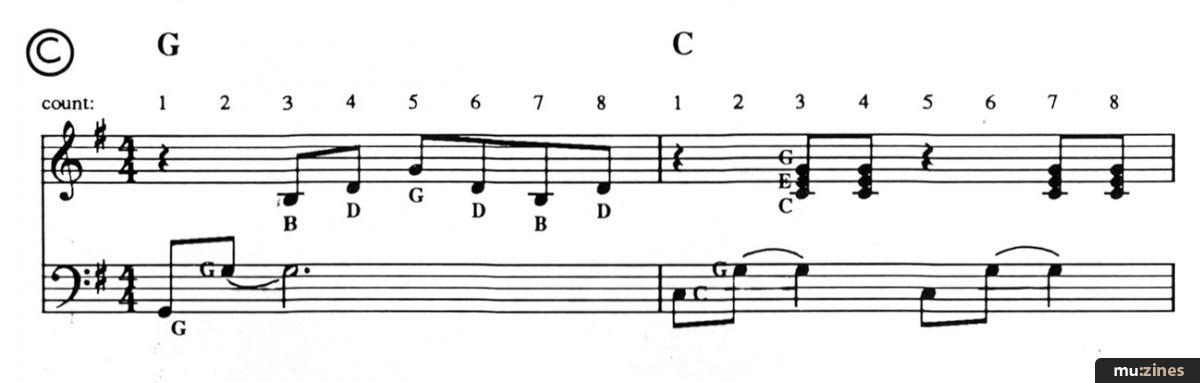
Don't forget these are the same voicings of the G and C chord as we used last time - the only change is the texture you apply between your hands.
It should also now be clear that the texture between the two hands can either be separated, as shown in the last example, or can overlap, as in Diagram D.
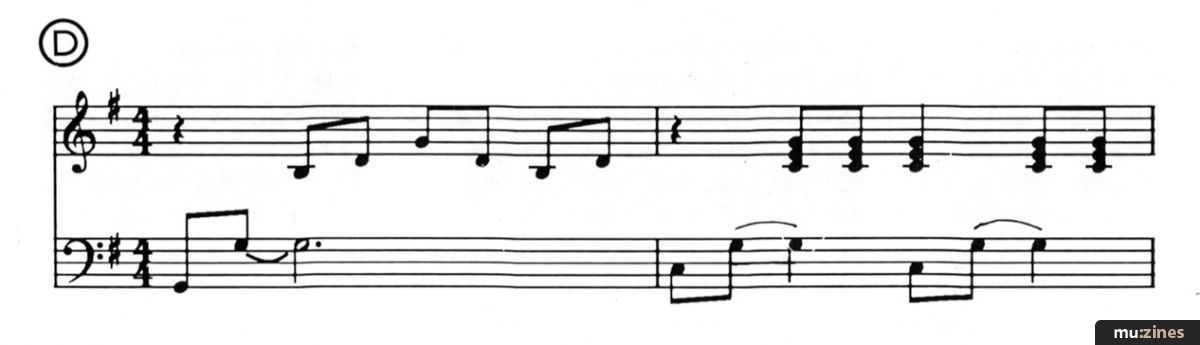
In this version, simply hold on to the right-hand part of the chord as the left hand completes the bassline effect, and you get a slightly smoother sound as the two parts overlap more often.
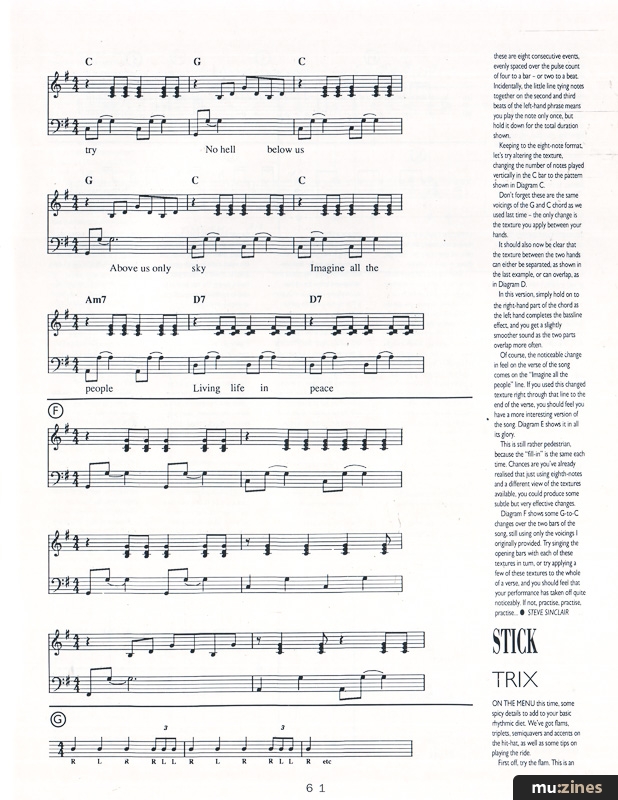
Of course, the noticeable change in feel on the verse of the song comes on the "Imagine all the people" line. If you used this changed texture right through that line to the end of the verse, you should feel you have a more interesting version of the song. Diagram E shows it in all its glory.

This is still rather pedestrian, because the "fill-in" is the same each time. Chances are you've already realised that just using eighth-notes and a different view of the textures available, you could produce some subtle but very effective changes.
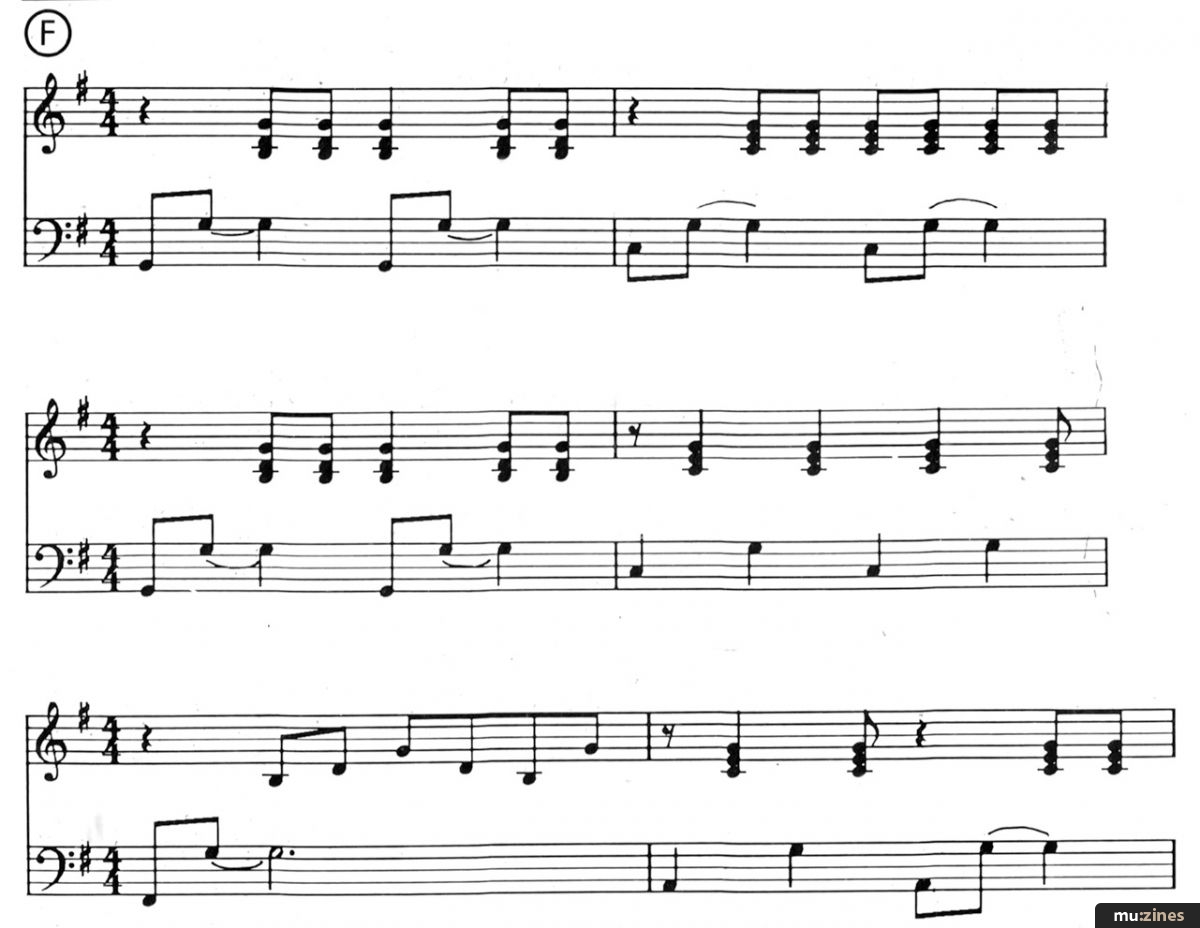
Diagram F shows some G-to-C changes over the two bars of the song, still using only the voicings I originally provided. Try singing the opening bars with each of these textures in turn, or try applying a few of these textures to the whole of a verse, and you should feel that your performance has taken off quite noticeably. If not, practise, practise, practise...
More from these topics
 |
 Ultra Vox (Part 1) |
 Drum Hum |
 Vocal Infection - Voice Training |
 The Right Root |
 Chord of the Month |
 Touching Bass - Bass Playing & Programming (Part 1) |
 Stick Trix |
 Hard Times - 7/4 |
 Two Pay - Two-Chord Songs |
 Fret Fax |
 Chord of The Month - Keyboards |
Browse by Topic:
Tuition / Technique
Music Theory
Publisher: Phaze 1 - Phaze 1 Publishing
The current copyright owner/s of this content may differ from the originally published copyright notice.
More details on copyright ownership...

Phaze 1 - May 1989
Do It Yourself
Feature by Steve Sinclair
Help Support The Things You Love
mu:zines is the result of thousands of hours of effort, and will require many thousands more going forward to reach our goals of getting all this content online.
If you value this resource, you can support this project - it really helps!
Donations for August 2026
Issues donated this month: 0
New issues that have been donated or scanned for us this month.
Funds donated this month: £0.00
All donations and support are gratefully appreciated - thank you.
Magazines Needed - Can You Help?
Do you have any of these magazine issues?
If so, and you can donate, lend or scan them to help complete our archive, please get in touch via the Contribute page - thanks!
If you're enjoying the site, please consider supporting me to help build this archive...
...with a one time Donation, or a recurring Donation of just £2 a month. It really helps - thank you!

 @mu_zines
 RSS Feed
 Blog
Blog