


Magazine Archive
Home -> Magazines -> Issues -> Articles in this issue -> View
London College of Furniture | |
Technology & EducationArticle from Sound On Sound, May 1989 | |
Are you looking for an engineering career in the audio industry? Perhaps a musical technology course at the London College of Furniture might set you on the right path. Course tutor Tim Orr explains why...
Are you looking for an engineering career in the audio industry? Perhaps a technology course at the London College of Furniture might set you on the right path. Course tutor Tim Orr explains why...
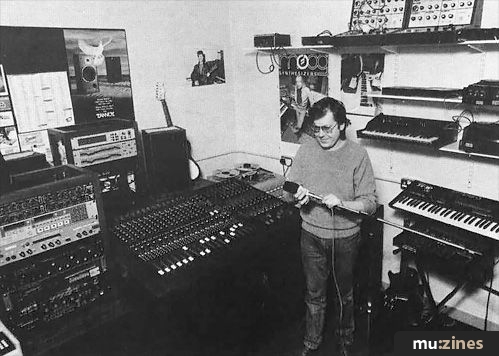
Course tutor, Tim Orr, in the 16-track music studio.
If you have visited the British Music Fair in the last three years, you may have come across a stand occupied by the London College of Furniture. This was not an organisational error nor was it a sales pitch for piano stools and other specialised furniture associated with the music business. The College has a Music Technology department, which runs educational courses in electronic and acoustical engineering for the music and audio industry. It also offers a wide range of courses in instrument making based on traditional craft skills.
The Music Technology department is possibly one of the oldest in the country. It was established in 1897 as a piano trade school, and has since undergone several metamorphisms. The College moved to its current location in the East End of London in 1970. Until recently, much of the music and furniture industry used the same raw materials (dead trees), hence the symbiosis between furniture and music.
ELECTRONICS FOR THE MUSIC INDUSTRY
The College offers courses in electronic engineering, with a specific bias towards the music and audio industry. The needs of these industries are constantly and rapidly changing. Twenty years ago, monophonic music synthesizers were just arriving on the scene. They were constructed without the use of integrated circuits, being made entirely from discrete components. Mixing desks and multitrack tape recorders were the latest innovation. The idea of a 'personal computer' was absurd (it wouldn't fit in the building!) and the word 'software' was a new entry into the English language. Since that time, technology has produced many revolutions: microprocessors have enabled machines to 'appear' semi-intelligent; MIDI has provided a universal communications link between devices; reverberation has been 'integrated'. Computer technology and software dominate most systems, and recording and synthesis techniques are now implemented by dedicated digital integrated circuits.
Electronic products are evolving at a tremendous rate. This rate of change presents an exciting challenge to all aspects of the industry, particularly in education and training.

The course provides ample time for students to get to grips with keyboard synthesizers, samplers, drum machines and other recording studio equipment.
TRAINING COURSES
The College has constantly revised its course material to keep up-to-date with the current wisdom in the music business. The course is goal seeking, in that it educates students so that they can obtain employment in the buoyant areas of the electronic music industry. A wide range of basic theory is covered in lectures. This theory is broad-based and is applicable to most aspects of electronic engineering but with special attention to the contemporary use of electronic technology in the music industry.
Special attention is paid to the 'hands on' use of electronic test equipment. Students also have opportunities to use the studio facilities and are encouraged to make and record music.
HND (Higher National Diploma) students have to design and construct electronic machines as part of their project work. The College provides a wide range of services to assist in this work. These projects are electronic devices for use in the audio or music industry. In recent years students have produced a 16-channel mixer, digital delay lines and samplers, guitar effects units, a modular synthesizer, guitar practice amplifiers, self-powered studio monitors, electronic drums, microprocessor-based MIDI units, and many other devices. The practical experience gained is invaluable training for future employment. During the final term the College puts on a Summer Show (June 27-30), which is open to the music trade and the public. On display are examples of student project work, some of which can also be viewed at the British Music Fair.
Specialised lectures deal with the various aspects of digital and analogue engineering for the music and audio industry. Topics covered in the analogue section include amplifier and filter design, synthesizer technology, and noise performance. The digital section covers digital oscillators and filters, applications of microprocessors in musical products, MIDI, pitch shifting, harmonising, sampling theory, oversampling and rate conversion using digital filters.
The Acoustical Engineering course includes acoustics and electro-acoustics and covers such areas as physical and psycho-acoustics, room acoustics, loudspeakers and microphones, sound recording and reinforcement. Students perform a range of electro-acoustic measurement techniques as an integral part of the course. They also gain user experience of musical technology by developing their sound recording skills in the College's 16-track music studio.
Future courses will deal with the expanding areas of digital audio and synchronisation, such as high performance sampling techniques, digital signal processing, AES/EBU serial data format, other digital audio standards, digital recording techniques, MADI, SMPTE and MIDI.
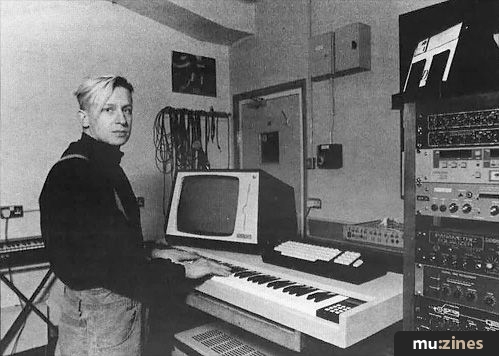
An LCF student at work on the College's Fairlight CMI sampler.
COLLEGE FACILITIES
The London College of Furniture is situated in a large, modern, seven storey building. Much of the building is occupied by industrial woodworking machinery, including a CNC milling unit that can manufacture solid guitar bodies 'whilst you wait'. Other facilities include the paint shop, silk screening, a plastics workshop, a photographic studio, a graphics department with an industrial copy camera service, and a computer suite offering a selection of CAD (Computer Aided Design) hardware and software.
The Music Technology department also has a wide range of facilities. For example, the Music Studio contains the following equipment: 16-track tape recorders, a 16-track mixer, a Fairlight CMI sampler, Yamaha DX7, Sony RDAT machine, CD player, assorted reel-to-reel and cassette units, record deck, a modular synthesizer, several other keyboard synthesizers, various studio and guitar amplifiers, studio monitors, gates and compressors, graphic and parametric equalisers, spectrum analyser, assorted guitars, drum machine and acoustic drums, Atari ST computers, delay lines, reverb unit, numerous microphones, etc. This equipment is used to instruct students in studio practices and techniques, to familiarise them with current music hardware, and to produce and record music.
In addition, the Acoustics lab houses a broad selection of professional digital and analogue test and measurement equipment. This is used to investigate the performance of acoustic instruments, loudspeakers, and microphone systems. The equipment includes a Bruel & Kjaer 2034 dual channel FFT analyser, a B&K/Hewlett Packard model analysis system, and a B&K Hetrodyne analyser.
The Electronics section has a large range of design, manufacturing and test equipment. Epson PC-AT CAD workstations enable students to run various software packages to produce circuit diagrams and multi-layer printed circuit board designs (hard copy is produced from a Roland XY plotter). There are also several cross-assemblers for popular microprocessors, EPROM blowers, filter design software packages, and several word processor systems. Electronic and acoustic frequency responses can be tested and plotted using the Neutrik analyser. Single and double-sided printed circuit boards are produced entirely in-house. The store room is well stocked with electronic components for the project work. It also contains a wide selection of tools, test equipment and a comprehensive data library. Also, sheet metal cutting, folding and punching facilities enable students to produce finished equipment panels and enclosures for their project work.
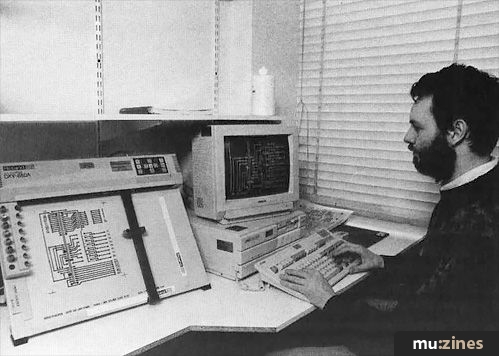
CAD workstation in use. Printed circuit boards (PCB) are designed on the Epson PC-AT computer (right) and then plotted out on the Roland DXY880A pen plotter (left). The plotted artwork is then photo-reduced and used to 'contact print' a PCB.
GRADUATE STUDENTS
The course provides a thorough grounding, and many LCF students have ended up working for well known companies in the audio and music industry, such as Syco, CMI, Stirling Audio and Neve. Their jobs have covered all aspects of the industry, from product design, manufacture and sales; publishing; programming and software sales; to band work, servicing and maintenance. Below are a selection of comments from ex-students:
- Peter Suthers, Technical Manager of Mayfair Studios; "It was a great place to be. I believe that the course offered by the College was excellent, much better than those from other institutions." "The industry is crying out for skilled maintenance and technical engineers."
- Tim Wallhead, Argent's Service Manager: "The course helped to introduce me to the musical applications of electronics."
- Steve Garth, Argent's/Sequential Circuits/Evenlode Soundworks Sales Director: "The College gave me a good grounding in music and electronics, which helped shape my career."
- Paul Bird, Industrial Design Consultant for Amek/Stepp/Aries: "The course provided a very practical introduction to electronic engineering."
- Paul Tebbutt, Argent's/Sequential Circuits/Jethro Tull (engineering): "Very enjoyable and a good practical course."
COURSE DETAILS
The department offers a wide range of courses for careers in the music industry with qualifications ranging from City & Guilds, B/TEC to BSc (in preparation). These are based on non-performing skills in the fields of electronic and acoustical engineering and current recording studio practices, instrument making, repairs and piano tuning. The individual courses are detailed below.
Music Technology and Modern Instruments
- Electronics and Acoustics for the Music Industry. Full time B/TEC OND and HND courses: 2 year duration.
- Piano design, construction, tuning and maintenance.
- Violins, violas, cellos, double bass.
- Classical guitars, steel string and jazz guitars.
Early Music (MIDI-evil?)
- Early stringed instruments: lutes, viols, baroque violins and guitars, harps and citerns.
- Early keyboard instruments: harpsichords, clavichords, spinets, virginals and early pianos.
- Early woodwind instruments: shawms, crumhorns, recorders and bagpipes, clarinets, flutes, bassoons and oboes.
FURTHER INFORMATION
The London College of Furniture, (Contact Details).
More with this topic
 New Music - Electronics at East Anglia |
 Gateway Multitrack Course |
 Overtones |
 At School in the Studio |
 Studio Scene - University of Surrey Electro-Acoustic Music Studio |
Making It With Multitrack |
 Nine to Five Man |
 At Home In The Studio |
 CAMI - Pitch Training On The BBC Micro (Part 1) |
 Commercial break |
 Enterprise zone - Newham College |
 Recording Routes |
Browse by Topic:
Education
Publisher: Sound On Sound - SOS Publications Ltd.
The contents of this magazine are re-published here with the kind permission of SOS Publications Ltd.
The current copyright owner/s of this content may differ from the originally published copyright notice.
More details on copyright ownership...

Sound On Sound - May 1989
Donated & scanned by: Mike Gorman
Feature by Tim Orr
Previous article in this issue:
Next article in this issue:
Help Support The Things You Love
mu:zines is the result of thousands of hours of effort, and will require many thousands more going forward to reach our goals of getting all this content online.
If you value this resource, you can support this project - it really helps!
Donations for May 2026
Issues donated this month: 0
New issues that have been donated or scanned for us this month.
Funds donated this month: £0.00
All donations and support are gratefully appreciated - thank you.
Magazines Needed - Can You Help?
Do you have any of these magazine issues?
If so, and you can donate, lend or scan them to help complete our archive, please get in touch via the Contribute page - thanks!
If you're enjoying the site, please consider supporting me to help build this archive...
...with a one time Donation, or a recurring Donation of just £2 a month. It really helps - thank you!

 @mu_zines
 RSS Feed
 Blog
Blog