


Magazine Archive
Home -> Magazines -> Issues -> Articles in this issue -> View
MB Electronics Jecklin Disc plus Microphones | |
The OSS System (Optimum Stereo Signal)Article from Music UK, December 1983 | |
Dr. Jecklin Disc meets Mr. Hyde (alias Nobby Line). New M & B Stereo Mike System On Trial

When stereo was first launched back in the fifties, the reaction was mixed, but largely rather cynical. It was a fad, they said, and one doomed to extinction. Any studio offering stereo recording facilities had a job on their hands just convincing the client to try it. 'Good solid mono' was undoubtedly the preferred system.
The relatively primitive technology of those days has a lot to answer for.
Stereo/Binaural: It's the same difference
Binaural is the name given to the way in which we human animals perceive spatial information. It all centres around the fact that we have two ears with a head in the middle (well, most of us do anyway!). The idea is that sound coming from a certain direction will arrive at one ear slightly before it arrives at the other; ie, if somebody shouts directly in to your left receptor, it will take a little time for the sound to go around your head and attack your right one. This is commonly referred to as 'phase information', and so clever is the brain that it can interpret this time delay to provide an indication of where the sound came from.
Also, in the same way in which a solid object placed in the path of a beam of light will cause a shadow, so the head will block sound at higher frequencies and cause a difference in intensity between the two ears. On lower frequencies, the wavelength of the sound is longer than the diameter of the head, and this allows the sound to easily curve around it, so that there is effectively no intensity differential. That's one reason why it's more difficult to sense the direction of low frequency sounds.
Binaural recordings are made using a dummy head with a microphone positioned in each 'ear' so that the output of each microphone is recorded on a separate track of a tape machine, just as with a standard stereo recording. In this way the aforementioned time and intensity information is captured on tape.
When listened back to via headphones, the sense of ambience and the spatial positioning of each instrument or sound source in the original recording is stunning when compared with normal stereo recordings. However, one criticism, or limitation associated with this technique is that when listened back to over a pair of spaced loudspeakers, a 'hole' is often experienced in the middle of the image. This is where the Jecklin Disc and the OSS (Optimum Stereo Signal) system based upon it, makes its entrance with claims of superiority. It has been designed for making stereo recordings intended for replay over speakers, and is said not to suffer from the hole-in-the-middle problem.
The Disc
It is not a particularly glamorous affair, this disc. It's a plastic construction and measures about 12" across, 0.3" thick and is sandwiched between two layers of pretty ordinary-looking foam rubber. A standard adaptor fixes it, edgeways on, to any normal mic stand. Two mic adaptors are attached at the periphery of the disc, one on either face. These positions are fixed, although the adaptors will allow the mics to swivel horizontally. Therefore, the choice of five positions provided around the bottom half of the disc for attaching the stand adaptor are important to allow resetting of the microphone angle in the vertical plane. In the centre of the device is a small hole through which is threaded a freely moving piece of nylon cord. The microphones are positioned by pulling the cord fully through to each side in turn, perpendicularly to the disc and aligning each mic's capsule with the end of the cord. This is simply to ensure that the two transducers are spaced equally on either side to give a balanced stereo image.
The shape of the disc is obviously not going to duplicate the effect of a dummy head, but the positioning of the mics puts them about 7" apart, which is not unlike the distance between the average pair of human ears. A diameter of 12" might possibly create acoustic shadows down to a lower frequency than would naturally occur for certain angles of incidence (200Hz is quoted) but on the other hand the disc's relatively two-dimensional shape would, in some cases, provide a less obstructed path to the two receptors than would be the case for the human equivalent. This is apparently the reason put forward for the lack of the hole in the stereo image over speakers.
Certainly sound coming straight on from the front will meet no direct obstruction in its path to the mics, and unlike the situation with humans, it will be partially absorbed and partially reflected from the disc into the mics, which are separate from it as opposed to the relatively flush mounting of human ears to the head.
The microphones recommended for use with the disc are omni-directional in their polar response, or in other words they are equally sensitive to sound arriving from all directions. Here again, the shape of the ear, and its shadowing effect on high frequency information coming from behind, is not accounted for. In fact there are many aspects of the human head and its adornments which have a significant effect upon the way in which we perceive spatiality.
More precise analysis outside of laboratory conditions is a bit tricky. All that can be said from looking at the various angles involved is that there is undoubtedly going to be a fairly complex set of differences between the phase and intensity information, based purely on the variant shapes of head and disc.
First Assemble Your Ensemble
The major application of this system then is stereo recordings of ensembles. To this end I assembled the equipment according to the suggested manner, in the music room (the room without a bed in it!). In addition to my own efforts at the pianoforte, I enlisted the assistance of a friend on acoustic guitar and, out of desperation to swell our numbers to reasonable 'ensemble' proportions, I called the neighbour in to squeeze the cat.
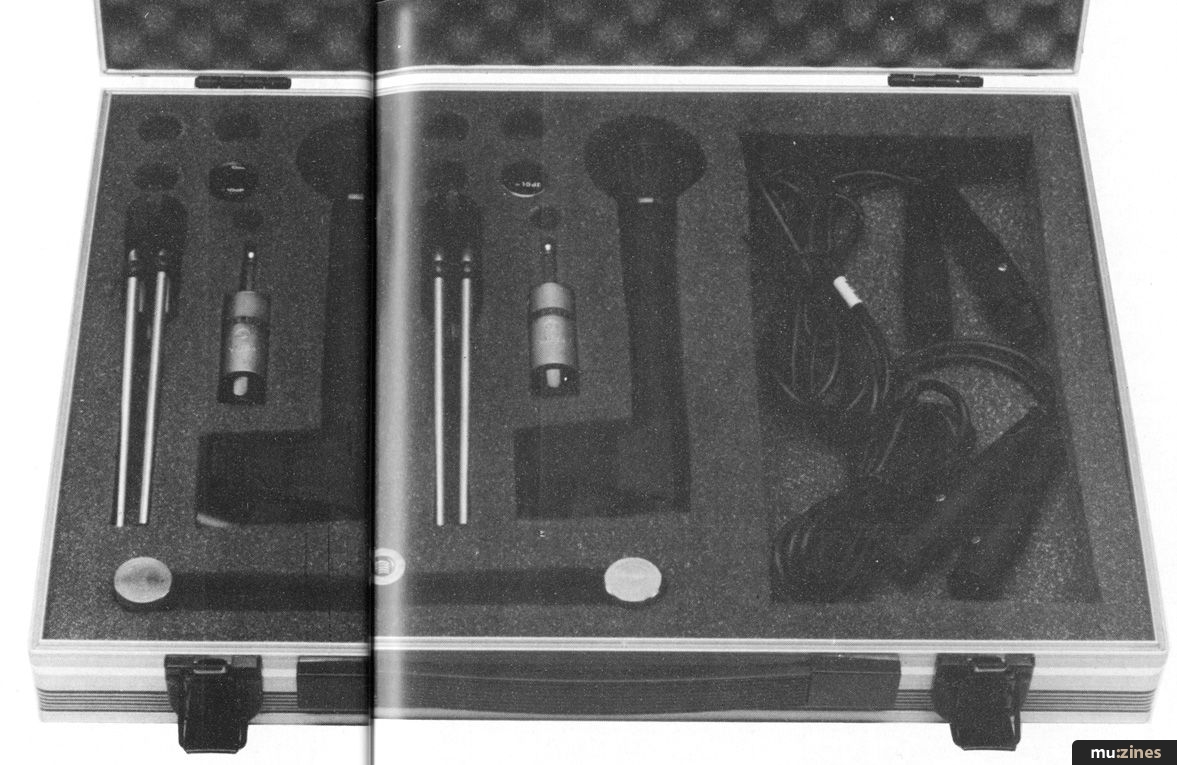
The mics did go through a mixer, but solely for purposes of gain — no equalisation was added. Said friend and I wove a sparse web of single notes and staccato chords around a D, G, C progression whilst the cat mourned its very existence at the hands of the neighbour. (Only joking, cat lovers.) (It was really a dog — Ed.) This sparseness was a purposeful ploy aimed at giving a clear indication of spatiality; the room we were using was reasonably live in a boxy, living-room sort of way, and so it wouldn't have taken much to excite a high degree of undesirable reflected sound, immediately confusing the imaging. The results, even over speakers, were quite impressive, with clear imaging and clean sound. We also recorded ourselves just chatting and moving around the room, getting in close, rustling papers and coats whilst opening and closing doors in the far field. (That's a technical word meaning further away, not outside in a field, you understand.) The effect on headphones was similar to a dummy head recording with a high degree of perspective and depth being apparent. As usual with such recordings, there was no height information and it wasn't possible to accurately discern back from front, but that is to be expected with all standard binaural techniques. In my experience, the only system capable of capturing such information clearly is the brainchild of Italian inventor Hugo Zuccarelli, and goes under the title of 'Holophony'. The OSS system can be bought complete as a kit in a robust executive-style case. This includes the disc, a pair of high quality condenser mics with both omni-directional and cardioid capsules, a gooseneck, a crossbar for mounting a straight stereo pair, a pair of table stands, a flexible adaptor to go between capsule and body, a pair of balanced XLR-to-unbalanced jack adaptors and a pair of normal microphone stand adaptors. The price for that lot is on application only, but suffice it to say that the mics supplied (PMB 640s) cost £189.75 apiece, and the disc goes a further £66.20. The 640s are undoubtedly very nice mics, and the omni capsules provide a wonderful vocal sound if you can control the ambience, However, if your finances aren't up to that, there are less expensive alternatives on the mic front in the form of the PMB E350 electret plus omni capsule at £72.22 or the omni dynamic PMB 119C at £62.68.
The system as a whole has rather limited applications for home recording, because this 'straight to stereo' approach relies on low level background noise and musically conducive acoustics, neither of which can generally be guaranteed in the home. All the same, the mics are very good in their own right, and with the interchangeable capsules they could be used for a variety of applications. They'd be interesting to experiment with in a studio, though.
Also featuring gear in this article

Publisher: Music UK - Folly Publications
The current copyright owner/s of this content may differ from the originally published copyright notice.
More details on copyright ownership...

Music UK - Dec 1983
Gear in this article:
Review by Nobby Line
Previous article in this issue:
Next article in this issue:
Help Support The Things You Love
mu:zines is the result of thousands of hours of effort, and will require many thousands more going forward to reach our goals of getting all this content online.
If you value this resource, you can support this project - it really helps!
Donations for April 2026
Issues donated this month: 0
New issues that have been donated or scanned for us this month.
Funds donated this month: £0.00
All donations and support are gratefully appreciated - thank you.
Magazines Needed - Can You Help?
Do you have any of these magazine issues?
If so, and you can donate, lend or scan them to help complete our archive, please get in touch via the Contribute page - thanks!
Please Contribute to mu:zines by supplying magazines, scanning or donating funds. Thanks!
Monetary donations go towards site running costs, and the occasional coffee for me if there's anything left over!

 @mu_zines
 RSS Feed
 Blog
Blog