Video In The Dark (Mike Oldfield)
(EMM Apr 86)


Magazine Archive
Home -> Magazines -> Issues -> Articles in this issue -> View
Mike Oldfield | |
Mike OldfieldArticle from Sound International, February 1979 | |
You've read the rest, now read the best... or is it the other way round? Whatever you may have seen elsewhere, we reckon his mate Paul Brett gives us a more accurate picture of life as An Extremely Talented Person With A New Album Just Out.
Guitarist Paul Brett talks to ex-guitarist-turned-multi-instrumentalist Mike Oldfield and extracts the facts that everyone else missed.

It must be the dream of most musicians to be heralded as this decade's single most successful composer and musician with world-wide sales in excess of eight million on one album alone. Tubular Bells was released in 1973 and still occurs in the charts, yet Oldfield spent two years trying to get it signed to a record company and finally, after numerous rejections, Richard Branson was persuaded to release it on his newly-formed Virgin label and the two took off together. The companies who rejected it must still be kicking themselves!
Oldfield formed his first band at the age of 10, 'touring' the local youth clubs. If I Had A Hammer was the first song he ever learned to play and he still does a beautifully ear-shattering rendering of it on request, which will prompt all neighbours to ask, 'Who did you have at your place today?' if you live in a flat like I do.
His first album ever was released when he formed a duo with his sister, Sally, at the tender age of 14; then after forming and disbanding Barefeet and playing bass and lead guitar with Kevin Ayers, Tubular Bells was conceived, demoed and rejected during the period 1971-73.
His second solo album Hergest Ridge was released on Virgin in 1974 and entered the charts at No 1 pushing Tubular Bells to No 2; another achievement which would make most of us just a tiny bit envious! Ommadawn followed in 1975 and, until now, apart from his singles and a compilation album Boxed in 1976, all has been strangely silent. Where has he been? Resting on his laurels? No, he has been suffering from a common ailment well-known to all musicians: dissatisfaction with anything he has come up with. Until recently, that is. Having suffered from that condition myself, plus the fact that we have a common interest in one Tom Newman (sound engineer/producer/Irish businessman), I was curious to find out more about the man behind the guitar (and if you knew Tom you would know what I mean). Allow me to illustrate...
At the opening of The Venue, Virgin's new club in Victoria, some time ago Tom persuaded Mike, Richard Branson and various other people who will no doubt wish to remain anonymous, to dress up as babies; 'dress up' being a not-very-apt description of a strategically placed towel and safety pin per person. I need go into no detail of what happened when the party got into full swing, except to say Mike's original selection of Roman attire would have been warmer at this time of year, especially as their transport consisted of an open-topped car. Tom is full of little stories such as this and it sums him up perfectly!
Now I had been informed by Tom that interviewing Mike is not the easiest of tasks to perform, mainly because the guitarist/composer of the aforementioned multi-million selling albums is not the most forthcoming of exponents in the art of verbal communication. Bearing this in mind, and also that I myself have been interviewed many times, have been asked a thousand meaningless questions, and have given just as many meaningless answers in return, I could understand the reasons why young Michael might be a little reticent in spilling forth his thoughts for publication.
One factor — that may be the main reason I ever got to interview Mike at all — is that during his three year 'absence' he has undergone a new type of encounter — a group-like therapy called Exegesis devised by Robert D'Aubigny. It takes the form of seminars where a given number of people shed, or attempt to shed, their inhibitions by talking publicly about private problems until they gain confidence enough to face these problems instead of only talking about them.
Mike, until now, was painfully shy to the extent that interviews and the like were virtually impossible; yet in the few weeks around our chat alone he had attended a number of parties and get-togethers and had even thrown one himself. I've heard many people commenting on the fact that Mike is more extroverted than before, although his basic personality is still the same. Tom Newman comments: 'At one time if Mike went to a party, he would just melt into a corner somewhere and you'd hardly see him all evening. He's almost gone to the other extreme now! I've never seen more than about three people in his house at once, so Mike actually planning to throw a party for a hundred shows what this seminar has done for him. I'm really pleased for him.'

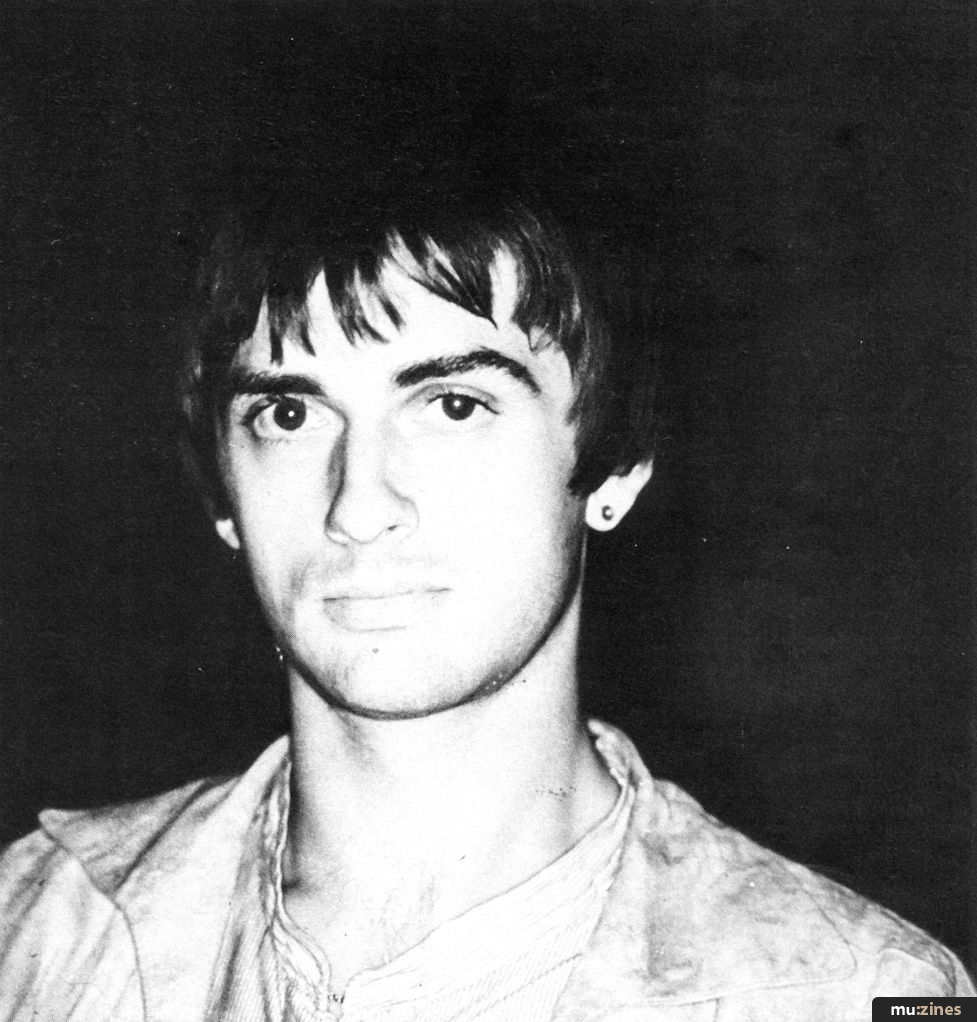
Mike even looks different. Gone is the shoulder-length hair and a new, slimmer Mike has emerged. Some unkind soul, while stuffing barbequed steak and red wine at the said party, asked whether Mike 'had been knocked on the head'. If you've never been shy to the point of sitting at a gathering of people wishing that the ground would open up and swallow you, you just would not understand. It must be worse still if you have to get up on a stage to perform in front of thousands of people, which may explain the rarity of Mike's live concerts. All I can say is that Exegesis has certainly worked for him.
Originally, the interview was supposed to take place at the Music Museum in Kew (south-west London), but on the afternoon in question some kind anonymous person informed the Virgin press office that the museum was closed, so we opted for a cup of tea and a chat at my flat in Fulham.
So there we were, Mike Harris (photographer), Sally Cooper and Sandra Goode (PR ladies), Mike Oldfield, myself and Tommy the chow chow who seems to be gaining a reputation for stealing the show. Tea was duly served (though I opted for a bourbon), followed by a request from Mike to inspect my guitar collection. It seemed to be the magic combination which immediately opened up the elusive lines of conversation.
Once surrounded by some half a dozen guitars, I began by asking Mike if he had been influenced by any guitarists and he replied by playing a selection of guitar pieces by John Renbourn, Bert Jansch and Al Stewart, which rather surprised us all. 'Bert Jansch's Needle Of Death is a real favourite of mine, as are some of the early Al Stewart instrumentals,' he revealed. 'By the way, I really like his new single, Time Passages. John Renbourn is another guitarist who has influenced me. I'd really like to meet him.' (Are you reading this, John?) On being asked whether he was influenced by traditional music, something that most listeners to Mike's albums might be excused for assuming, Mike replied that this was not necessarily the case, as long as it held a good melody line. He then proceeded to demonstrate a 5-figer clawhammer technique and some fine country picking incorporating the longest little finger-nail I have seen to date. In reply to those sceptics who think that some really successful musicians have made it by luck and minor talent, Mike is not one of them. He really can play that guitar!
On the electric side of playing, Mike really rates Hank Marvin. He finds that although there is a definite difference in technique between acoustic and electric guitar playing, he himself plays both finger-style. 'They are completely different both in technique and control, but I first played acoustic, then alternated a bit, so I've learnt to play the two side by side. I really like the sound of a 12-string.' He leans over, picks one up and plays a few chords: 'It's got a unique identity when it comes to sound. I remember going into a shop and picking up a 12-string for the first time. I just kept on playing this Gerry and the Pacemakers riff over and over again.'
Then followed the rendering of If I Had A Hammer which brought Tommy the chow running in to stand nose to nose with Mike as if to ask what it was all about. 'My St Bernard, Wellington, was great when he was a pup — just a ball of fur about this big.' He has a distinct affinity for animals. Tommy, usually the most aloof of creatures, was fascinated by Mike and the strange noises he could make. 'I've got two Irish Wolfhounds as well, Gog and Mag Wag. I'll have to lock them in the kennels on Saturday though, I'm having a belated November the fifth party. Would you like to come?'
Just then the phone rings; it's Tom Newman, alias the Scarlet Pimpernel (we seek him here, we seek him there). He is waiting for us in the pouring rain outside the Music Museum, although it was he who informed Virgin that it was closed. We all had a good laugh about that because it is just about the only occasion that he has ever turned up on time.
I then turned to the question of recording, a subject of particular interest to me, especially as Mike has a studio built adjacent to his house. 'It's a 24-track quad studio that I designed to my own requirements and got various people in to build for me. That's where I record most of my albums. The control room is about 25 feet square and the studio itself is about 25 feet by 50 feet. It's got Ampex tape recorders, an Eastlake monitor system and various special "toys", such as the Eventide Clockworks Phaser and Flanger, an EMT digital reverb unit and bits like that. All the mikes are Neumann KM86s and U87s. My mixer was built by Rebis, a company in Birmingham; they aren't really known as builders of mixers They make parametric equalisers, compressors and stuff, but have built mixers for Tom's and my studios.'
What about recording acoustic guitar — any special techniques? 'Well, usually I record acoustic guitar in mono except when it is featured solo, then I record in stereo. I've remixed some of my albums in quad too.' Marvellous to be able to nip next door to put down ideas on tape as they occur to you, but what happens when a new album looms on the horizon? 'Most of my ideas are developed on piano, then I lay a good backing track and search for melodies. If I've got a good chord sequence to write to I can always find a melody to play over it. Ommadawn, for example, is based around two chords like this - (quick demonstration). 'And Incantations, my new album, is based around one chord and a series of fifths. It took me somewhere in the region of nine months to record it. Apart from the instruments I played myself, I used a medieval choir (style, not age), a schoolgirl choir and an assortment of session players on strings. Mike Laird played trumpet and Pierre Moerlin made some good contributions on drums and vibraphones. My brother Terry and Sebastian Bell did the flute parts and David Bedford conducted.' I commented on the extract from Longfellow's Hiawatha set to music: 'Yes, Maddy Prior sang on that'.
As a double album, I could well believe the hard work and time that went into its completion, but one man working alone must sometimes find new ideas difficult to come by. Did Mike find that this was the case? 'Yes, it's always a problem, but I wouldn't have it any other way. I've never worked in conjunction with anybody else on my compositions.
'I'm taking Incantations on the road. We'll be playing in Spain, France, Belgium, Holland and Germany. The line-up will consist of around 50 musicians, which will include a 32-piece string section, a choir, three keyboards, a vibraphone and various percussion and two other guitarists, one doubling bass. Tom is putting together the PA system that I want to use. It consists of a 24/4 APR computer master mixing desk and Rebus sub-mixers. The frontal speakers are Quad electrostatic, a total of 64 in all, with 16 Eastlake audio monitor speakers. The Quads will be powered by Quad amps and the Eastlakes by Amcron amps. The stage monitors are a combination of Eastlake and Quad — a total of about 3000 watts frontal power. The electrostatic speakers will be used for the choir and strings as they are smooth-sounding quality speakers; the Eastlakes will be for the guitars, vibraphone and percussion as they have a harder sounding effect.'
At this point I play some 12-string guitar at his request and then we duet in 5/4 time with Dave Brubeck's Take Five; Mike comments that he would like to learn more jazz. It was interesting watching and listening to Mike, surrounded by guitars on all sides, playing tasty little tunes that he has accumulated over the years. I asked him if he'd ever considered recording a purely acoustic solo guitar album. 'I'm working on that for the future. I'm definitely going to do it as I've got all these tunes; it's something that I've wanted to do for ages now. Another thing I'd like to do is a rock version of Teddy Bear's Picnic, like this, look...' We listen, and cannot decide whether he is serious or not. Perhaps he is.
'I've also written some music for an educational film, the demos of which I used in the composition of Incantations. It will probably be shown in colleges and educational media outlets; I don't know about general release.' How did William Friedkin come to use a section of Tubular Bells for his film, The Exorcist? 'The first thing that I knew about it was when I got a phone call from Richard telling me that was being used. I keep meaning to go and see it, but with one thing and another, I haven't got round to it yet.'
When you are used to being interviewed yourself it's always a temptation, in a sadistic sort of way, to drop in a few journalists' favourites to get another point of view, so I took the opportunity to ask whether he preferred live performances or recording. 'I like them equally. I get satisfaction out of playing whatever the circumstances.'
That statement sums up my impression of Mike Oldfield. It is frustrating that I cannot convey to you in words the music that was played during the interview; it plays a vital part in what was said, for I had the feeling that had there been no guitars available, it might have proved to be an embarrassingly silent afternoon. As it was, it turned out to be an extremely enjoyable encounter.
As a 'PS', Sandra and I decided to take Mike up on his offer regarding the fireworks party and see the man in his castle to conclude my impression. After driving through gale force winds and driving rain (sounds like a rock song) and being smashed up the backside by a veteran World War I weekend driver who claimed he was 'only trying to stop', we finally arrived at Mike's place, a many-roomed estate in Gloucestershire, at the end of a narrow roadway littered with the visiting guests's cars. Due to the slippery road conditions, I narrowly missed Tom Newman's new (old) Jensen — hee, hee — but must confess to scraping an old banger in the scramble to park on the muddy hillside.
Upon entering via the kitchen, I noticed some nude photographs and a lifesize cardboard cut-out of our host in various poses pinned on the wall. (Could this be what Tom meant by 'the other extreme'? Or is it just well-photographed fun?) After duly reporting our presence, we were ushered out into the garden to enjoy the barbecue, wine, rain, wind and one hell of a firework display, reminiscent of one's memories of Bonfire Night as a child, which climaxed, along with theatrical oooh's and aaaahhh's, with the heavens literally exploding — very much a winner.
Back inside, some friends of Mike's performed an excellent rendering of Tubular Bells on old-fashioned squeezeboxes, which lent the piece an extremely traditional sound, while in another room Mike, complete with gum-boots, played bass guitar behind a talented singer/guitarist whose name I did not catch, but then it didn't really matter because the music was so good. We left the party with Mike doing what he does best — guitar-picking.
All photos supplied by 'VisualEyes'
More with this artist
 |
Publisher: Sound International - Link House Publications
The current copyright owner/s of this content may differ from the originally published copyright notice.
More details on copyright ownership...

Sound International - Feb 1979
Donated & scanned by: Mike Gorman
Interview by Paul Brett
Help Support The Things You Love
mu:zines is the result of thousands of hours of effort, and will require many thousands more going forward to reach our goals of getting all this content online.
If you value this resource, you can support this project - it really helps!
Donations for August 2026
Issues donated this month: 0
New issues that have been donated or scanned for us this month.
Funds donated this month: £0.00
All donations and support are gratefully appreciated - thank you.
Magazines Needed - Can You Help?
Do you have any of these magazine issues?
If so, and you can donate, lend or scan them to help complete our archive, please get in touch via the Contribute page - thanks!
Please Contribute to mu:zines by supplying magazines, scanning or donating funds. Thanks!
Monetary donations go towards site running costs, and the occasional coffee for me if there's anything left over!

 @mu_zines
 RSS Feed
 Blog
Blog