


Magazine Archive
Home -> Magazines -> Issues -> Articles in this issue -> View
Musical Micro Survey | |
Article from Electronic Soundmaker & Computer Music, March 1984 | |
Concise guide
A round-up of popular micro-computers from a strictly musical viewpoint
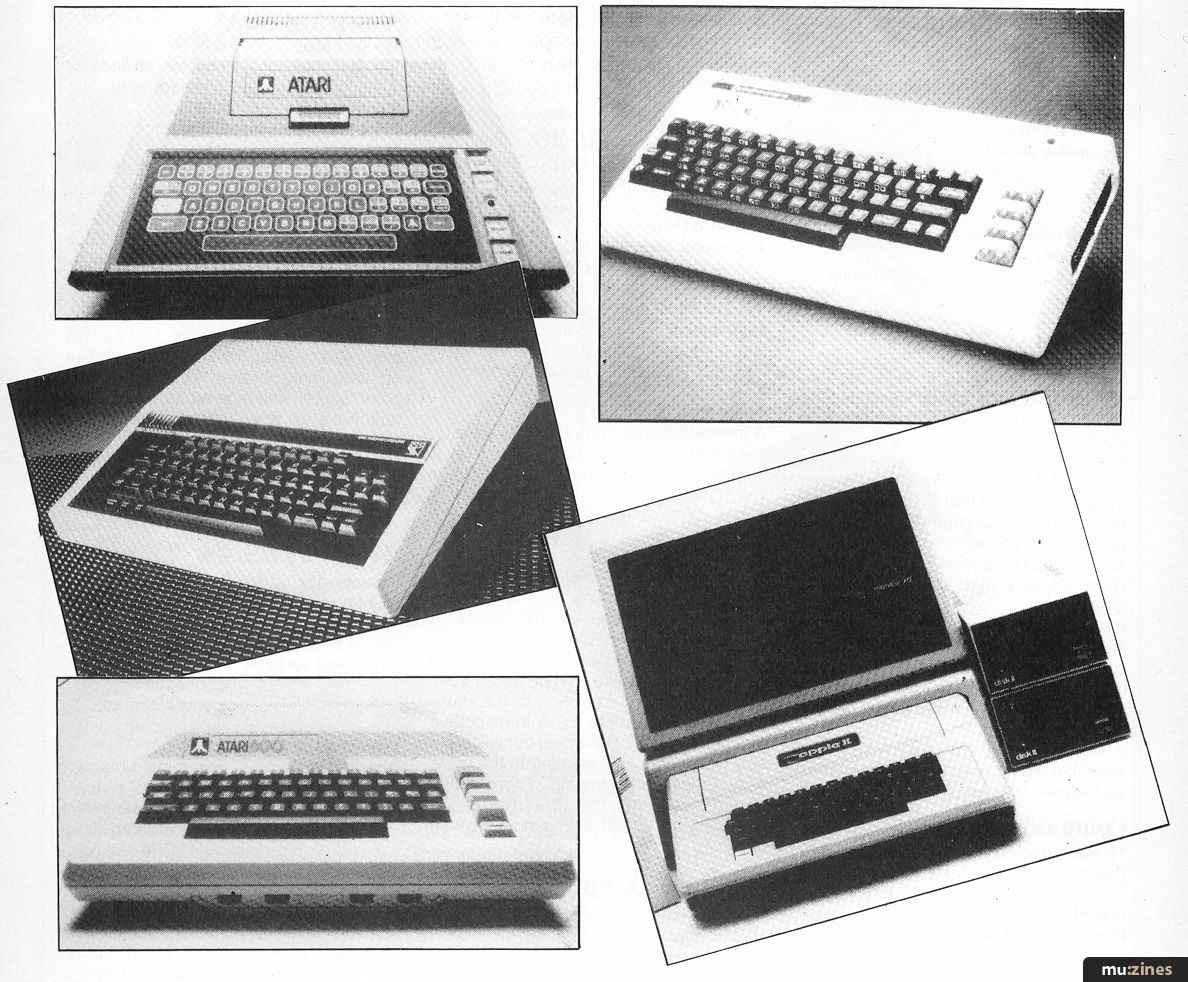
After six months of our popular computer music articles, we thought it would be an idea to summarise some of the conclusions. The listings below are by no means comprehensive, but should give some indication of the musical power of-some of the popular machines, and an at-a-glance index of cost and flexibility... Due entirely to the demands of alphabetical order, we start with the Atari 400...
Atari 400
| Memory size: | 16K |
| Display: | TV, 24 lines of 40 characters |
| Size of BASIC: | 8K |
| Expansion sockets: | BUS connection, serial output, cartridge, tape |
| Typical retail price: | £200 |
| Distributor: | Atari (UK) Ltd, (Contact Details) |
Summary
This home computer forms the basis of a very powerful, attractive and flexible system. Programs can be loaded from tape cassette, ROM cartridge or floppy disc (disc drive necessary). The software available covers the whole spectrum of applications — games, educational, business, etc. Good range of peripherals (accessories).
Likes: packaging, availability, software, colour, sound (4 voices, 3 octaves)
Dislikes: touch keyboard
Music capabilities: The Atari computers are particularly attractive games-playing machines, and their musical capabilities remain a strong selling point, with four voices on each model.
Atari's Music Composer cartridge is an excellent introduction to computer music despite one or two minor shortcomings. The Advanced Music (on the user-written APX catalogue) meanwhile, extends the Atari 800's range to over 8 octaves on each voice.
Apple II
| Memory size: | 48K |
| Display: | TV, 24 lines of 40 characters |
| Size of BASIC: | 8 or 12K |
| Expansion sockets: | BUS connections |
| Typical retail price: | £650 |
| Distributor: | Apple Computer (UK) Ltd, (Contact Details) |
Summary
One of the earliest microcomputers made for the mass market. Continues to sell despite newer, smaller, cheaper competition. Suitable for home, office or school. Widely used.
Likes: availability of software, graphics, sound
Dislikes: typewriter keys too close together
Music capabilities: Any discussion of musical micros would be incomplete without making reference to the Apple II, which despite being overpriced in these budget conscious times, is still at the top of the pile in a musical context. The enormous amount of ready-written software available for this model largely explains its leading position.
Atari 800
| Memory size: | 16K |
| Display: | TV, 24 lines of 40 characters |
| Size of BASIC: | 8K |
| Expansion sockets: | Serial output, BUS connector |
| Typical retail price: | £400 |
| Distributor: | Atari (UK) Ltd, (Contact Details) |
Summary
The big brother of the 400. The 800 features a proper typewriter keyboard. The 400 and 800 together are probably the biggest-selling home computers in the United States. Extra money in the form of 16K RAM cartridges can be added to increase the memory from 16K to 48K. Cartridge and hand-controller sockets are provided for games; although this model is marketed primarily as a business or educational computer, it is undeniably a very impressive games computer too.
Likes: packaging, presentation, availability of accessories and wide range of software.
Dislikes: None
Music capabilities: The Atari computers are particularly attractive games-playing machines, and their musical capabilities remain a strong selling point, with four voices on each model.
Atari's Music Composer cartridge is an excellent introduction to computer music despite one or two minor shortcomings. The Advanced Music (on the user-written APX catalogue) meanwhile, extends the Atari 800's range to cover 8 octaves on each voice.
BBC Microcomputer
| Memory size: | 16K(A), 32K(B) |
| Display: | TV, 32 lines of 40 characters (A) 30 x 80(B) |
| Size of BASIC: | 16K (A & B) |
| Expansion sockets: | Parallel & serial, BUS connection, analogue output. Tape (A&B) |
| Typical retail price: | £299(A), £399(B) |
| Distributor: | BBC Microcomputer Systems, (Contact Details) |
Summary
Two models are available — Model A with 16K memory and Model B with 32K. Since its introduction, the BBC micro (in either configuration) has attracted a great deal of interest and widespread acclaim. Its main attraction for the newcomer to programming, of course, is that it is supported by a BBC computer programme series and a great deal of software.
Likes: colour, sound, typewriter-style keyboard, very good expansion potential, graphics
Dislikes: can't think of any at all
Music capabilities: As one of the most sophisticated micros on the domestic market the BBC models have been rather let down by the absence of a ready-written music programme.
Nonetheless, the Beeb has considerable potential for the more ambitious and advanced user.
Commodore 64
| Memory size: | 16K |
| Display: | TV, 25 lines of 40 characters |
| Size of BASIC: | 12K |
| Expansion sockets: | IEEE 488 standard, parallel output |
| Typical retail price: | £200 |
| Distributor: | Commodore, (Contact Details) |
Summary
The Commodore 64, from the same stable as the trendsetting PET, builds upon the Vic-20's good points and remedies its shortcomings. 'Sprite graphics', a term coined by Atari, are featured. The user can set up a graphics shape on the screen and easily move it around as a whole — great for games where you want to move a player or spaceship around.
Likes: plenty of on-board memory (64K), colour, sound (3 voices, 8 octaves, 4 waveforms) which approaches facilities of full music synthesizer, typewriter-style keyboard, should have good software support, improved display format (25 x 40) compared to VIC.
Dislikes: programmes for PET and VIC-20 will not run on the 64 without some rewriting.
Music capabilities: With nine octaves as opposed to the Vic-20's three, the 64 is more like it. Its natural competitor the Atari 800 though, has the extra voice, providing for a rather fuller sound.
Commodore Vic-20
| Memory size: | 5K |
| Display: | TV 23 lines of 22 characters |
| Size of BASIC: | 8K |
| Expansion sockets: | BUS connection, disc, printer, serial, tape |
| Typical retail price: | £150 |
| Distributor: | Commodore, (Contact Details) |
Summary
A low-cost colour computer designed for the home and educational market. It takes its name from the Video Interface Chip on which it is based.
Likes: full typewriter keyboard, colour, sound (3 tone generators each of 3 octaves)
Dislikes: display format (23 lines of 22 characters within a coloured border), limited memory (5K — expandable to 29K).
Music capabilities: Decent price cuts and package deals make the Vic-20 an even more attractive proposition to the musician. For £130, a three voice, three octave machine is pretty generous, but will probably be found a little wanting to the more wide ranging imagination. Thorn EMI's music program for this model is, however, an effective and no-nonsense option.
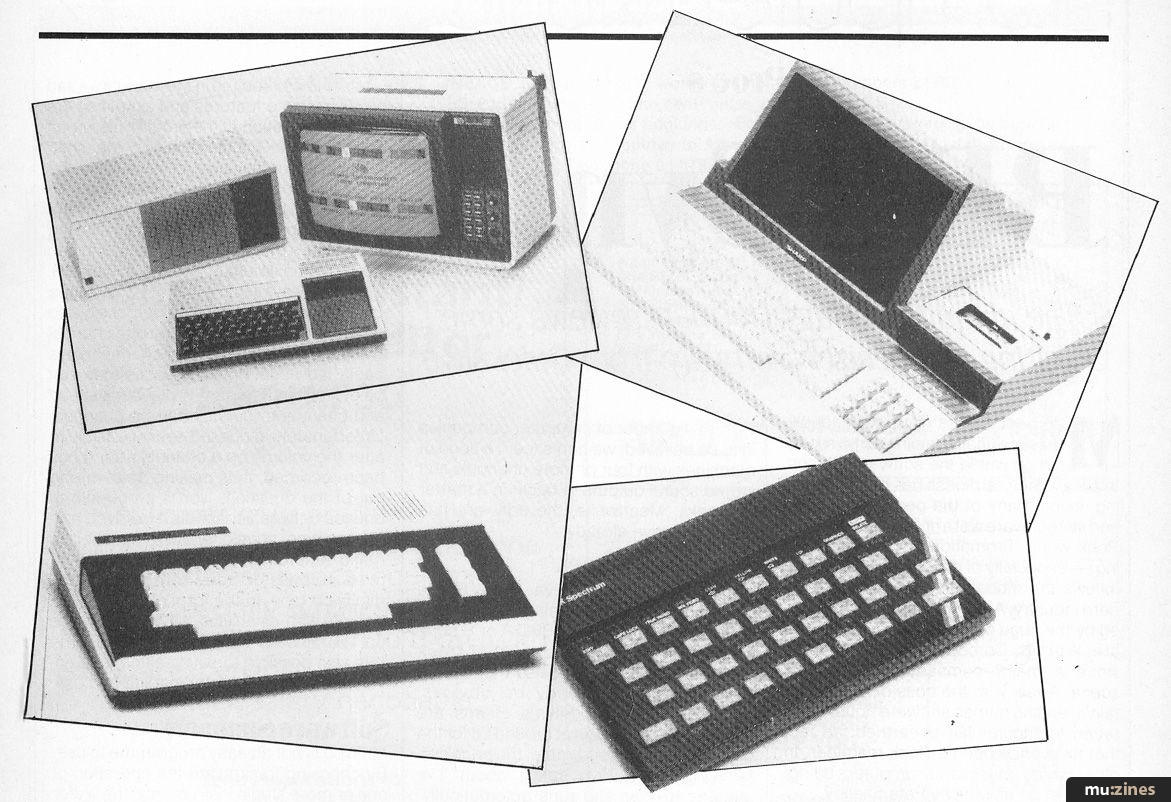
Sinclair ZX Spectrum
| Memory size: | 16-48K |
| Display: | TV, 24 lines of 32 characters |
| Size of BASIC: | 10K |
| Expansion sockets: | BUS connection, tape |
| Typical retail price: | £125 (16K) £175 (48 K) |
| Distributor: | Sinclair Research, (Contact Details) |
Summary
The successor to the ZX81, the ZX Spectrum does more and costs more — it has a colour output, sound output and a moving-key keyboard. Like the ZX81, it uses a keyword system — you hit one key to put certain words on the screen instead of having to spell them out in full.
Likes: colour, sound output, much more memory than the ZX81, slim, attractive packaging, moving-key keyboard.
Dislikes: poor sound generator.
Music capabilities: Shouldn't be mentioned in the same breath as any of the above. With a single 'voice' generated by a crummy peizo-electric loudspeaker, the Spectrum sounds like a wasp in a tin.
Sharp MZ-80A
| Memory size: | 48K |
| Display: | Monitor, 25 lines of 40 characters |
| Size of BASIC: | 12K |
| Expansion sockets: | BUS connector |
| Typical retail price: | £550 |
| Distributor: | Sharp UK Ltd, (Contact Details) |
Summary
The mid-range Sharp model. Like its less expensive relative, the MZ-80 is a combined unit, incorporating keyboard, computer, screen and tape recorder. The 80A features a full typewriter keyboard with a numerical keypad.
Likes: typewriter keyboard, sound
Dislikes: no colour
Texas TI 99/4A
| Memory size: | 16K |
| Display: | TV, 24 lines of 32 characters |
| Size of BASIC: | 14K |
| Expansion sockets: | ROM pack, BUS connection, joystick control, tape |
| Typical retail price: | £125 |
| Distributor: | Texas Instruments (Consumer Division), (Contact Details) |
Summary
An improved version of the older TI 99/4. Not very widely advertised. Recent price reductions make this quite an attractive buy now. Can be used with a speech synthesizer.
Likes: colour, sound (3 voices, each 5 octaves), full typewriter keyboard.
Dislikes: not widely available compared to its main competitors.
Music capabilities: sound, in one form or another, has always been the TI 99's forte — it comes with an optional speech synthesizer. Its basic capacity of three voices and five octaves equip it reasonably well for musical applications.
Dragon 32
| Memory size: | 32K |
| Display: | TV, 16 lines of 32 characters |
| Size of BASIC: | 16K |
| Expansion sockets: | BUS connection, tape |
| Typical retail price: | £199 |
| Distributor: | Dragon Data Ltd, (Contact Details) |
Summary
Mettoy, the toy company, is manufacturing this British design in Swansea — hence the name and Welsh dragon logo. It offers 32K of memory compared to the VIC's 5K or indeed the Atari 400's minimum complement of 16K. Comprehensive graphics control commands. Sound is relayed through the television speaker.
Likes: typewriter-style keyboard, colour, sound.
Dislikes: price a little too high, shortage of software compared to its main rivals.
Music capabilities: Like the BBC micros the Dragon has an impressive musical spec sheet, with volume control between 0 and 31 and string arrays of up to 255 characters.
The new music software packages from Dragon should be appearing on the market before long.
Summary
Our samples represent the range of computers available for up to about £650. The trend is for prices to fall. Sinclair's ZX81 was recently reduced to under £50 and Atari's 400 and the more expensive 800 have fallen by around £100. The big question that you, the consumer, has to answer is 'Which one do I buy?' That largely depends on what you want to do with the machine and whether or not you have had any previous experience of computers.
There are many people who have no particular application in mind but feel that they really ought to find out something about these new-fangled gadgets. If you fall into that category, you ought to look at the cheapest models available. The Sinclair ZX81 gives as good an introduction to computing as anything, as long as you don't mind having a black and white display. If you're really sold on colour, then go for the VIC-20 or ZX Spectrum.
Sinclair computers operate a little differently from 'normal' computers. If you compare a ZX81 or Spectrum keyboard with that of any other computer, the big difference is that the Sinclair keys are stamped with both a letter and a word. For instance, the Spectrum's 'P' key is also stamped with 'PRINT'. Pressing it alone causes the word 'PRINT' to appear on the screen. By using the shift function, each key can be made to perform up to five functions — confusing at times. Most other computers require that all commands be spelt out in full.
If you've already had some experience of using a computer, you may have a better idea of what you'd like to use one for. Narrow down your choice to just two or three models by looking at the prices, the amount of memory available compared to what the software for your application requires and the availability and price of any peripherals that you may need; a printer or a disc drive for instance.
The last point demands some explanation. Peripherals, mentioned above, are merely devices or accessories that can be plugged into a computer. There's no point in deciding that it would be nice to use a computer to store and print out all your correspondence if you then discover that you can't afford the printer. Think about the system as a whole — all of the hardware and software.
A vast range of software is available on audio tape cassettes, but for some applications a different storage medium is preferable. For this, the magnetic film is made in the form of a disc, a 'floppy-disc', instead of a tape. The advantage is that data can be recorded on or read from the disc much more quickly than is possible with tape. The main disadvantage is that the disc drive attachment tends to be very expensive.
You must also decide whether you like the look of one of the newest systems, like Oric-1 or Dragon 32, or prefer to stick to an established system with a proven track record, like the ZX81 or BBC Micro. When you have narrowed down your choice, it is then essential to be able to see the shortlisted models in action. Visit a couple of computer shops and spend some time tapping the keys and having demonstrations of the machines' capabilities. Take your time. The only thing you can be sure of is that computers are here to stay — you have all the time in the world to decide which one is right for you.
More from these topics
 The Musical Micro - Rag Bags and Hotch Potch |
 On the net |
 The Integration Game - Improving your MIDI Environment (Part 1) |
 PC Notes |
 The Buyer's Bible |
 Sampling Keyboards |
 Data To Music Conversion - A Low Cost Peripheral Circuit For Your Computer |
 Amiga Notes |
Software Support - Hints, Tips & News From The World Of Music Software |
 Atari Notes |
Buyer's Bible |
 Checklist |
Browse by Topic:
Buyer's Guide
Computing
Publisher: Electronic Soundmaker & Computer Music - Cover Publications Ltd, Northern & Shell Ltd.
The current copyright owner/s of this content may differ from the originally published copyright notice.
More details on copyright ownership...

Electronic Soundmaker - Mar 1984
Donated & scanned by: Mike Gorman
Feature
Help Support The Things You Love
mu:zines is the result of thousands of hours of effort, and will require many thousands more going forward to reach our goals of getting all this content online.
If you value this resource, you can support this project - it really helps!
Donations for May 2026
Issues donated this month: 0
New issues that have been donated or scanned for us this month.
Funds donated this month: £0.00
All donations and support are gratefully appreciated - thank you.
Magazines Needed - Can You Help?
Do you have any of these magazine issues?
If so, and you can donate, lend or scan them to help complete our archive, please get in touch via the Contribute page - thanks!
Please Contribute to mu:zines by supplying magazines, scanning or donating funds. Thanks!
Monetary donations go towards site running costs, and the occasional coffee for me if there's anything left over!

 @mu_zines
 RSS Feed
 Blog
Blog