


Magazine Archive
Home -> Magazines -> Issues -> Articles in this issue -> View
News | |
Article from Sound International, June 1979 | |
Aria Competition Answers, Portland Studios, Introducing News Notes
Helios cease trading
We are very dismayed to learn that the highly respected custom console manufacturers, Helios, have recently been forced to cease trading. Helios are very well-known for their equipment, and are one of the few companies to have offered such comprehensive design flexibility and console customisation. Yet, it appears, all is not lost. Arrangements are being made to continue service support for the large number of Helios customers worldwide, and founder Dick Swettenham tells us that 'A way will undoubtedly be found to ensure that the Helios concept of "real custom-built consoles" will continue to be available'; watch this space for developments.
Helios consoles are regarded by many top engineers and studios as the best; and not without good reason. Helios consoles are performing effectively in a large number of studios all over the world, including Maison Rouge, Basing Street and Town House Studios in London. We wish Dick and all those others involved with Helios the very best wishes for the future.
However, Dick informs us that the audio engineering consultants, Richard Swettenham Associates, are unaffected by all this bad luck; they may be contacted at (Contact Details).
Late Arrivals at the Combotesters Ball
The Stingray Super Combo is to be replaced by a new combo next month; in the meantime the new-ish Stingray Professional and Cobra Lead may well find favour with potential Carlsbro lovers. The Stingray Professional offers an 'upmarket' alternative to the disappearing Super; it has 'C-Mos Logic Control electronic digital switching' of effects status and channel selection by means of a remote 4-way footswitch. Power output is quoted at 150 watts RMS; there are LEDs to tell you what's on; Reverb; 'Suzz'; and ADL for Chorus, ADT and vibrato effects; and a built-in compander. Rrp will be getting on for the £500 mark.
The Cobra Lead is the other side of the coin, and goes for just over £200. 60 watts into a single 12in driver, its small size and simple operation make it look viable for studio or live use.
More info from Carlsbro Sound Equipment, (Contact Details).
Aria competition answers
As promised last month, when we revealed that Adrian Teasdale had won the guitar and Stephen Worsfold the bass in the Aria competition, here are the answers and the names of them what were right (but lost — unfortunately).
So the answers: first the guitar section (I'll repeat that, the guitar section). Les Paul is generally credited with having pioneered multitrack electric guitar techniques; a pair of strings like those found on a standard 12-string are called 'a course'; the Fender Broadcaster became the Telecaster in 1950; Johnny Ramone is guitarist with the Ramones (no!), Geoff Whitehorn with Crawler, Billy Rogers with the Crusaders, Elvis Costello with EC and the Attractions, Chris Cross with Ultravox!, Ernie Isley with the Isley Brothers; woods traditionally used in guitar making include rosewood, ebony, mahogany, spruce, maple, etc; there are two crotchets per second when tempo is indicated as (crotchet) = 120; a zero fret is a fret next to the nut at the head of the fingerboard which leaves the nut free to provide merely string spacing — the zero fret supplies intonation; Rickenbacker made so-called 'frying pans' in the Thirties; normal tuning for open D six-string guitar is D, A, D, F#, A, D; Reykjavik is the capital of Iceland.
Secondly, the bass section (I won't repeat that). Leo Fender is usually credited with having invented the electric bass guitar; roundwound strings tend to give more top response than flatwounds; the Gibson EB1 was introduced in 1953; Pete Briquette is bass player with the Boomtown Rats, Ronald Lapread with the Commodores, Larry Graham with Graham Central Station, Paul Simonon with The Clash, Alan Gorrie with the Average White Band, Andrew Bodnar with the Rumour; rosewood and maple are the two most common woods used for the fingerboards of electric basses; the five notes of the bass clef, bottom to top, are G, B, D, F and A; a zero fret is explained in the guitar section; Dan Armstrong was the guitar maker associated with the 'See Through' basses of the early Sixties; the tuning of the Fender Bass V was/is E, A, D, G, C; Lima is the capital of Peru.
Now what? Oh yeah — the right ones. Correct for guitar were: S Baxendale, South Shields, Tyne and Wear; D Crispin, Paignton, south Devon; Paul Edmonds, Hyde, Cheshire; John Fordrey, Norwich, Norfolk; Mark Jeffries, London SE24; John C Kennedy, Bolton, Gtr Manchester; Pete Sargeant, Fetcham, Surrey; Frank Shipman, Watford, Herts; D Zivanic, Stoke Hill, Coventry, Warwicks. And correct for bass were: Laurence Canty, London N 10; Tim Clarke, Shawlands, Glasgow; Philip Davy, Bean, Kent; J Farmer, Sunderland, Tyne and Wear; Pete Francis, Blackpool, Lancs; John Knox, London NW 3; Steve Mason, London, NW 5; Carole Moss, Bradford, Yorks; Duncan Noble, Cambridge, Cambs; Steven Potts, Carlton, Notts; Ian Vickerton, Hull, Humberside; Tony Waite, Hartlepool, Cleveland. The end.
Teac 4-track
Can't let another month go by without at least a brief mention of the new Teac A3440 4-track on ¼in tape machine, a worthy successor to that trusty old workhorse the A3340S. Although I'll be reviewing the new machine in much greater detail in a couple of month's time — including a close look at the differences in line-up procedure and general operational features between the old and new models — here's a brief rundown of the much improved Teac 4-track.
Most noticeable about the A3440 is the fact that the controls have been streamlined and considerably simplified. (And not before time has Teac done away with the archaic left/right front and left/right rear nomenclature, which is a hangover from the dim distant days of discrete four-channel quadraphonics, or whatever it was called; on the new machine tracks are simply labelled 1 to 4.) Gone are the numerous collection of buttons for individually switching each track between input, sync and tape replay; instead a set of three clearly labelled pushbuttons simultaneously changes the status of all four tracks. The safe/ready record switches are now arranged in a neat row, with associated LEDs that light to show a track has been selected for record 'ready'. A single LED beside the 'record' buttons flashes when one of the safe/ready buttons is pressed, and remains lighted when record mode is entered. Simplicity itself.
Headphone monitoring has also been sorted out, a set of four pushbuttons and master level control allowing any combination of track outputs to be routed to the single headphone socket. While the transport controls and tape path are identical to the A3340S, the new machine now features a very useful ±5% varispeed. Unfortunately, Teac haven't seen fit to incorporate a 'stop-at-zero' feature linked to the resettable tape counter.
One major disadvantage I can foresee with the new machine (two, in fact, if you include the lack of frontpanel tape EQ and bias select switches) is the fact that inputs to the A3440 have to be selected between mic or line input. A pity that the mic/line facility of the old model wasn't retained, since it is often very useful to be able to mix mic and line inputs onto each track.
These aggravations aside though, the new A3440 is a joy to use, and so much simpler to operate than its predecessor. And the price? At a basic cost in the UK of £888 without VAT (just under a grand with the Government levy) the new machine costs about £200 more than the A3440 (which can still be had from one or two stores while stocks last for between £650 and £700). For the name and address of your nearest Teac stockist, contact Harman UK, (Contact Details).
Cuemix foldback system

An enterprising bunch of engineers working at the Roundhouse Studios in north London, answering to the collective name of Design Electronics, have come up with an ingenious and elegant solution to that age-old problem of musicians never being satisfied with an engineer's foldback mix. You know the problem: either the drummer wants more of the bass guitar, or the vocalist wants lead guitar during the solos, but keyboards during the middle eight. The new Cuemix system allows different members of the band to control - in the studio - their own individual balances between four discrete foldback signals provided by the control room.
And, what's more, there are no connecting wires between the control room and the foldback stations to become tangled and otherwise get in everybody's way. (Perhaps before very long somebody will come up with a way of doing away with microphone cables; but that's another story.) The composite foldback signal is 'broadcast' around the studio area by means of an easy-to-install inductive wire loop placed around the wall near the floor. The loop will power as many receivers as could reasonably be required for most sessions.
As the photograph shows, each floor-standing foldback station comprises a base unit, which houses a rechargeable battery, receiver and power amplifier coupled to three paralleled output jack sockets, and a small four-channel mixer. A single battery charge should last for between two and four days, depending on the foldback level and frequency of use. To keep power consumption to a minimum, the unit turns itself off whenever the headphones are unplugged. Recharging the batteries takes only about 12 hours.
A separate, rack-mounting transmitter unit will interface with the foldback send output of any console, and is designed to switch the receivers to a standby mode to further prolong battery life whenever there is no input for more than one minute. By 'conventional' equipment standards, the system's technical specifications may not seem very amazing: 45dB signal-to-noise ratio and 35dB crosstalk. But as the system's designers, Peter Osborn and Peter Gallen, explained, it has 'more than adequate facilities for the job it has to do'. Each receiver is capable of delivering a total output power of 2.5W into high or low-impedance headphones (or even a small loudspeaker if that's your requirement) - more than sufficient for most applications.
And so to the cost: £1200 for a transmitter plus two receivers, with additional receivers costing an extra £400 each. For more details, including information about the MkII stereo version they are currently working on, contact Design Electronics, (Contact Details).
Gateway on the move
Gateway Studios, whose small but well-endowed abode in Balham, South London, has earned a highly-deserved reputation for its friendly and relaxed environment, recently moved to larger premises in Wandsworth. Rates for 8-track work are a very reasonable £8 per hour. The studio also offers a special service for songwriters, whereby Gateway will arrange for a song to be recorded by a hand-picked group of session musicians.
Co-owners Lisa Jackson, whose engineering skills have always been a key feature in Gateway's success story, and Dave Ward, who looks after the day-to-day running of the studio (plus helping out with the occasional session), are paying close attention to maintaining a very relaxed working atmosphere in Gateway's new home. As they pointed out, such an environment is the only one that will inspire musicians to give of their best. There is plenty of nearby off-street parking, and no problem with access for a band's gear; there are no steps to climb between the street and the studio entrance some 20 feet away.
Measuring around 30 ft by 20 ft, the main studio will accommodate even the biggest of bands. Plenty of movable isolation screens are available to create areas of dry or lively acoustics wherever necessary, or to make up a temporary drum booth or amp trap. The control room is equipped with a 16-input/8-output Soundcraft Series 2 desk, the first eight input channels offering extremely comprehensive sweep EQ facilities. Tracks are laid across ½in Ampex 406 tape laced on a Teac Tascam 80-8 machine, complete with eight channels of dbx noise reduction, while a sturdy Revox A77 takes care of stereo mastering.
Microphones are mainly AKG and Shure models, with a large selection on hand to cover all eventualities. Ancillary gear includes one of the very new Roland Studio spring reverb units, which sounds very nice indeed. (Other studios would be well advised to check it out for themselves.) Tannoy HPD speakers in cubic enclosures powered by Quad 405 power amps provide a very good quality of well-rounded control room monitoring. Visiting musicians can also avail themselves of a wide selection of MXR and Roland effects pedals and sound degraders.
Lisa and Dave plan to use some of the spare space at Gateway (of which there is more than a little) for synthesiser and recording workshops. If there is sufficient demand (pens and paper out, people) they may even offer individual rehearsal rooms where musicians can leave their gear set up and ready for practice sessions.
There is some more about the studio in this and next month's issue — Sound International has just finished a series of technical and subjective tests on 20 guitar combos at Gateway. Until then you can reach Lisa Jackson or Dave Ward on 01-223 8901, at Gateway Studios, (Contact Details).
Studio News
Just enough space this month to mention three studios that opened recently in the London area.
Rock City Sound is a fully-equipped 24-track studio located in the middle of the Shepperton Studio Centre, whose on-site amenities include PA and equipment hire, fully-licensed restaurant, large canteen and pub, with the very picturesque Shepperton Village only a few miles down the road. Pride of place in Rock City's control room is taken by one of the new and extremely comprehensive 32-input/24-output Trident TSM consoles, linked to a trusty 3M M79 24-track for track laying and two Studer A80RC tape machines for stereo reductions. JBL 4343 cabinets powered by Amcron power amps — plus the ubiquitous Auratones — take care of monitoring. Effects units include a Delta Lab digital delay line, EMT 140 echo plate, AKG BX15 spring reverb, BEL flanger, Marshall Time Modulator, dbx and Trident stereo compressor-limiters and a bank of Kepex noise gates. The studio proper measures about 20 by 30 feet and has two amp traps built into one wall and a (movable) drum booth set up in a corner. Easy access from the outside world to the studio floor is provided by a large double door straight into a loading and unloading bay. Rates are a very reasonable £30 per hour during the day, and £35 after 6 pm. For a glossy brochure about Rock City Sound (which, incidentally will be the subject of a 'Studio Profile' in a forthcoming issue of SI), contact studio manager Drew McCullock at Shepperton Studio Centre, (Contact Details).
Music Works is the new name of Virtual Earth studios, which recently moved across town from Swiss Cottage to Holloway. The new premises comprise a 24-track studio and several tape copying rooms; there are also plans to open a small 8-track demo studio in the near future. Control room hardware centres around one of the new and very attractive AHB Syncon desks equipped with 28 input/output/monitor modules, working into a Lyrec TR532 24-track and an elderly (but perfectly respectable) Klark-Teknik SM2S stereo reduction machine. All track laying is done without Dolby noise reduction; instead Scotch 256 tape is recorded at +10dB and all machines spin at 30 in/s to keep signal-to-noise ratios to reasonable levels. Studio monitoring is handled by a pair of Eastlake TM3 enclosures powered by H/H power amps. Ancillary units at the disposal of house engineer Matthew Peevers include one of the versatile AMS DM2-20 flanger/phasers, a Rebis RA402 stereo parametric EQ and Grampian Spring reverb, together with a rack of excellent Roger Meyer noise gates. Studio space comprises a reasonably dead area with built-in drum booth, amp and piano traps, plus a section behind glass doors where the walls of untreated brick make it ideal for 'live' recordings of strings, brass or even vocals. Although situated on the second floor, easy access to the studios is ensured by means of a large cargo lift and outside hoist (how do you think they got their Hammond Organ in?). Currently rates are running at a very honest £30 per hour for 16 or 24-track work, with no excesses at all (including Christmas Day working). Studio manager Al Williams can be reached at The Music Works, (Contact Details). (I plan to take an in-depth look at the studio in the near future).
Tape One also recently moved premises across Soho and now resides at 29/30 Windmill Street, just off Tottenham Court Road. Their new premises comprise a cutting room (soon to be the happy owner of a new microprocessor-controlled Neumann VMS80 lathe — only the fourth to be installed in the UK), three copying rooms and an 8-track 'speech' studio for commercials, drama and radio productions. Studio rates are £55 for a pair of LP masters and £35 for singles: £15 per hour for tape copying services; and £20 per hour for the speech studio. Studio manager Bill Foster can be reached on (Contact Details).
You might like to ask Tape One for an illustrated brochure describing Mobile One, which is owned by the Glasgow-based ILR station, Radio Clyde, but run and operated on their behalf by Tape One's amiable Barry Ainsworth. At 42 feet in length, Mobile One is reputed to be the largest mobile truck presently in use in Europe. Internal acoustic treatment and monitoring bears the unmistakable touch of Eastlake's Tom Hidley (how do you put ???-rock in a truck? — Ed). A 36-input/24-output MCI JH-400 desk has been linked via tie lines to a 16-input/16-output Trident Fleximix sub-mixer, thereby offering a total of 52 input channels and up to 40 tape outputs groups. (And such a large number of outputs are needed, because the mobile carries two MCI 24-track machines that can be synchronised together to give 46-track operation for recording live concerts.) Hiring rates by the week and month are heavily negotiable, so give Barry Ainsworth a call on (Contact Details) if you are interested in a booking.
News Notes
Teac have released a new cassette recorder with sync: the A-108Sync at just £225 rrp, which should make it an interesting buy for home demos... Electro-Harmonix, the US manufacturer of value-for-money onstage effects boxes with such bizarre names as Clone Theory, Golden Throat and Screaming Tree, have set up a permanent UK operation at (Contact Details). There are separate 'phone numbers for Sales — (Contact Details) — and for Servicing — (Contact Details)... Ampex have announced a new 'Metal Particle' tape to be issued in cassette format initially, thus joining Philips, 3M and others in the application of new tape technology in this field, offering better headroom and HF response... ITA will exhibit their range of ITAM products at APRS in June, including the 1610 recorder and a new 20/8 mixer with 16-track monitoring, plus the Otari range and other goodies... The latest list we have from the Music Center in Hamburg shows some interesting guitars from the shop which claims 'Europe's largest selection of original American guitar oldies'. Nice ones include a '54 Les Paul gold top, a '63 Everly Brothers, a maple neck '58 Strat and lots of Mossmans and Burns. Contact Bernhard Kurze, Music Center, (Contact Details), for more details... Polygram have chosen Klark-Teknik DN27 ⅓-octave graphics for their studios worldwide; first 30 units will go to their Dutch studios. Klark-Teknik have also recently got DN27s into Abbey Road, Phonodisc and Beacon Radio... Atlantex Music are doing well with MXR and other products in the UK, and announce the promotion of David Scott to Sales Manager: good luck!... An excellent jazz event coming up worth aficionados' attention: The 5th Bracknell Jazz Festival boasts Cecil Taylor, Louis Moholo's Spirits Rejoice, and the Mike Westbrook Big Band on July 7th, followed by Jan Garbarek's quintet, Barbara Thompson's Paraphernalia, the Dick Morrisey/Jim Mullen Band, and the London Jazz Big Band on the 8th. Advance tickets bought between now and July 6th are £7.75 for the weekend, from the South Hill Park Arts Centre, Bracknell, Berkshire, England. Soundcraft will be showing three new ranges at APRS including the Series 400 4-group 8-track desks, 3B 24-out master consoles and the SCM381-8 8-track recorder...
Shure Electronics have entered the condenser mic market with the SM81 state-of-the-art rugged mic... Some worthwhile extra-UK deals have been sorted out for good ole Marshall amplification recently: for Japan through Yamaha Music International, and for Australia through the International Warehouse Sound Co Pty Ltd of Fitzroy, Victoria. Next stop Greenland?... Allen & Heath, having sold three 8-track packages to Genesis and one to Peter Gabriel (the latter on our recommendation) have now sold a package to Gallagher and Lyle, and a portable system housed in CP flightcases to John Entwistle; they've also shipped Syncon consoles to Hank Marvin, and to studios in Germany, Holland and the Far East... EMO Systems' new cable tester is now available via Turnkey, and behaves very well — a useful box... AKG announce a new cardioid condenser mic, the C535EB, plus additions to the CMS range: capsules CK22 and CK4 — all on show at APRS... Ridge Farm Studios now have resident 24-track MCI system, JBL and Tannoy monitoring, EMT Gold Foil echo, and plenty of soundbenders...
Meanwhile, back in India, Custom Sound have been gaining a foothold of sorts. A certain Lieutenant Colonel Gregory (you remember Greg, dont-cha) needed a fab PA for the Commonwealth Expedition there — what should he choose but a Custom Sound Trucker PA amp, cabs and stands? We can but quote CS: 'The desert sands, lack of spares, heat, damp and the jolting around in Land Rovers crossing areas without made up roads, were all factors which led to the choice of Custom Sound's products for the expedition.' Know the feeling, huh?... New eq dept: Parametric from Orange County Electronics, via Parasound in San Francisco, offers four bands with centre frequencies variable from 20 to 20k Hz in overlapping five-octave ranges, 40dB control range and Q variable from 0.33 to 10; Graphic from Spectra Sound in Salt Lake City, the 1000B has two channels using Bi-Fet and Gyrator technology, ±15dB range in ten bands... Deals at Frankfurt dept: UK availability set up of S D Curlee guitars through Musicaid of St Albans, of Washburn electrics and acoustics, and QSC power amps courtesy of Brodr Jorgensen, and of the Hondo/S D Curlee guitars by way of John Hornby Skewes Ltd... Acoustilog announce a new Reverb Timer, the 232A, displaying reverb time digitally in each of 19 frequency bands, and including auto level-setting and 63 to 12.5k Hz range... Billy Cobham has signed his name on a bit of paper that makes an appearance at the new Olympia music fair in London this summer a certainty; date to bung in the MU diary is July 28th. Plans are also in hand for a second Tama drum clinic if you didn't make the recent one at the Young Vic don't miss this one) at 'a London venue' on the evening of July 29th... Audio & Design (Recording) Ltd Reading now offer two additional SCAMP units, S02 Mic Preamp and S100 Dual Noise Gate: fit nicely into the rest of the superb SCAMP range of audio processing gear... Alternative Voice magazine offers up-to-date information on offshore and land-based pirate radio stations — find out where to tune for really independent radio: (Contact Details)... New stereo spring reverb unit from Sound Workshop; model 262 offers high-quality spring reverb with two eq channels...
Portland Studios
Last autumn the Barn Group of companies (chairman: Chas Chandler) purchased the entire IBC Studio complex in London's Portland Place (opposite BBC Broadcasting House). Making a name for itself in the mid-sixties during the halcyon days of the 'beat boom', over the years IBC has been responsible for countless single and album successes. In recent years, however, financial problems encountered by the studio's then owners, Mellotronics, did little to enhance its standing in the fickle and fanciful world of studio booking.
Since the purchase Barn, who renamed the premises Portland Recording Studios (an inspired choice of name considering the location), have been gradually renovating and updating — where necessary — the cutting room, 8-track commercials/jingles studio, tape copying rooms and main studio and control room. The cutting room was soon back in operation under the able and affable control of ex-Master Room cutting engineer, George 'Porky' Peckham, with the other facilities re-emerging over the last few months.
Now I am happy to report that the main studio is back in operation, having undergone some fairly major alterations. The control room, which looks down into the studio from about 30 feet up, has been extended out and over the studio floor by another 12 feet to provide some much-needed space. The 32-in/24-out custom-built console, fabricated from unusually wide modules with 'people-size' control knobs and faders in perfect proportion, has also been moved forward to improve the monitoring position. Channel routing is somewhat bizarre, since the desk doesn't have any output group faders as such. Instead, the direct/panned output of each module or the output of six sub-groups can be selected via multi-position switches to each input on the multitrack. A separate monitor bank on the righthand side of the desk is arranged in two tiers of 12 channels to save space.
Track laying is handled by a trusty Ampex MM1200 24-track, complete with one of Audio Kinetic's brilliantly useful 'intelligent' autolocators, the XT24 Intelocator, with an Ampex AG440 and ATR100 on hand for mastering. A full complement of sound enhancers is available at the throw of a switch or the insertion of a jack. They include no less than three MXR digital delay lines (which, according to Portland Engineer Andy Miller are 'extremely useful' for a wide variety of flanging/phasing effects as well as straight delay, and are 'more versatile and better than an Eventide for noise'); three stereo and one mono EMT reverb plates; an Audio & Design VocalStresser ('great on guitars and vocal tracks') plus a Scamp rack of noise-gates, filters and the new Autopan module; a Klark-Teknik DN-34 Analogue Time Processor; an Eventide Instant Flanger.
The studio proper is enormous; some 40 feet square with a high ceiling.
Studio rates are currently £50 per hour, with negotiable discounts for longer bookings. Call Leslie on (Contact Details) for further details.
Publisher: Sound International - Link House Publications
The current copyright owner/s of this content may differ from the originally published copyright notice.
More details on copyright ownership...
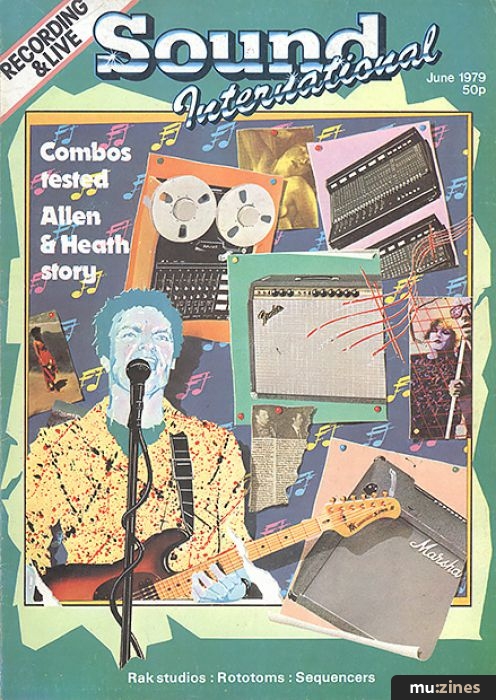
Sound International - Jun 1979
Donated & scanned by: David Thompson
Competition by Mel Lambert
Help Support The Things You Love
mu:zines is the result of thousands of hours of effort, and will require many thousands more going forward to reach our goals of getting all this content online.
If you value this resource, you can support this project - it really helps!
Donations for October 2026
Issues donated this month: 0
New issues that have been donated or scanned for us this month.
Funds donated this month: £0.00
All donations and support are gratefully appreciated - thank you.
Magazines Needed - Can You Help?
Do you have any of these magazine issues?
If so, and you can donate, lend or scan them to help complete our archive, please get in touch via the Contribute page - thanks!
Please Contribute to mu:zines by supplying magazines, scanning or donating funds. Thanks!
Monetary donations go towards site running costs, and the occasional coffee for me if there's anything left over!

 @mu_zines
 RSS Feed
 Blog