


Magazine Archive
Home -> Magazines -> Issues -> Articles in this issue -> View
Peavey Patriots | |
Article from In Tune, December 1984 | |
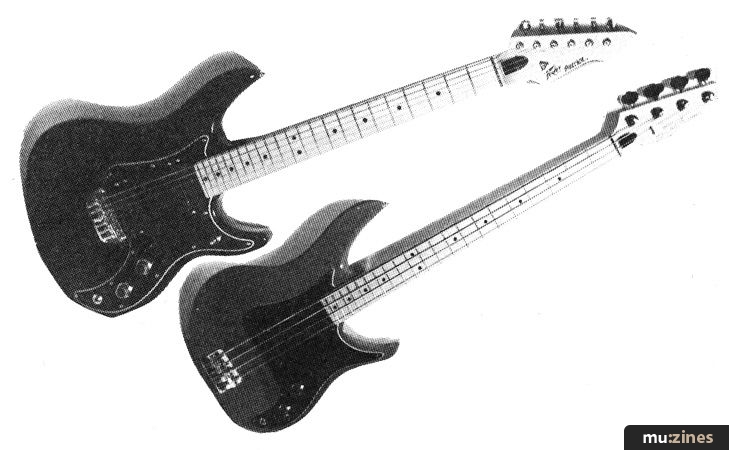
Peavey's original attempt at taking the guitar world by storm wasn't as successful in the Britain as in the U.S.A. But now, armed with new designs and attractive prices, they're destined to attack the Far Eastern domination of the lower-price guitar market head-on. IN TUNE assesses their latest basic models - the Peavey Patriots.
GUITAR
(RRP £143.75, inc. VAT, with Natural finish, £16.10 extra in Black, White, Red or Yellow)
Priced to compete directly with lower-cost Japanese-made guitars, the Peavey Patriot (quite probably a deliberate choice of name for their home market!) looks like a lot of guitar for your money - in terms of quality, if not in actual size. In fact from a dimensional point of view it's a fairly small-bodied instrument, quite light in weight and very comfortable to handle. With no disrespect intended whatsoever, it would be a good choice on these counts for physically small guitarists or young ladies with Rock 'n' Roll in their veins.
The Patriot's body material is described as 'hardwood' (which could imply just about any normally encountered guitar-making wood), and is well contoured on the back for comfort. Natural finish is the basic option, but a range of colours is offered at a small extra cost - likewise a very attractive black moulded plastic case, which will set you back an extra £28.75 if you buy it with the guitar.
To get the price of an American-made instrument down to that of a similar Japanese or Korean one, Peavey's manufacturing process has obviously been orientated towards automated production. In this it has obvious similarities to Fender - but that's not to say that it's a copy, just that the two makes have a similarity in their manufacturing approach.
A laminated maple neck, providing a 23 3/4" scale with 23 frets, is fastened to the body with four bolts. On our sample this gave a nicely rigid neck joint - even despite the 'neck tilt angle adjuster' which Peavey have opted for, despite Fender's previous failed attempts to popularise this idea. What it does is enable you to alter string height not via the bridge (although the saddles will adjust individually if you want), but by unfastening the neck fixing screws and then altering the neck angle - and hence the string height - via a screw on the neck joint plate. It seems a bit of a complex process to us, but does have the merit that it prevents you from completely messing-up saddle heights and the strings' curve against neck radius proportions. Only time will tell how popular this system becomes.
The rest of the Patriot is pretty conventional. Kluson-like machines adorn the headstock, and a graphite nut is used to eliminate any possible sticking string difficulties. This may be more useful on the tremolo equipped model (which adds an extra £32.77 inc VAT to the asking price), but it shows up-to-date ideas on Peavey's part.
Hardware is simple but effective. The bridge comprises individual spring-loaded saddles offering full adjustment, and two ideally positioned metallised controls with easy to grip ribbing (one volume and one tone) handle the output along with an over-size pickup selector switch. Peavey call this latter device 'military grade' - electrically and mechanically speaking it may well be, but it really is a bit clumsy-looking! Nonetheless, it's silent in operation.
The pickups fitted are two single coil units, each with single 'blade' pole-pieces. The idea here is to avoid notes fading-out as they sometimes do when strings are bent between traditional individual pole-pieces.
The Patriot is a particularly nice guitar to handle. Its bodily lightness and manoeuvrability are complemented with a neck carved on a 12" radius - almost flat to the touch. This makes string bending a doddle in that there is no pronounced neck camber to choke-off notes as strings are bent. The neck's maybe a little wide for some tastes, but it's still very fast. The fretting standard on our sample was also very good, medium/light, well contoured wire having been used.
The Patriot's sound is, again, very pleasing; in fact for all that it may look a bit basic, it plays very well and has a first class tone. There's plenty of high top provided by the bridge pickup (with a healthily high output for overdriving amps if required) and this changes to an unexpected warmth and depth when switched across to the neck pickup. Sustain is a fair average and the sound, while somewhat Fender-ish, is equally good for clean Country styles at one end and more head-banging uses at the other.
Overall, our feeling was that the Patriot would make a fine first or second guitar - especially for a younger player. It has a better sound than many of its Far Eastern-made competitors, is easy to play and should be mechanically reliable.
The Patriot looks, we'll admit, a bit plain and unassuming, but it both performs and sounds very well indeed. Don't be put-off by the spartan looks - it's a sturdy little guitar with a lot of player potential. Try it - we think you could be captivated by its undeniable value for money!
BASS
(RRP £182.85 inc. VAT, in Natural finish, £16.10 extra in colours)
If anything, the Patriot bass is quite a bit more like a Fender than is the Patriot guitar. It resembles a Precision rather closely, but that's probably inevitable - how many basses don't take something (often everything!) from Leo Fender's original?
The fairly dense-feeling body is made of maple if coloured, or of Southern ash if it's a natural-finished version, and feels good and weighty when strapped on. The neck is bolt-fastened to the body and, as with the Patriot guitar, it features a tilt adjuster to raise or lower the string height. Scale length on the Patriot bass is 24 3/4" and the neck has 23 frets, each very well finished on our review model, of a medium gauge and well contoured for speed and comfort. Hardware on the Patriot bass is as equally simple as that on the guitar. The machines are open-backed types, well geared and very accurate in use. There's a graphite nut and a triangular chromed string cleat to hold the D and G strings in place. The bridge is a direct Precision type and, for all its popularity as a design, this could (perhaps should) have been improved upon as some 'slappers and pullers' might find it possible to pull the saddles out of alignment if they're heavy handed. As it is, the bridge provides full adjustment, but it is, to say the least, a bit primitive.
The single pickup is, again, a single coil blade-type, but this time completely sealed inside a moulded casing. It's wired to single volume and tone controls, again well-placed and easy to grip.
From a playing point of view the Peavey may look like a Precision but the neck feels quite different. It has a flatter-feeling camber and, although quite wide, is extremely fast as it's quite shallow in depth. Access to the top frets is fine and most bass players should find this a very comfortable neck to use, even on long sets.
Tonally, with a maple body and neck combined with a single coil pickup, the Patriot bass has a hard and driving sound - ideally suited to modern tastes. It's a bright and alive instrument with absolutely nothing muffled in the basic sound. It will (if you back-off the tone control) produce a deeper, warmer tone, but it's fundamentally got an up-front sound. Our sample (with brand new strings on, of course) sounded particularly vivacious and we'd say that it would go down especially well with either funky or hard-Rock styles.
At the price, the Patriot bass does have some fairly strong competition but it's a very rewarding instrument to play and has a more distinctive sound than many of the countless 'me too' designs around in this price range. Again, it looks like a good buy and we can certainly recommend you to try it with the expectation that you're unlikely to be disappointed.
More details from Peavey (U.K.) Ltd., (Contact Details).
Publisher: In Tune - Moving Music Ltd.
The current copyright owner/s of this content may differ from the originally published copyright notice.
More details on copyright ownership...

In Tune - Dec 1984
Donated by: Gordon Reid
Review
Help Support The Things You Love
mu:zines is the result of thousands of hours of effort, and will require many thousands more going forward to reach our goals of getting all this content online.
If you value this resource, you can support this project - it really helps!
Donations for July 2026
Issues donated this month: 0
New issues that have been donated or scanned for us this month.
Funds donated this month: £0.00
All donations and support are gratefully appreciated - thank you.
Magazines Needed - Can You Help?
Do you have any of these magazine issues?
If so, and you can donate, lend or scan them to help complete our archive, please get in touch via the Contribute page - thanks!
Please Contribute to mu:zines by supplying magazines, scanning or donating funds. Thanks!
Monetary donations go towards site running costs, and the occasional coffee for me if there's anything left over!

 @mu_zines
 RSS Feed
 Blog
Blog