


Magazine Archive
Home -> Magazines -> Issues -> Articles in this issue -> View
Article Group: | |
Product News | |
Article from Electronic Soundmaker & Computer Music, March 1984 | |
Heavy Metal Rules
If Richie Blackmore, Gary Moore, or Michael Schenker is your favourite guitarist, the Boss HM-2 Heavy Metal is your favourite pedal.
It's purpose-designed to give the powerful, harmonically rich sound of heavyweight valve heads driving 4 x 12's. It's not an Overdrive and it's not a Distortion — because it can do all that these can do — and more. The secret is in a unique Colour Control system which can be used to boost the highs for a hotter sound with a hard edge, or fatten out the mid frequencies for really full, heavy sounds.
And not only will the HM-2 do things to a small amplifier that you simply won't believe, but it also has an exclusive dynamic sensitivity that can add an extra dimension to guitar technique. Play a soft passage and the sound of the guitar is natural or only slightly warmed up.
But soar into a solo and the pedal responds to the more powerful dynamics of your playing by cutting loose its full sustain and power.
The HM-2 is a remarkable new addition to the guitar hero's arsenal and not least remarkable is that it costs just £49.00 inc. VAT.
SLICK MIX

Frankfurt sees the launch of two new mixers from Boss.
The BX-400 and the BX-600 are respectively 4:1 and 6:2 designs. They're mixing desks stripped for action - pared down to essentials but boasting an audio specification comparable with expensive pro desks (after all, they may well be used in large sound systems as submixers for keyboards or microphones). Unlike some small mixers they're bug free, foolproof and compatible with just about any instruments or equipment.
The BX-400 has mike/instruments/line pads on each channel plus a simple rotary gain control and a master volume. An LED peak meter will warn of overload and there's plenty of headroom on the output. Which means this unit will ensure a clean sound without clipping distortion.
The BX600 is more sophisticated design with gain, volume, effect and panpot controls on each channel, twin master volumes and twin effect masters. There is effects send and stereo effects return. If not using an effect the send can be used for a monitor output and the returns for two auxiliary channel inputs, making an 8/2 mixer.
The Boss mixers are efficient and cost-effective in stage and home studio applications, an inexpensive, reliable way to get the best out of your band or instrument system.
The Playbus Challenge
Play Bus is the new all-purpose portable amp system from Boss.
It's so effective that Roland are taking a leaf out of a well-known food manufacturer's book and challenging you to make a comparison.
The procedure is simple. Just turn up at your local Boss dealer's with your own instrument and, if you like, your own amplifier. Then turn up the Boss Bus, put on the headphone microphone unit supplied with the bus itself. And play. And if you don't like the sound from the Boss Bus better than your own amplifier, the dealer will clean your ears out free of charge. (For the fairest comparison, make a recording first from the conventional amp and then from the Play Bus to avoid having to compare airborne with headphone sound.) This unprecedented offer expires soon, so don't delay in checking out the Play Bus. Your dealer will demonstrate how it can take the place of a stage amplifier, a studio amplifier, and how several can be linked up for group practise and recording. He will show you a sound capability that rivals the most sophisticated instrument amplifiers with built-in continuously variable Gain/Drive, Bass, Treble, Volume, Stereo Chorus with Rate and Depth control and even a built-in noise gate, paradoxically this pocketful of power gives some of the warmest, raunchiest overdrive around: Roland are confidently waiting for the first HM band to appear on stage using Play Buses linked to the PA and a backdrop of amp heads and 4x12's made of cardboard. The Stereo Chorus is comparable with the Jazz Chorus and Chorus Cube, and Reverb and Echo can be achieved by altering the rate and depth settings. Because of the sophisticated delay section the Play Bus can add fullness and power to vocals which is why it comes already supplied with microphones as well as headphone set.
The Play Bus is already becoming standard equipment for pro musicians who appreciate its convenience and versatility for practise and rehearsal. But for many more small bands, the Play Bus is all the 'back line' they're ever going to need. Especially since whoever opts for the Play Bus route will find it completely bypasses the problem of rehearsal space and equipment shifting.
Roland put Space in Bass
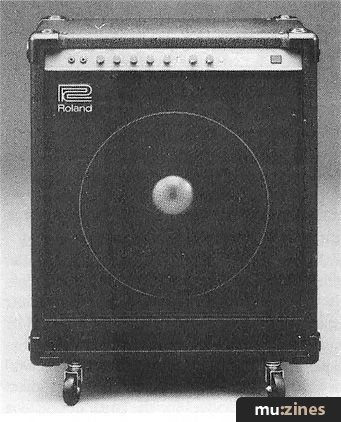
Roland BN-100: Bass chorus for £679
Roland are rapidly becoming one of the largest amplifier manufacturers in the world with a consistent policy of providing something for everyone.
The new BN-100 and BN-60 bass combos are in the Jazz Chorus tradition of professional amplifiers to prestige specifications. They are however completely original designs and for the first time offer a built-in chorus facility specially designed to work in the bass frequencies.
The amplifiers are respectively 100 and 60 watts. They have active 4-band Eq with bypass switch for natural guitar sound. New heavy duty 38cm speakers are used. A preamp output is provided as well as line out and a separate output for Chorus. The Chorus can be kicked in by footswitch and has rate and depth controls on the front panel. A cannon type connecting socket is provided on the Line Out.
Because there is a separate Chorus output stereo Chorus can be achieved by connecting this to a second amplifier, and the end result is a degree of power and dimension that no other amplifier has ever given to Bass players. The BN-100 and BN-60 should be compared with the British and American heavyweight bass machines that sell for around the £1,000 mark.
Mother of Invention
There will always be those who don't want to be tied down to a single instrument design, however versatile. Such musicians - or producers or studio owners or whatever they might be — tend to spend tremendous amounts of money buying everything on the market because every instrument has something that no other quite does in the same way.
And such people are the obvious customers for modular systems. Now, Roland have introduced a MIDI—based modular system that will be more versatile and more economical than anything that has gone before it. The modules will be rack mounted and will cover every aspect of synthesis. They will of course be capable of being driven by any MIDI keyboard but a special 'Mother Keyboard', the MKB-1000, has been introduced as the nucleus of the new system. The keyboard is purely a driver. It has an 88-note scale and uses wooden, weighted keys to the standard of the finest concert grands. It is dynamic sensitive and has programmable floating split with Whole or Dual modes.
The MKB-1000 connects to its various sound modules by a single standard MIDI cable, and the first two modules, a piano and a synthesizer (similar to the JX-3P) will be shown at Frankfurt.
MSQ-700 — The World's First MIDI Sequencer
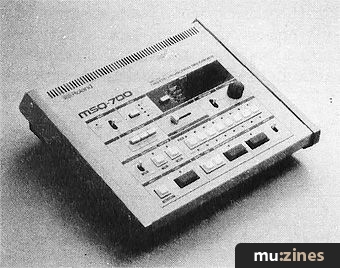
The MSQ-700 is a centre of attraction at Frankfurt 1984 because it's a product that reaches far into the future. As the first ever MIDI microcomposer (with DCB capability into the bargain) it's ideal not only for Roland synths but any new Sequential Circuits, Korg, Yamaha or other models using the system.
The MSQ can be programmed in real time or step time. You can treat it like a digital tape recorder and simply play into it, recording one of the eight tracks at a time and 'mixing down' to produce layering and other multitrack effects. Or you can programme in step time. There are 6,700 notes available — memory enough for a couple of albums at least! When programming in real time a special 'resolution' control can be used if desired to 'correct' the performance to the nearest half, quarter or whatever fraction of a note is required. Tracks can be recorded and then 'chained' together in the required order.
Used with MIDI instruments, the great advantage of the MSQ-700 is that it is not just a triggering machine, but can remember all MIDI parameters. This means it can remember patches and so alter the sounds of the controlled synthesizer, it can remember pitch bend, keyboard split, hold, dynamics and so on. Thus for the first time a microcomposer can play a complex piece with a variety of different sounds and effects without someone having to adjust the synthesizer to produce those sounds. And because MIDI is a multi-channel system one MSQ-700 can control more than one synthesizer. This revolutionary development means that a band can play an entire stage set while in the pub across the road.
The MSQ-700 can interface with most Roland products, from the Drumatix to the Jupiter 6 and Jupiter 8. It has a tape sync out facility which gives perfect synchronisation to a recorder for multi tracking. A cassette interface is provided to store programmes for re-loading later.
In this latest of the Roland microcomposers, it is possible to glimpse the true potential and versatility of a MIDI-based interface system. And in doing so, to glimpse the future.
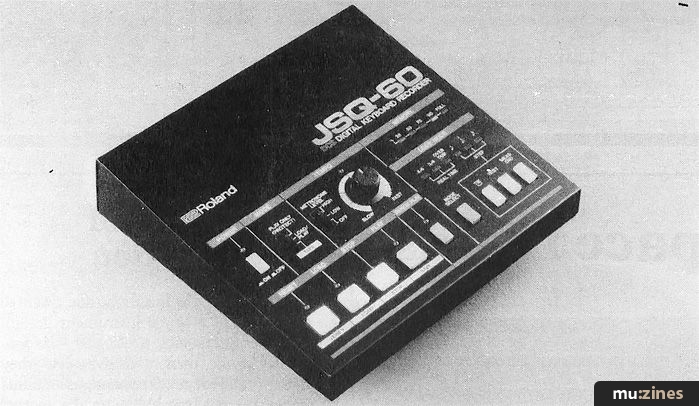
Juno Recorder
The new JSQ-60 belongs to the same digital generation as the MSQ-700 but is designed as a polyphonic sequencer for DCB products such as the Juno 60 and the Jupiter 8A. It can also be used with any MIDI product by means of the MD-8 interface device.
The sequencer can record up to 2,500 notes and can be programmed in step or real time. It can memorize not only notes but sounds too by recording patch shift data on the Juno 60 or patch preset data on the JP-8. Like the MSQ-700 this sequencer will often be used as a digital multitrack since layering and overdub techniques are possible.
Sync outs are provided for interface with the TR-606, TR-808, TB-303 or MC-202. Once a piece is recorded it can be saved by a cassette dump system.
The JSQ-60 costs just £250 — a most economical accessory that will give your DCB synth the capabilities of a microcomposer.
Free Sequencer with Every Delay Machine
Yes, every time you buy one of the new Roland Digital delays, you get a versatile sequencing device into the bargain.
In fact, you get it in one and the same unit. Take the SDE-3000 which lists as just under £800. Naturally it has a full range of delay functions plus modulation and phase reversal. Conveniently it has a maximum delay of 4.5 seconds. But with such a long delay it is possible to play a coherent pattern of up to 15 or 20 notes, each of which is reproduced perfectly by the 16-bit ADA chips. To provide a sequencer all Roland needed to do was add a 'Hold' function which enabled the sampled sound to be repeated indefinitely without degradation. Just to put icing on the cake, the programmes are still remembered when the unit is switched off. Tempo can be adjusted for the repetition.
Delay in some form or other is probably the most widely used special effect in existence — even to the extent that for example vocals are liable to sound flat and unconvincing without a touch of 'dimension'. Digital delays are the best but also the most expensive, so it helps that with the eight-programme Roland SDE-3000 or the four-programme SDE-1000 you effectively get two devices for the price of one — a studio calibre sound processor and an extra programmable source which can be interfaced with an electronic music system. Indeed, you can even flick from one mode to the other with a footswitch controlled programme change.
The SDE-3000 and SDE-1000 retail at £399 and £799 inc. VAT and are available now at all Roland dealers.
COMING SOON
A Guitar Synthesizer to end all Guitar Synthesizers
Imagine a guitar synthesizer module with a wealth of sounds comparable with a good poly synthesizer. Imagine a guitar synthesizer module which can actually be linked to a keyboard or drum machine so that either of these can be directly played by the guitarist. Imagine a guitar controller which is purpose-designed for synthesis, which is easily the most imaginative yet playable design since Leo Fender's originals — not an over-the-top poser but a genuinely new concept in guitar design. Imagine two components that are radically new, yet completely compatible and interchangeable with existing guitar controllers and synthesis modules. Alternatively, if your imagination is not up to it, wait for our next 'Newslink' for full details.
Doctor on Display
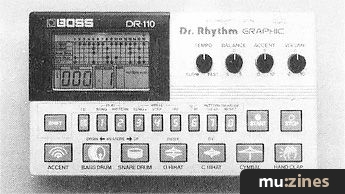
Boss have announced a spectacular update for the world's most famous rhythm machine, the DR-55 programmable Doctor Rhythm.
The new Doctor, called the DR-110 Graphic, dramatically improves on the 'user friendliness' of the previous Doctor Rhythm yet despite being child's play to programme, is infinitely more versatile.
The key to this achievement is the LCD Graphic display, which takes up almost a quarter of the control panel. This features a special grid which shows how you have programmed each 16 or 12 note pattern: a sort of built-in notebook which enables you to keep track of what you're doing. The DR-110 is a very sophisticated instrument which comes complete with 16 built in rhythm patterns and allows a further 16 to be user programmed. When the patterns have all been programmed they can be played in any required sequence to create two 128 bar rhythm parts. The patterns are arranged in four banks, and the pattern composition grid, the track (one or two) the bank (a, b, c, and d), the particular pattern (one to 32), and the mode (write, song, play, pattern play etc) are simultaneously displayed on the screen. As most people who have used an advanced rhythm composer are aware, the greatest problem is 'losing your place' in the middle of a complex rhythm part. With the DR-110 you're kept fully informed of what's going on, so programming is much quicker and simpler.
The new Doctor features bass, snare, open and closed hi hat, cymbal and handclap sounds plus accent. These can be played with fingers to give a performance or to programme in real time. It has controls for accent, volume balance (between drum and cymbal sounds) and tempo. It's battery powered and almost pocket size, and priced to become the biggest contemporary music success story for 1984. The Doctor Rhythm is dead — long live the Doctor Rhythm.
Two Technologies Get in Rhythm
The long awaited TR-909 is Roland's new flagship rhythm box and is the first ever to combine the advantages of digital and analogue technology in one unit.
This means that TR-909 sounds are able to offer the best of both worlds, and the unit can do things that are impossible for purely digital units because they are restricted by the technology they use.
Extensive research showed that neither digital nor analogue technology is clearly superior. It was found that for some sounds, notably the cymbals, the accuracy and cleanness of digital sampling could not be beaten. On the other hand, for really strong, gutsy drum sounds Roland have found ways of using analogue technology that gives a better result than the rather 'clinical' digital sampling. Just as, for example, a lead line synth like the SH-101 will not and cannot be replaced by a digital instrument because an analogue sound source is much more punchy.
As a result, the TR-909 is designed with digital cymbal sounds but analogue drum sounds. All the sounds are based on completely new circuits and represent a refinement on anything that's gone before. There are also certain bonuses from using this hybrid concept. For example on the drum section you can alter one parameter of the sound without effecting any other: something that's impossible on a digital machine. For instance with a digital system if the toms are tuned higher you get a shorter note: with the Roland you don't. Again, a digital sound is identical whether it's played quietly or loudly, but a natural drum sound changes character when the drum is hit lightly (you can hear the skin). With Roland's analogue sounds, the natural drum effect of the sound changing when it is softer is rendered faithfully. There are separate buttons for 'loud' or 'quiet' independent of overall accent and the 'kit' operates on three dynamic levels.
The TR-909 also performs in stereo: a stereo image is 'pre-panned' or alternatively the separate outputs for each drum can be mixed externally.
The new machine has a range of drum, cymbal and other percussion sounds that is little short of spectacular and the memory capacity is 896 bars x 4 two banks. There are eight different degrees of flam and shuffle in addition to the normal time setting facilities. Tempo can be pre-programmed.
Last but not least, the TR909 is the first MIDI drum machine ever. This means it's compatible with the MSQ-700 sequencer and all present and future MIDI products by Roland and others. An interesting consequence of this is that the machine can be played by a keyboard or the GR-700 guitar synth — and both guitarists and keyboard players will achieve unusual effects when they develop their existing technique to play drums.
The TR-909 is highly competitive and dealers can be encouraged to put it alongside any digital unit currently available. Hybrid technology linked to MIDI technology will effectively drum the opposition out of town.
Percussion Synthesizer for £63

Roland drum machines now give the most convincing drum sounds to be heard, but there is also a trend for percussion sounds which are creative rather than imitative. The Percussion Synthesizer will give a wide variety of such sounds including most of the 'electronic' drum sounds favoured by contemporary musicians. There are controls for sensitivity, pitch, decay, sweep, rate and depth (an LFO as well as a VCO is provided) and slide switch for LFO wave form. The Percussion Synthesizer will give a wide variety of such sounds including most of the 'electronic' drum sounds favoured by contemporary musicians. There are controls for sensitivity, pitch, decay, sweep, rate and depth (an LFO as well as a VCO is provided) and slide switch for LFO wave form. The Percussion Synthesizer can add a pure-electronics dimension to any Roland drum machine by being linked to a trigger output, where it can be programmed just as if it were one of the on-board drum sounds.
A Big Hand for Drum Machines
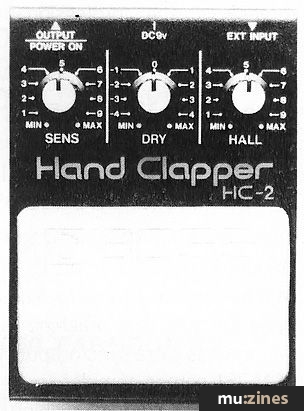
The Boss HC-2 Hand Clapper can either be used on the trigger output of a drum machine or can be struck manually by means of a pad. It gives a wide range of handclap sounds from 'dry' to 'thick'. Power is by nine volt battery or a mains adapter and the handclap unit costs £49.00 inc. VAT.
Publisher: Electronic Soundmaker & Computer Music - Cover Publications Ltd, Northern & Shell Ltd.
The current copyright owner/s of this content may differ from the originally published copyright notice.
More details on copyright ownership...

Electronic Soundmaker - Mar 1984
Donated & scanned by: Mike Gorman
Roland Newslink
News by Roland UK
Help Support The Things You Love
mu:zines is the result of thousands of hours of effort, and will require many thousands more going forward to reach our goals of getting all this content online.
If you value this resource, you can support this project - it really helps!
Donations for April 2026
Issues donated this month: 0
New issues that have been donated or scanned for us this month.
Funds donated this month: £0.00
All donations and support are gratefully appreciated - thank you.
Magazines Needed - Can You Help?
Do you have any of these magazine issues?
If so, and you can donate, lend or scan them to help complete our archive, please get in touch via the Contribute page - thanks!
Please Contribute to mu:zines by supplying magazines, scanning or donating funds. Thanks!
Monetary donations go towards site running costs, and the occasional coffee for me if there's anything left over!

 @mu_zines
 RSS Feed
 Blog
Blog