


Magazine Archive
Home -> Magazines -> Issues -> Articles in this issue -> View
Pulse Six-String | |
Article from One Two Testing, October 1985 | |
small and perfectly cheap
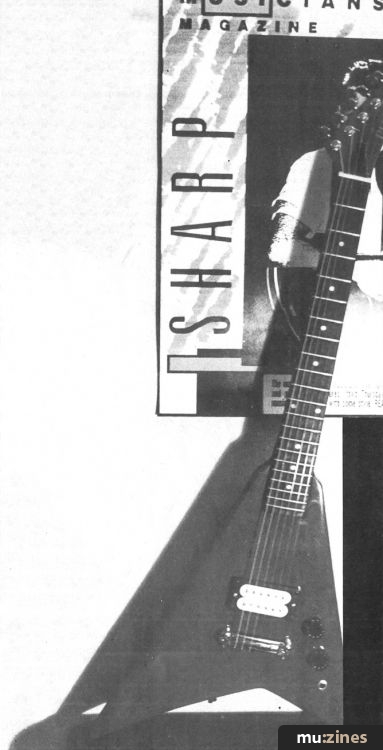
WHAT CAN YOU GET for £70 these days? Well, apart from 412 Mars Bars, 50 copies of One Two, 14 sets of strings, and about a third of a Gibson Flying V, you could lavish your moola on the subject of this review.
Barnes & Mullins have procured from the craft shops of Korea the Pulse series of six-string electric guitars. The three models illustrated in B&M's voluminous catalogue each come with one twin-coil humbucking pickup and one volume knob. The shapes range from the mutant "star" of the 2144, via the Stratocaster-esque curves of the 2143, to the foreshortened V of our review model, the 2142, the guitars all sharing the angled 'Kramer' headstock, with strings splaying out from the white plastic nut.
Our guitar, though still priced at £70, came with both tone and volume controls. Veritably a bargain, even if no-one could ascertain whether the tone was now standard to all types.
Here comes the bright blue guitar (white, black and red are also available). It looks small. Measure it and see that it's only 1½in less than a Strat from bridge to nut. Pick it up and find that it weighs very little though still manages to be well-balanced on a strap (though being V-shaped, it doesn't like sitting on your knee). According to B&M, construction material for both neck and body (excluding the fingerboard) is "nato", a Filipino mahogany substitute renowned more for its defensive properties and fancied by cabinet makers for drawers.
Machine heads are open cogs of the most basic sort, though there are six individual ones and they function tolerably well (which proved fortunate). The neck is fat and semi-circular in profile, with 21 equally fat (though not Gibsonian) frets mounted on a very pleasant rosewood fingerboard. The playing surface is wide, and the strings are mounted a comfortable distance in from the edge. Nice.
The neck/body joint is a four-bolt chrome-plate job which is better finished than many guitars of three times the price — a snug fit, and no room to wedge a plectrum at all. One annoyance about this area is the location of the strap button on the heel of the neck just before it disappears into the body, as it can catch your hand on its way up to the 21st fret. Not too much of an annoyance, though.
No scratchplate is allowed to mar the celestial blueness of the Pulse, which means the adjustable humbucker sits on naked polyurethane. Handily below and behind lie the volume and tone controls, just ripe for those Steve Howe violinings; nice smooth response they offer, with no great leaps in noise factor.
The bridge is an all-in-one tailpiece assembly, with the strings passing through from the neck side, then doubling back over the metal bar. It's mounted on two pegs which are height adjustable, and the whole bar (by virtue of two scruffy looking screws) can be moved lengthways. The method is crude but, with the aid of a stepped upper surface to the bridge (cf most acoustics), is effective, as the intonation was fine.
So what do you get for £70? A guitar, that needs setting up and re-stringing, to start with. One wind round the tuning peg is not enough for yer average B string, as the Pulse was only too happy to prove, slipping about at the slightest opportunity.
When it would stay in tune, it was obvious that there was too much daylight under the wires; so out comes the office screwdriver, and down comes the action. Mmmm, nice: twang twang twiddle twang bend twang plunk. "Plunk"? "Plunk", indeed, goes the G-string at the sixth; "clank" goes the D-string at the sixth. Oh dear, a high fret.
High frets aren't the end of the world, and any shop attempting to sell you a guitar (even for only £70) should be willing to cure the ailment for you. Don't take any bullshit, just take your money elsewhere if they refuse. And if you're thinking of buying the Pulse as a first guitar, get a knowledgeable friend to look at it with you. The problems that occurred with my review model are unlikely to affect all the others, but it's best to check.
It doesn't sound like only £70 worth of guitar. The treble/bridge position humbucker is pleasantly noisy, and reacts well to the tone and volume controls; "volume" does not cut off the upper frequencies, while "tone" does, in such a way as to make the Pulse sound warmer rather than muffled. It sustains nicely, too. A very pleasant little guitar to tootle about with.
Those used to more substantial noise boxes like Gibson, Fender, Aria and so on will find the Pulse light and insubstantial to hold and play; though it sounds large enough, it feels too small to be taken seriously. This is a mistake. This guitar costs £70, which is cheap. Find one without a dodgy fret, and you find yourself a bargain.
PULSE six string: £72
CONTACT: Barnes & Mullins, (Contact Details).
Publisher: One Two Testing - IPC Magazines Ltd, Northern & Shell Ltd.
The current copyright owner/s of this content may differ from the originally published copyright notice.
More details on copyright ownership...

One Two Testing - Oct 1985
Donated by: Angelinda
Review by Jon Lewin
Help Support The Things You Love
mu:zines is the result of thousands of hours of effort, and will require many thousands more going forward to reach our goals of getting all this content online.
If you value this resource, you can support this project - it really helps!
Donations for May 2026
Issues donated this month: 0
New issues that have been donated or scanned for us this month.
Funds donated this month: £0.00
All donations and support are gratefully appreciated - thank you.
Magazines Needed - Can You Help?
Do you have any of these magazine issues?
If so, and you can donate, lend or scan them to help complete our archive, please get in touch via the Contribute page - thanks!
If you're enjoying the site, please consider supporting me to help build this archive...
...with a one time Donation, or a recurring Donation of just £2 a month. It really helps - thank you!

 @mu_zines
 RSS Feed
 Blog
Blog