


Magazine Archive
Home -> Magazines -> Issues -> Articles in this issue -> View
Record Talkback | |
EuropeansArticle from Electronic Soundmaker & Computer Music, November 1983 | |
Recognising Europeans
Paul Coster recognises a new album as Europeans
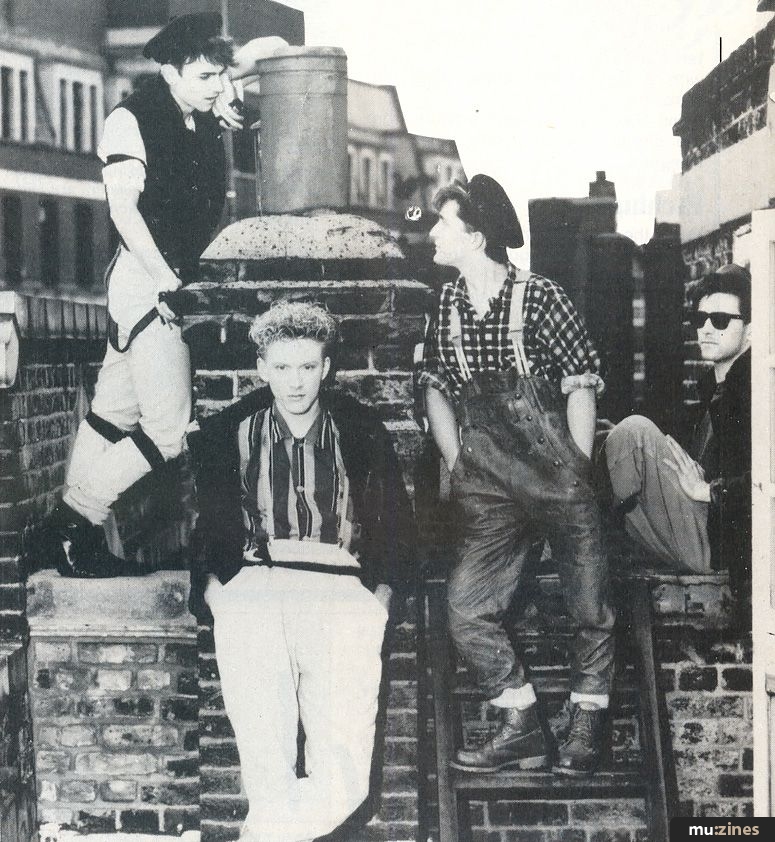
Every now and again, from amongst the morass of synthesised sounds emerging from an oft-times stagnant chart, a new band produces a single that receives few accolades and subsequently fades into oblivion. For most aspiring chart-toppers, this is sufficiently depressing to cause nagging doubts about continuing in the business — they fade away with the record. It is refreshing, then, to find an innovative and exciting electronic band, who have not been deterred by the potential despondency surrounding one such setback. They are Europeans — bubbling under, ready to break as A&M's latest cause celebre.
Their current single — American People — is primed for the charts and the first album, on A&M, should be in the shops as you read this. It is a combination of electronic rock and off-beat, yet steeped in harmony, new wave music. Reminiscent of XTC with strands of Gabriel, though considerably different from either, the album takes a while to assimilate stylistically. However, as someone who is extremely wary of bands riding on the back of heavy promotion from their record company, the learning process was surprisingly memorable.
Boys In The Band
Europeans are four multi-talented musicians whose only assent to contemporary style is the instrument line-up — drums, guitar, keyboards and bass. Not that they're content with just any instruments, as Steve (keyboards) was quick to stress: "We are all fairly critical about the equipment we use." The band — Steve Hogarth, Fergus Harper, Geoff Dugmore and Colin Woore — recovering from the bereavement of having had most of their gear stolen, still use quite a selection. Colin (guitar) plays a Roger Giffen Custom Telecaster, an old 50W Marshall and "...a couple of beaten up Celestions in an old H&H cabinet". For keyboards, Steve uses Minimoog, Jupiter 8, Wave 2, Yamaha CP70 and various other pianos. Also, the album includes some Fairlight and sound effects from an ARP Odyssey. The drummer, Geoff, who's possibly the most particular about 'that final sound', has a Gretsch kit with power toms (deep shells), Rogers snare, Octobans, Roto-toms "...and make sure you mention the Paiste cymbals." In addition to these 'live' drums, Geoff also arranged to have some sounds put onto PROMs for the LinnDrum — rumour is that Roger is using some of these as standard issue!
Back to basics (sorry about the pun), Ferg the bass player, uses Wal Active Eq, Aria Pro Fretless and a hired Fender Precision. These are played through an Amcron DC300, Mega cabinet and Roland Pre-amp. He also has a Music-Man Stingray (for live work), Trace-Elliot amp and collected Roland pedals. And Mark Thomson, who's no slouch when it comes to 'freebies' in exchange for mentioning manufacturers' names (he's also the band's manager) casually added that all of them "like Porsches as well, if anyone out there is listening" (...and so do I, for that matter).
Bath Time!
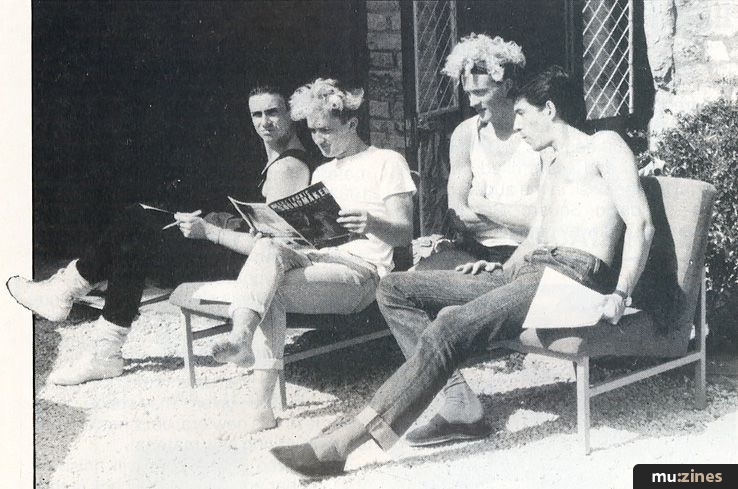
Europeans' record company, A&M, invited selected members of the press — young master Horkins (IM) and me — down to Crescent Studios in Bath to see and hear them 'in action', remixing some tracks previously recorded at The Townhouse (Vic Coppersmith producing). Steve takes up the story: "We came down to Bath to re-record some of the songs on the album. No disrespect to Vic whatsoever, because it worked as it was, it worked very well, but since we recorded the songs we've been playing live a lot and we changed aspects of a few of the songs. We've also come here to try a couple of remixes". These were being done by David Lord of Pete Gabriel fame. "David remixed our single Recognition — Vic Coppersmith recorded it over at The Townhouse early this year and David Lord remixed it a couple of weeks ago".
"Since we recorded the songs we've been playing live a lot and we changed aspects of a few songs..."
Recognition is an up-tempo piece, with fanfare synthesizer and Kiki Dee on backing vocals. It is no surprise that the band got David Lord, as well as an American DJ ('Jelly Bean'), to do 12" versions for clubs and discos — it's pretty addictive stuff!
I wondered if the band might have been slightly 'left out' with all this mixing and re-mixing going on, but that didn't seem to be the case. Geoff elucidated: "I think that on this whole session there have been points where we haven't agreed — that's great because obviously we have a very definite view of how we perhaps think something should be. But in a way we're so close to the songs that it's always difficult to be too objective about it — it's really helpful when there's an outside person saying, 'Well, you know, believe me, I think this works better this way."
The week at Bath was going so well that the band's manager requested time to remix the whole album. So, what had started as minor changes to three tracks — Recognition, American People and Falling — turned into a comprehensive revision (working with the original recording) of the whole album. The final result: 10 tracks conceptualised in March '83, then updated during August to include several 'live nuances' — it seems to have worked extremely well. The best example of the kind of enhancements that Europeans achieved is to be found on Falling. This is full of extra drum beats giving a very punchy sound, with flanged, strummed guitar and strong vocals. Having listened to both the Townhouse and Crescent versions of the song, there's no doubt that the time spent has added an exciting dimension to the final sound.
"We were deliberately trying not to be fashionable... we wanted a name that was wide-ranging."
The same is true of American People — an immediately appealing piece with a catchy chorus and some subtle piano and reverse attack percussion. Top this with a middle section reminiscent of Phil Collins and there's a definite impression of popular rock.
"The album will be current, it won't reflect something that was recorded at the beginning of the year — it will be very much what we're doing now". Illustrating this, Voice On The Telephone was not fully completed at The Townhouse and The Manor, so the band had the opportunity to add some "bits". The finished song is slightly lighter and more conventional than those mentioned so far, soundly similar to recent Roxy Music.
"Songwriting is a fusion process of four brains going at once..."
What's In A Name
The next few minutes of the interview were possibly the most entertaining, as a minion of the local watering hole (where else does one do interviews!?) suddenly decided to 'water' the patrons. Intense drama followed as a vain attempt was made to rescue the manager's jacket from this unprovoked attack... after he'd picked it up and brushed it off, there were a few moments of respectful silence, providing a clear shot at the 'Why call the band Europeans' question — it proved to be a toughie.
"We were wondering what to call the band — we thought, what about Death...Cult...Club...Gang...Society." They even thought of 'Genesis', but "that was already used... so we called it Europeans" (quite logical really). "We liked the name — it didn't sound too transient. We were deliberately trying not to be fashionable — didn't want a name that was fashionable, we wanted a name that was wide-ranging."
This democratic attitude obviously extended to song writing, as evidenced by the drummer's not insubstantial monologue on the subject. "What generally happens is that I come up with a musical idea on the piano, which I can't play — so, right away we're stuck with an interesting thing. All I do is just sit at the keyboard until I find something that sounds nice to my ear, which usually sounds hideous to the rest of the band. Then Colin has the arduous task of transferring all these notes into guitar chords, which usually means he's doubled up." Steve takes up the story: "Our first single — Animal Song (a primitive rocky number with pulsating bass line and some unusual percussive breaks) — was written musically by Colin and lyrically by Ferg from an idea by me. So, it's not like we've got somebody sitting down saying 'Here we are, this is the song, this is the music — let's arrange it'. It quite literally is — and I hate to use this word 'cos it's an old hat word — a fusion process of four brains going at once."
Geoff continued with a pertinent example: "There was one particular thing that happened on two or three of the tracks, to do with the drums. We recorded the drums on a single microphone way up on the ceiling, then compressed it to hell so it was like a kind of crackling sound — we used it on a track called 'Innocence'." This is fast and lively with a slow build up and Gabriel-like atmospherics. As with most of the group's songs, the title reflects fairly well the subject — in this case, it's childhood's freedom from inhibitions.
Another track which includes highly compressed drums, is called Going To Work. Sadly, it's not included on the album, but does form part of the band's live show, currently travelling the country, and due at the City of London Poly and LSE on 21st and 22nd of October respectively — it's well worth catching the performance. I recently attended the gig at Dingwalls and despite Steve almost losing his voice (and his temper with a rather self-willed microphone stand), the show went very well. I just hope the gear can stand up to successive 'treatments' as the tour progresses!
Power And Glory
The remaining tracks on the album are a mixture of slow, haunting melodies, with delicate piano, and beat-oriented 'power-pop' with screeching solos and multiple voice harmonies. All of the songs are held together by resounding drums and rhythmic bass — quite an achievement considering the range and depth of Ferg's vocals.
The ability to play, sing and perform without detriment to the songs, is for me the single most notable aspect of Europeans. It should ensure they continue on the road to success.
More with this artist
 So You Say - Geoff Dugmore (Europeans) |
Publisher: Electronic Soundmaker & Computer Music - Cover Publications Ltd, Northern & Shell Ltd.
The current copyright owner/s of this content may differ from the originally published copyright notice.
More details on copyright ownership...

Electronic Soundmaker - Nov 1983
Donated & scanned by: Mike Gorman
Feature by Paul Coster
Help Support The Things You Love
mu:zines is the result of thousands of hours of effort, and will require many thousands more going forward to reach our goals of getting all this content online.
If you value this resource, you can support this project - it really helps!
Donations for June 2026
Issues donated this month: 0
New issues that have been donated or scanned for us this month.
Funds donated this month: £0.00
All donations and support are gratefully appreciated - thank you.
Magazines Needed - Can You Help?
Do you have any of these magazine issues?
If so, and you can donate, lend or scan them to help complete our archive, please get in touch via the Contribute page - thanks!
If you're enjoying the site, please consider supporting me to help build this archive...
...with a one time Donation, or a recurring Donation of just £2 a month. It really helps - thank you!

 @mu_zines
 RSS Feed
 Blog
Blog