


Magazine Archive
Home -> Magazines -> Issues -> Articles in this issue -> View
Rocket 'n' Roll It | |
Ampeg Reverberocket R-212R Valve Guitar ComboArticle from Sound On Stage, January 1997 | |
Paul White heads for the stars with the Ampeg Reverberocket — an unashamedly retro-styled 50 Watt, all valve guitar combo.
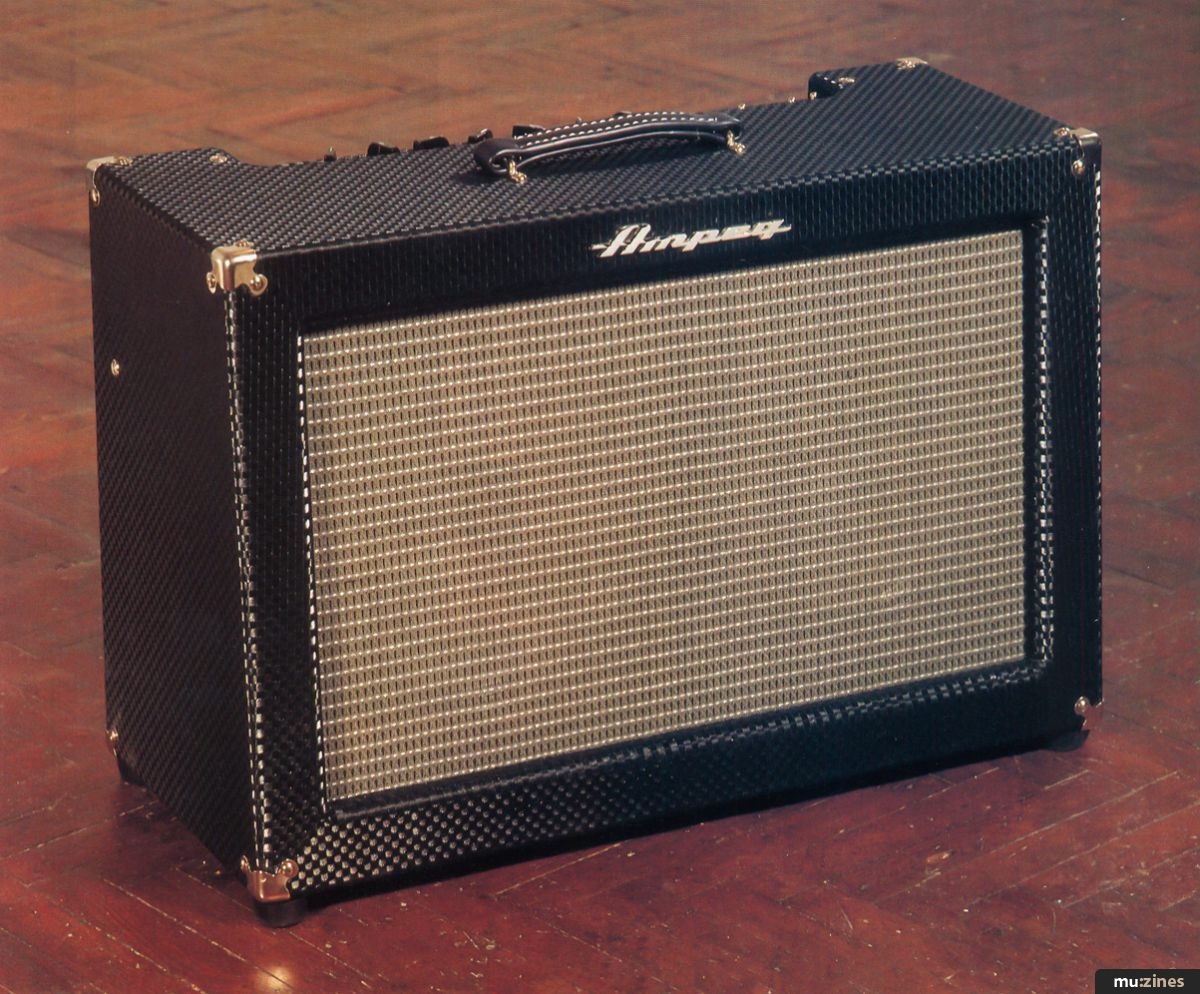
Although Ampeg is one of the longest lived names in American amplifier history, I get the impression that few people really know what to think about them. Most players will have heard of the company, and most will tell you that its products are supposed to be good, but how many have actually used them? I have to admit that I too fell into this category until recently.
The Reverberocket is a deliberate throwback to the 1960s in name, circuit design, and presentation — the low gain input socket is even labelled Accordion, although I doubt if it will ever be used as such! Everything about the amplifier is traditional, from the open-backed speaker cabinet to the spring reverb nestling in its vinyl bag in the bottom of the cabinet. Unusually for an American amp, however, is the choice of EL34 output valves, which are more normally associated with British amplifiers. Americans tend to steer more towards 6L6s and the like, and as will be seen later, this gives the amp something of a mid-Atlantic sound.
Essentially, today's Reverberocket is a 50 Watt, all valve, open-backed combo, with simple clean/dirty channel switching. All the controls are common to both channels, except the Gain and Master controls used to set the dirty channel overdrive and level; Reverb affects both channels. An optional dual footswitch may be used to switch channels and to turn the reverb on and off.
Constructionally, the amplifier follows the usual valve combo design — the chassis is mounted upside down at the top of the cabinet so the valves hang down into the cabinet. I must say that from an engineering viewpoint, this has always disturbed me. Valves rely on convection to dissipate the not inconsiderable amounts of heat they generate, yet with the chassis directly above them, this can't be very efficient. What's more, the valves (two EL34s and three 12AX7s) are positioned directly behind the speakers, and while low notes might generously be interpreted as forced-air cooling, the propensity for microphony means that valves have to be selected with care. Valve amplifiers have been built this way for decades, and I don't see it changing on my whims, but one of the Sovtek EL34 output valves in the review model crackled loudly whenever I played hard (until I cleaned the pins). Furthermore, both output valves were annoyingly microphonic at high playing levels, so I guess I must have a point!
As a concession to the European market, the more usual fixed mains cable has been replaced by an IEC mains connector and separate lead. This is all very well and good, but the socket is located on the chassis underside, inside the cabinet, several inches up behind the wooden rear panel. This makes it almost impossible to plug in the power lead unless you actually put your head inside the cabinet, and even then you need a torch! I think the best bet is to leave the lead plugged in permanently.
"... a very accomplished all-rounder, with a sweet clean channel and a very flexible overdrive section."
The cabinet itself is finished in an unashamedly retro vinyl, which is patterned with little embossed squares (not unlike the Fablon used to cover school exercise books). Plated metal protectors are fitted to all corners of the cabinet, and the control panel is chromed with nice chunky plastic pointer knobs. The legending for the controls is printed under the knobs (and in very light ink at that), adjacent to the recess in the cabinet top, so unless you stand right over the amplifier, you can't easily differentiate between the controls. Putting the legending above the knobs might have helped slightly. Other than the main socket, all connections are located on the top panel. There is no provision for unplugging the speaker or adding an extension speaker.
1 by 12 and 2 by 12 versions of this amplifier are available. The speakers, which are not branded themselves, have pressed steel chassis and 1.5-inch voice coils with a power rating of 50 Watts each. By subtracting the weight of the 1 by 12 version (45lbs) from the 2 by 12 version (55lbs), I was able to ascertain that the speakers weigh around 10lbs each. They are mounted on the rear of the front baffle and protected by a fairly standard but attractive grille cloth.
IN CONTROL
After the choice of guitar or accordion inputs (the only difference is that the accordion input is 6dB less sensitive), the control setup is extremely simple. A three-band tone control is shared between both channels; each channel has its own volume control (called Master in the case of the overdrive channel); and the overdrive channel has a further gain control to set the amount of overdrive. There's no presence control.
I don't have a circuit diagram for this particular model, but looking back at the schematics of the original Reverberockets, the tone controls appear to be based on the tried and tested Fender style passive EQ network. The treble control has a wide 24dB range. Interestingly, this acts at 2kHz when the overdrive channel is being used and 5kHz when the clean channel is active so as to provide a more useful tonal balance between the two channels. By contrast, the Mid and Bass controls are fixed at 700Hz and 40Hz respectively, with the bass also having a 24dB range, although the mid's range is restricted to a modest 8dB. In practice, the mid tonality is affected as much by moving the bass and treble controls up and down, relative to the mid-range, as it is by the Mid control.
"... I was impressed by the sound of the Reverberocket and really enjoyed playing through it."
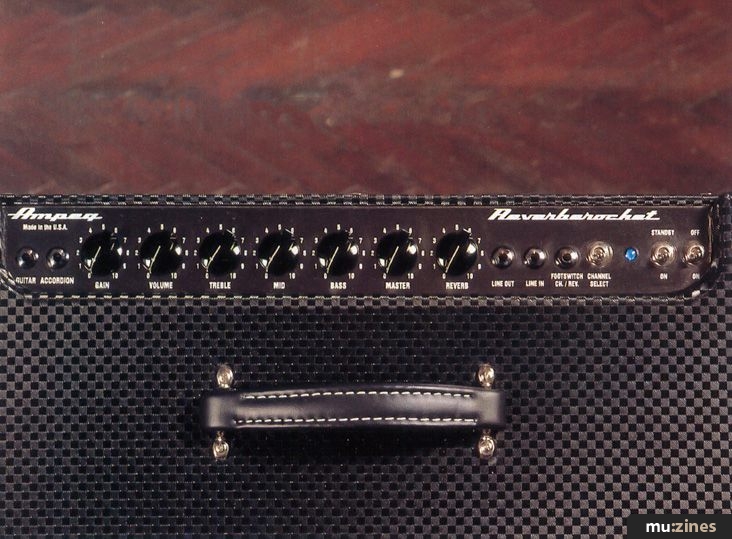
All the controls are common to both channels, except the Gain and Master controls used to set the dirty channel overdrive and level. Other than the power socket, all connections are located on the top panel
Reverb simply sets the level of spring reverb signal added to the basic guitar sound. For those who want to use external effects, there are two effects loop jacks: Line In and Line Out. Line Out provides a feed to external effects or to additional power amplifiers, while Line In interrupts the normal signal path so that the whole amp signal flows through the externally connected unit. Alternatively, Line In may be used to feed an external signal into the power amp section of the Reverberocket — in which case the guitar preamp section is disconnected. Unfortunately, there is no way of controlling the send or return levels for matching to outboard processors with different sensitivities.
Last in the control section comes the footswitch TRS jack socket, a toggle switch for switching channels, the Standby switch, and the Mains switch. Standby leaves the valve heater current flowing but turns off the HT when the amp isn't being used. The reasoning behind this is to extend valve life and avoid warm-up time when the amp is powered up from cold. A blue power light shows when the amp is switched on, but there's no separate standby light.
GIGGING
Tested with my Strat Plus, the Reverberocket actually turned out to be a very accomplished all-rounder, with a sweet clean channel and a very flexible overdrive section. The amount of overdrive available is quite enough to turn any guitar into a feeding-back, squealing monster at gigging levels. More modest settings reveal an amplifier very well suited to blues, R&B, or good honest '70s style rock. Tonally, I'd say the sound was more Marshall 50 than Fender, but not exactly like either. The EL34s are able to conjure up an assertive bark, but with a pleasantly sweet edge to it, and there's just enough intermodulation distortion to get that classic distorted Fender sound if you happen to be using a Strat or Tele. The only flaw was that at high volume, the output valves rattled annoyingly, and the cabinet upper back panel also joined in at only slightly higher playing levels.
I particularly like the touch responsiveness of tube amplifiers, and this one doesn't let the side down at all in that respect. There is a nice tendency to bring out the second harmonic when you're soloing hard, yet you can play quietly and the sound will clean up proportionally. The tonal range is also wide enough to let you coax a punchy vintage rock sound out of a single coil instrument such as a Strat; my Strat Plus, switched to the bridge pick-up or bridge/middle setting, sounds surprisingly close to what I used to get out of my old Gibson SG Special played through a Marshall 50.
"... the Reverberocket comes very close to being the pub rocker's ideal amp."
Also worthy of mention is the reverb. Although it can get a trifle overpowering when turned up full, at more sensible settings it has a nice warm, spacious character that doesn't leave you craving for effects. At gigging levels, the Reverberocket can hold its own against a drummer quite nicely. Unlike some of the smaller valve amps, which feel decidedly stretched when played close to the limit, this one manages to sing rather than choke, and the speakers have a comfortable, yielding quality more reminiscent of British Celestions than most American speakers.
By the way, whatever happened to those soft vinyl covers that used to come with amps back in the '60s and '70s?
CONCLUSION
With the exception of a few very minor design niggles, and the rather microphonic output valves fitted to the review model, the Reverberocket comes very close to being the pub rocker's ideal amp. For smaller venues, it's quite capable of cutting through without help from the PA, while for bigger gigs where it will be miked up, it still provides more than enough on-stage level to keep the player happy.
Although the 2 by 12 Reverberocket costs a good deal more money than a budget 50 Watt amp, the extra power and musical tonality, plus the flexibility of the overdrive channel makes it a very attractive buy. There are cheaper valve amps in this power range, but then there are also far more expensive ones that don't sound nearly as nice to my ears. Given the choice, I think it's worth spending the extra on the 2 by 12 version of this amp rather than 1 by 12 model — you never know when you'll need that extra bit of power and projection. Admittedly 55lbs is heavier than some combos, but at least it's manageable, especially if you forget the handle and just get both arms around it. That's more than can be said for another well-know American amplifier of my acquaintance, which left me virtually incapable of playing once I'd struggled to carry it into a venue!
Ultimately, there are many good valve amplifiers around from which to choose, and I can't claim to have used anything like all of them, nevertheless I was impressed by the sound of the Reverberocket and really enjoyed playing through it. To my ears, it combines the best of the British and American classic amp sounds and is well worth trying.
Reverberocket R-212R £785 including VAT.
Washburn UK, (Contact Details).
pros & cons
pros
- Very flexible overdrive with plenty of range and responsiveness.
- Great sounding clean channel.
- Very easy to get a good sound.
cons
- Silly mains lead location.
- Control panel legending hard to see from playing position.
- Effects loop levels not variable.
summary
A wonderfully flexible amp with a very musical, commanding sound. Ideal for pub and club gigs.
Publisher: Sound On Stage - SOS Publications Ltd.
The contents of this magazine are re-published here with the kind permission of SOS Publications Ltd.
The current copyright owner/s of this content may differ from the originally published copyright notice.
More details on copyright ownership...

Sound On Stage - Jan 1997
Review by Paul White
Help Support The Things You Love
mu:zines is the result of thousands of hours of effort, and will require many thousands more going forward to reach our goals of getting all this content online.
If you value this resource, you can support this project - it really helps!
Donations for May 2026
Issues donated this month: 0
New issues that have been donated or scanned for us this month.
Funds donated this month: £0.00
All donations and support are gratefully appreciated - thank you.
Magazines Needed - Can You Help?
Do you have any of these magazine issues?
If so, and you can donate, lend or scan them to help complete our archive, please get in touch via the Contribute page - thanks!
Please Contribute to mu:zines by supplying magazines, scanning or donating funds. Thanks!
Monetary donations go towards site running costs, and the occasional coffee for me if there's anything left over!

 @mu_zines
 RSS Feed
 Blog
Blog