


Magazine Archive
Home -> Magazines -> Issues -> Articles in this issue -> View
Article Group: | |
Roland SDE-2500 | |
Studio TestArticle from International Musician & Recording World, July 1985 | |
Curtis Schwartz expands his programming power and refines his live sound with the Roland SDE-2500 MIDI Digital Delay

Expand your synth's programming capabilities
At this year's Frankfurt Music Messe, Roland unleashed a multitude of MIDI peripherals on the unsuspecting music trade — MIDI mixers, a MIDI Digital Reverb, coloured MIDI leads (?), and their first MIDI Digital Delay, the SDE-2500, which is the first of these new products to arrive on our shores.
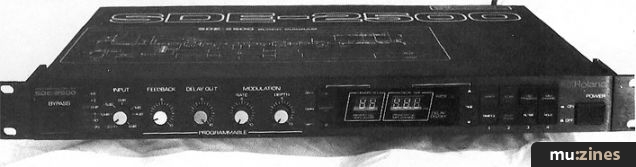
Built into an unassuming 1U 19" rackmounting unit, the SDE-2500 is designed to be connected to a MIDI synth, and used in conjunction with the individual programs of the synth itself. The SDE-2500 does this by having 64 memories for storage of the DDL parameters — delay time, modulation, feedback etc, therefore expanding the range of sounds or sound effects that can be had from any MIDI synth.
As many programmable synthesizers usually have 64 memory patches, the SDE-2500 is the first MIDI digital delay to be able to directly link to every patch from a synth, even with synths that have 128 memories or more. All shall be revealed.

One LED flashes at rate of LFO
What's It Got?
On the front panel, the 2500 has controls (from left to right) for Delay Bypass, Input Attenuation, Feedback, Delay Output Level, Modulation Rate and Depth, Delay Phase Invert, Feedback Filter and a Hold function. All of these controls (other than Input Attenuation and Bypass) are totally programmable, and that also includes the delay output level. The level at which the 2500 operates can either by at the standard pro level of +4dB or at the instrument level of -20dB (switchable from the rear panel) with the input attenuation making up the gain between the two settings as it ranges between -22dB and +6dB itself.
This DDL looks very similar to both of Roland's other two programmable DDLs, the SDE-1000 and the SDE-3000, with the blue alphanumeric display in the center of its facia. The display itself is divided into two sections — the left hand side indicating the current memory location, and the right hand side indicating the present delay time setting.
The delay time on the SDE-2500 goes up to 375mS at a full bandwidth of 17kHz (+1, -3dB), and up to 750mS at the reduced bandwidth of 8kHz. This, at first, seemed to be a little limited for a machine costing £600, and the reason for it only going up to a maximum of 0.75 seconds is that a huge chunk of the internal computer's memory is used up by the 64 memories. Nevertheless, it is a fact (more or less) that most practical applications of a Digital Delay Line use very short delay settings — for flanging, chorusing, and ADT effects.

All controls are totally programmable
On either side of the displays are incrementor buttons which will increase and decrease the memory patch number and the delay time settings, whilst switching MIDI On/ Off/Omni as well. Furthermore, when the MIDI mode is selected (by pressing the MIDI channel button), the display also changes too and indicates Omni mode On or Off as well as the MIDI channel number.
When it comes to details, Roland always seem to have the little goodies that make all the difference. In particular, the SDE-2500 has a button marked 'MIDI Program' with which you can program which patch number on the synth will trigger which memory bank in the SDE-2500. In this way, not only does it enable you to have specific patches relating to any of 128 or more synth voices, but it also makes it very easy to rearrange patch configurations without having to copy memory locations (although that option is also catered for with the Copy button... ).
On the front panel are two LED indicators, one of which flashes at the rate of the LEO, and the other relates to the delay On or Off status of this unit. These last two functions, and several others, can be controlled via footswitch from the rear panel connectors.
In addition to the audio and MIDI inputs and outputs, the rear panel has half a dozen options for footswitch control of different functions — the delay On/Off and Hold functions can be switched by foot, as well as the modulation rate of the LEO being controllable from an external control voltage. The memory numbers themselves can be increased and decreased from footswitches, and there is one more socket on the rear panel labelled Playmate which will, if not grasp the attention of the devoted Playboy subscriptionees, enable you to determine the delay time by hitting the appropriate footswitch twice. The gap between the clicks then relates to the delay time (maximum of 750mS).


Rear features half a dozen options for footswitch control
EXTENSION
To hook up the SDE-2500 to the relevant MIDI synth only requires a single 5-pin DIN lead, and once connected, the system acts as if it were an extension of the synthesizer itself (which is what it becomes, I suppose...) To write the delay settings into their respective memory locations only takes a matter of seconds, and once this is done I found the SDE-2500 to behave as the responsible member of the MIDI society that it is.
There are certain effects which bring synth voices to life — chorus or medium-length echo for a rich string patch, a slow flange adds depth to percussive voices — and it is in this area that the SDE-2500's greatest asset to the synthesist lies, in being able to link the ideal effects settings to the voice patches themselves.
Although £600 can buy a conventional DDL with twice this unit's 750mS of delay time, Roland's SDE-2500 offers the MIDI synthesist a means of expansion of a synth's programming power in a way that can give specific effects to suit specific patches. By having 64 memories, it will certainly save valuable studio time when looking for a well loved sound.
ROLAND SDE-2500 MIDI DIGITAL DELAY - RRP: £600.00
Also featuring gear in this article

Delay Tactics - Roland SDE2500 Delay
(EMM Oct 85)

Roland Digital Delay SDE2500
(HSR Sep 85)

SDE-2500 - A MIDI Delay
(IM Apr 85)

SDE-2500. The memories linger on
(IM Jun 85)
Browse category: Studio/Rack FX > Roland
Publisher: International Musician & Recording World - Cover Publications Ltd, Northern & Shell Ltd.
The current copyright owner/s of this content may differ from the originally published copyright notice.
More details on copyright ownership...

International Musician - Jul 1985
Recording World
Review by Curtis Schwartz
Help Support The Things You Love
mu:zines is the result of thousands of hours of effort, and will require many thousands more going forward to reach our goals of getting all this content online.
If you value this resource, you can support this project - it really helps!
Donations for July 2026
Issues donated this month: 0
New issues that have been donated or scanned for us this month.
Funds donated this month: £0.00
All donations and support are gratefully appreciated - thank you.
Magazines Needed - Can You Help?
Do you have any of these magazine issues?
If so, and you can donate, lend or scan them to help complete our archive, please get in touch via the Contribute page - thanks!
If you're enjoying the site, please consider supporting me to help build this archive...
...with a one time Donation, or a recurring Donation of just £2 a month. It really helps - thank you!

 @mu_zines
 RSS Feed
 Blog
Blog