Roland TR-909 - Digital Rhythm Composer
(EMM Mar 84)


Magazine Archive
Home -> Magazines -> Issues -> Articles in this issue -> View
Roland TR909 | |
Article from One Two Testing, April 1984 | |
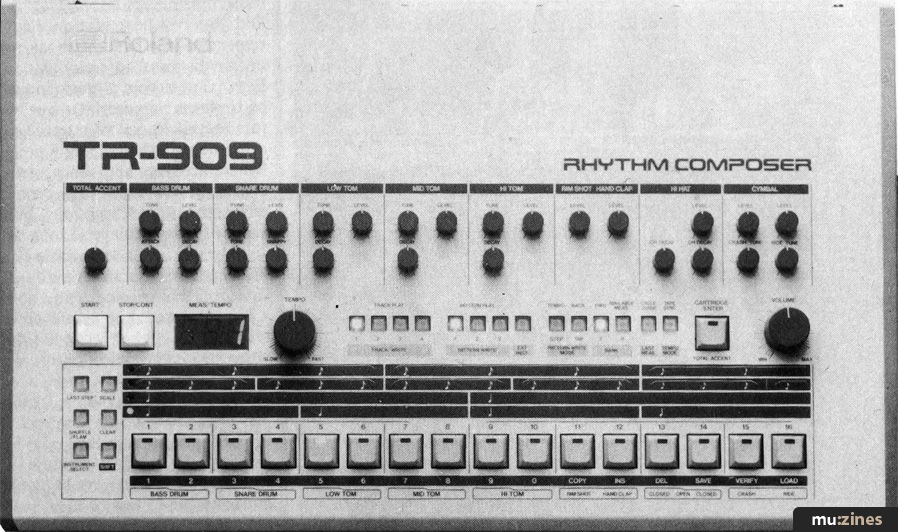
PRECONCEPTIONS: Roland, who seem to have a reputation for getting things right at the moment, have not been exactly secretive about the imminent arrival of their new drum-machine, the TR909. Its slow and rather stately approach, being markedly sub-sonic, was inevitably preceded by all sorts of rumblings and rumours as to the nature of the sounds that this wonderful new box (or "Rhythm Composer", as Roland prefer to call it) would provide.
'Roland go digital,' we were told by myriad excited journalists, as if this were a sign of the Second Coming. As a member of a group actively involved with using live drum-machines, I felt my own palms grow a little damp at the prospect of a successor to our much-loved TR808, especially if it offered 'real' drum sounds at unreal prices. So, happy was the day that I set off for Roland's factory in sunny Brentford...
PRECEPTION: Alan Townsend of Roland UK: "Roland needed to make a new rhythm unit, and of course, it had to be a good 'un. Good sounds, that was the first priority. But they realised that there are certain disadvantages in just sampling real drums and having digital sounds. It would have been very easy to do that – for example the cymbals are PCM – for all the drums, but there are certain disadvantages.
"First, they analysed real drum sounds with a 16 bit processor, and compared it to the sounds they made using analog technology. Where they've been able to do that, and have admitted defeat, as in the cymbals, they've used PCM technology – digital sounds. We think our analog system is an advantage; the reason I say this is people have got it into their minds that 'digital has to be best'. But there are problems involved."
PERCEPTION: The Roland TR909 Rhythm Composer is a drum computer that mixes digitally sampled and PCM-reproduced sounds (hi-hat, crash, and ride cymbals) with analog simulations (everything else) of real drums. Its memory can hold 96 different drum measures (the time the little light takes to travel past the 16 knobs), storing them into three pattern groups in Bank I, and three in Bank II.
These banks divide the memory capability of the TR909 into two halves which operate independently; each bank has four track groups which, when chained together, give each bank a maximum song length of 896 drum measures.
And if that's not enough, there's a "cycle" mode which locks the TR909 into a particular track, repeating that sequence until you tell it either to stop or continue the song.
There are 11 sounds to tamper with: the more exotic conga and claves options of the TR808 have been dispensed with in favour of the basic bass drum, snare, low-, mid- and hi-tom-toms, rim-shot, handclaps, hi-hat (both open and closed), plus crash and ride cymbals.
All the drums and the hi-hat have the option of loud or soft programmed sounds, which with the double-touch accent facility (press the relevant button once for normal, twice for accented sound) gives flexibility in stressing individual sounds throughout the bar. This is coupled with the total accent, as used on the TR606 and the 808, which accents the beat, and all voices on it.
There is another way of providing a human feel to the TR909's accenting: like all right-thinking synthesisers nowadays, it comes equipped with MIDI. Interface the 909 with any touch-sensitive keyboard, and it becomes possible to play the drums with the keys, using their sensitivity to control the volume of each sound. This gives an almost infinite level of variability, so Roland tell us...
RECEPTION: Writing drum patterns into the TR909 is a pleasure and joy to the senses. The mechanical knob-twiddling of the 808 has been replaced by electronic switches and LEDs which let you know precisely where you are, and when. You program the 909 in two ways, either in Step Write, using the instrument selector switch to insert each voice individually, or in Tap Write, actually playing the drum buttons in real time over a click track (provided by the rim-shot).
Step Write is a visual method, as the LEDs on the programming keys light up to show the location of each beat in the bar, as does the 808. Tap Write permits you to play at your own pace all the drums at once; it's a much faster way of programming patterns, as it allows even a rhythmic imbecile like myself to play interesting drum parts. If you get it wrong, you can always switch to Step Write to correct any errors.
Once you've hammered in your basic rhythms, chaining them into songs is relatively easy. Writing involves the simple procedure of shifting into track write mode, and selecting the rhythms that you want from any of the three pattern groups (48 different measures) in each relevant bank.
Having found the measure that you want, press the Enter key and it will be recorded in the memory; repeat this process for each bar. The digital counter which normally displays tempo (ranging from 37-290 beats per minute) shows how many bars have been recorded. Understandably, this process might take some time if the full 896 measure memory is used, a problem which harks back to the days of typing songs into troublesome TR606s.
In spite of the easier editing facilities on the 909, I found this method of track composing a step back from the TR808's "laissez-faire, as long as you stop it right" simplicity.
CONCEPTION: This technical stuff's all very well, but you can get that from the manual without too many language problems. It's what it sounds like that's important.
First point: the TR909 is a drum-machine, and it sounds like it. Apart from the cymbals, it uses little pieces of fiddly electrical stuff to make noises that sound like drums. It's not a Linn, nor even a Drumulator, and would not be mistaken for such, even by deaf persons.
That said, it does make a good noise. The bass drum has attack, decay, and pitch controls, and can be made to move mountains; the toms have decay and pitch, and can also put out a mighty racket. There's a fair degree of overlapping in their tuning (they can all be tuned to the same pitch) though the 909 doesn't suffer the 808's annoying trait of having a low-tom with more bottom than its bass-drum.
The handclaps are identical to the 808's, which came as something of a disappointment as a slur control to dirty up those nice clean hands would definitely improve matters.
The cymbals, being 'real' sound... er... 'real'; they are tuneable, but as their pitch is increased, so decay declines. Just like speeding up a tape, really.
The noise that let the 909 down, to my ears, was the snare. Even with full fiddling with the tune, tone, and snappy controls, it still sounded like a synthesised thud with a splash of white noise, which is not what one would expect from a £1000 drum-machine.
CONTRACEPTION: Therein lies the rub... the TR909 is available for £900-£1000, which puts it in the same price range as the Oberheim DX Drumulator, and the new Soundtraks, all of them digital machines.
It doesn't give the same degree of expression as these, even if special provision has been made for 'shuffle' and 'flams', and it certainly sounds less 'real', which is an audible deficiency.
When I asked Alan Townsend, who is Roland's chief demonstrator, what market they were aiming for, he replied that it was hoped that the 909 would find its own level. This absence of a clear marketing policy could well turn this machine into Roland's first white (well, pale grey plastic) elephant.
Even with its wonderful 'state-of-the-art' (this means 'modern') micro-chippery (tape dump, copy, tape sync, MIDI etc), the TR909 still sounds like a drum-machine, instead of a machine playing drums.
It seems too expensive for the majority of home-users and drummer-less groups (like my own), and yet it lacks the authenticity of real sounds for studio work, where the DX et al would still be very useful.
In its favour, I must say it is gloriously easy to use, and it can even be played live (pads aren't available yet, but with a MIDI interface, anything can happen). Perhaps if Roland were to withdraw the older machine, and drop the 909's price, they could market it as the 808½ it currently seems to be. But at £999 list price, it's a sore disappointment.
£999
Also featuring gear in this article


The Flexible Drumbox
(ES Jun 84)
Browse category: Drum Machine > Roland
Publisher: One Two Testing - IPC Magazines Ltd, Northern & Shell Ltd.
The current copyright owner/s of this content may differ from the originally published copyright notice.
More details on copyright ownership...

One Two Testing - Apr 1984
Review by Jon Lewin
Previous article in this issue:
Next article in this issue:
Help Support The Things You Love
mu:zines is the result of thousands of hours of effort, and will require many thousands more going forward to reach our goals of getting all this content online.
If you value this resource, you can support this project - it really helps!
Donations for August 2026
Issues donated this month: 0
New issues that have been donated or scanned for us this month.
Funds donated this month: £0.00
All donations and support are gratefully appreciated - thank you.
Magazines Needed - Can You Help?
Do you have any of these magazine issues?
If so, and you can donate, lend or scan them to help complete our archive, please get in touch via the Contribute page - thanks!
Please Contribute to mu:zines by supplying magazines, scanning or donating funds. Thanks!
Monetary donations go towards site running costs, and the occasional coffee for me if there's anything left over!

 @mu_zines
 RSS Feed
 Blog
Blog