


Magazine Archive
Home -> Magazines -> Issues -> Articles in this issue -> View
Sequential Circuits Max | |
Article from One Two Testing, February 1985 | |
preset poly
WHEN WE SPOKE to Sequential Circuits designer John Bowen at last year's Frankfurt show, he said there was one more keyboard to come from the technology that had developed the Six Trak poly. After that, he reckoned, they would have compressed analogue abilities into the smallest silicon space possible.
'Possibles' are these days changed rather more rapidly than swabs at the herpes clinic, so perhaps this isn't the last straw. Not entirely certain what it might be, in fact. The Max has the air of a MIDI expander (akin to Korg's EX800) which has had a keyboard added at the last moment.
The Six Trak, if you recall, was a six note polyphonic synth fronting up with 100 programmable memories, a smart, over-dubbable six line sequencer, and multi-timbral potentialities — to you, half a dozen different sounds on one, monophonic note.
The Max has only some of these facilities, and since you can find the Six Trak on special offers at close to the recommended retail of the Max... well, you decide.
The Max cannot be programmed except externally via another Six Trak or a MIDI equipped computer. It comes with 80, untouchable, factory pre-sets with 19 spaces for these externally programmed noises. If you want to edit a Max patch it would involve dumping that sound into a Six Trak, carrying out the changes on this 'work surface', then returning the goods to one of the Max gaps (numbered 80-99). A similar ritual can be carried out by computer which is capable of transmitting the MIDI code to talk to the desired parameter.
You won't be able to converse with the pre-sets themselves, they're fixed in Read Only Memory and can't be swayed. But each time you call up a sound using the Max's 10 button, calculator-style pad on the front panel, it positions that information in a 'scratchpad' memory where alterations can be made. It's then a matter of dumping the newly edited version into one of those 19 unsold seats.
I had mental problems with the Max in this regard. It seemed wrong for a synth with a Sequential sound to be non-programmable. You realise (or I did) how much you normally tweak the factory sounds of other polys. Even though 90 per cent of the Max's noises may be perfectly acceptable, if within the remaining 10 per cent, you can't find one really good piano patch that you like, or one really good string setting... that 10 per cent soon assumes unbearable importance.
And yet we've grown used to pre-set Casios, Yamahas, JVCs etc in the last couple of years, and they've rarely been as rich or varied as the Max. With that comparison in mind the Max speedily builds up the house points. But to give so much and not the final climax... Synthus-interruptus is not joyful.
I also found myself missing performance controls — neither mod nor pitch wheel are fitted — and the Max had dispensed with what I considered the Six Trak's most appealing talent — the ability to stack up six different sounds on one note making it a phenomenally powerful solo-ing synth. (This criticism is reinforced by the lack of powerful bass line or lead line sounds within the factory pre sets, and no easy way of manufacturing them.)
It does copy the Six Trak's 'multi-timbral' sequencer — quite possibly one of the worst phrases coined in '84 but there's little other way of outlining the concept. Imagine six separate sequencers all linked and all programmable, individually, in real time. They can be remixed on playback and have their voices changed.
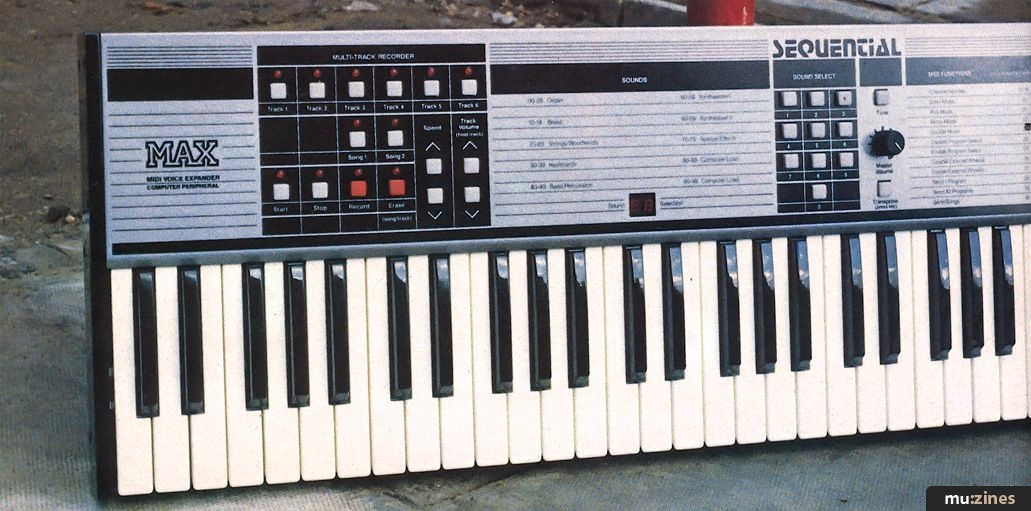
Before delving deeper into these technical-type areas, lets familiarise ourselves with the physicalities of the Max. It looks unlike any previous Sequential synth. It's completely flat, standing only two inches high and encased in black plastic with a metallic-grey painted front panel holding the one, lonely knob (for volume) and 28 soft, rubbery buttons. Those on the left of the panel operate the sequencer, those on the right call up the programmes. Not overimpressed with the action of these switches. They didn't feel firm when they made contact and a sharp sideways poke pulled the rubber part out of the panel leaving it hanging like a loose tooth.
The four-octave C to C keyboard takes up the entire front of the Max; directly above the D flat key in the centre is a two figure, red, LED display that reveals what sound you've selected. Nearby Sequential have included a general map of the pre-sets; a short list printed onto the panel — 00-09 Organ, 10-19 Brass, 20-29 Strings/Woodwinds, etc also covering Keyboards (piano, harpsichord, clav styles), Synthesiser 1, Synthesiser 2, Special Effects and a pair of electronic 'cupboards' for the computer loaded patches. There's a fuller explanation in the Max's operation manual.
Speaking of supplied literature, the operation manual is 22 sides long while the MIDI guide has 56 pages, and maybe that gives us the strongest clue as to how Sequential see the Max — a drum machine/computer/sequencer peripheral. Towards the end of the guide is a break down of the MIDI codes for the various synth parameters, represented by seven bit numbers. The maximum programming resolution is 128 steps (for the filter cutoff) but most of the parameters have the equivalent of 16 steps (eg attack time, sustain, LFO frequency). That degree of control is adequate but couldn't be described as generous in the face of many of the coming synths which offer 100 steps for everything.
Another printed list of instructions to the right of the control panel keeps you reminded of the wider MIDI functions and their code numbers. These can be entered via the sound selector switches (after you have first pressed the sequencer's erase button to convert the Max to MIDI thinking). 00-16 selects the MIDI channels, 20 calls up omni mode, 21 poly mode, 22 mono mode, through to 29 for send programme and 30 for send songs.
The rear of the Max is interestingly clear of too many plugs and sockets... just the five pin, Din, MIDI in and out, two phonos for the audio outs, plus one standard jack socket (that doubles as the headphone outlet). At the opposite end of the panel are a mains switch and a socket marked '8VAC 800mA power in'. Ah so, one explanation for the Max's compact-size — the power supply is external.
Some sentences on the sound of the Max before we plunge back into the middy waters of multi-timbral do-watsit-ing. The Max has a single analogue VCO bank oscillator with ADSR envelope generators for the oscillator pitch, filter and amplifier.
On turn-on, the Max takes several moments to skim through those oscillators, tuning them up. The manual warns that it may drift in the first ten to 15 minutes of play, and they were right. The autotune button pulls the machine back in line but takes 20 seconds to do it. After a while the Max settled down.
The programmes are drawn from favourite Six Trak examples selected by John Bowen and other members of SCI. That means alongside the gritty and fairly bright string options, and the smooth, rounded pianos, you've got the meowing cats, space chimes, aliens and alien winds. A popular selection.
With only one oscillator bank, the Max obviously misses out on the swimming, chorusey patches that come from detuning two oscillators. I found the string and brass patches slightly dry, definitely requiring a kiss of reverb or echo. Neither was there one, soft, muted, orchestral pre-set and normally the solution of sliding back the filter frequency and resonance wasn't available.
The bass programmes were lacking in punch and drive, and they couldn't be sandwiched into mono to beef up the impact. The organs conjured by the SCI programmers were tight and chirpy, as usual, and whenever asked to perform something flutey, the smooth, silky, Sequential oscillators came into their own.
The lack of a second bank of VCO's cuts out synced up lead sounds and once more, the absence of a mono facility doesn't push the Max forward as one of the world's champion soloing synths.
The Max returns to authority with some of its Synthesiser and Special Effects variations, demonstrating the accepted Sequential flair for loading-in strange, descending bells, artificial delays superimposed over slow decays, whines, winds, whistles and other works of wobbling LFO origin.
So then, it's striking in the outer regions of synthesis, but not so hearty for the more essential basic sounds unless your opinions exactly match those of SCI. Though you know the Max makes better analogue synth sounds than many Japanese pre-set devices, the resulting desire to fiddle with them becomes so strong, you're left feeling peculiarly short changed by what is theoretically a better device.
And last, the sequencer. The Max can store two independent sequences but has a maximum memory of 500 notes shared between them. If you exceed the limit, the record mode switches itself off. Like the Six Trak, the sequencer is divided into six tracks (prizes all round) which can be recorded independently in mono, all at once for a six note polyphonic piece or in pairs, trios, etc. You start by clearing one of the two songs then selecting a track or tracks (there are six appropriate buttons ranged across the top left hand corner of the panel each with an indicator LED), and hitting the record button. Nothing actually happens until you start playing, then the Max listens to and takes down what you have to say. Irritatingly, it has the old sequencer drawback of having to tap the stop button exactly on the beat if you want your sequence to loop, otherwise there'll be unpleasant hesitations or sudden lurches on playback. Neither is there a footswitch, as with some synths, that lets you halt the process without taking your fingers off the keys.
When the first track or set of tracks is recorded you can then go on to overdub extra lines on the remaining channels while listening back to the notes you've already put down. On playback each of the tracks can be given a different sound by pushing the record button while the song is playing, selecting the track to be altered and dialling in a new patch on the sound selector. The track then retains its new voice unless it is later reprogrammed. In the same way the mix can be altered by choosing the track and pressing one of the volume up or down buttons to the right of the collection of controls that make up the sequencer.
Lots to be done with this wonderful device. The Max programmes include a couple of drum machine noises so you can slap in a rhythm track and it's possible to inject notes into an existing, recorded channel.
Sequential advise that when recording mono lines, you take care with your fingering as brushing a second key might cause the sequencer to hiccup. There are no editing facilities — if you make a cock-up you have to redo the track — and I found that the two buttons for the playback speed gave only very coarse control at the lower end of their range. The sequence programmed by Sequential as an example (a masterful exhibition of the possibilities including a bass line, organ chord part, bass drum, snare and lead line) could be accelerated until it ran faster than a tram on dexies. But down the slow end, the pace of the sequence went up in such sizeable jumps, I'd worry about fine tuning the playback to suit your digits at a later date. If you haven't used all the tracks then you can play along with whatever spare oscillators happen to be around.
However, the major drawback is that the Max won't remember its sequences. As soon as the power is turned off, all your programming disappears and the factory loaded sequences reinstate themselves. Seems a pity that such capacity for invention should be lost when the plug's pulled, unless you take the trouble to dump the sequences, MIDI-wise to another Six Trak or computer.
I must admit to confusion with the Max and a certain feeling of puzzled pointlessness. As an expander it's too expensive; as a live performance keyboard it's too limited; as a competitor to the existing pre-set Japanese machine it's comparatively pricey, frustratingly incomplete and actually some way behind the present direction of Casios etc, which is towards a better degree of programmability (see last month's squint at the £395 CZ-101). Great engine, good seats and fine pilots, but as a complete plane, the package doesn't fly.
SEQUENTIAL CIRCUITS Max pre-set poly: £725
Also featuring gear in this article

Sequential Circuits MAX
(IT Apr 85)

Sequential MAX - Preset Polysynth
(EMM Jan 85)

The MAX Factor
(ES Feb 85)
Browse category: Synthesizer > Sequential Circuits
Publisher: One Two Testing - IPC Magazines Ltd, Northern & Shell Ltd.
The current copyright owner/s of this content may differ from the originally published copyright notice.
More details on copyright ownership...

One Two Testing - Feb 1985
Review by Paul Colbert
Ads for Gear in this article:


Help Support The Things You Love
mu:zines is the result of thousands of hours of effort, and will require many thousands more going forward to reach our goals of getting all this content online.
If you value this resource, you can support this project - it really helps!
Donations for June 2026
Issues donated this month: 0
New issues that have been donated or scanned for us this month.
Funds donated this month: £0.00
All donations and support are gratefully appreciated - thank you.
Magazines Needed - Can You Help?
Do you have any of these magazine issues?
If so, and you can donate, lend or scan them to help complete our archive, please get in touch via the Contribute page - thanks!
Please Contribute to mu:zines by supplying magazines, scanning or donating funds. Thanks!
Monetary donations go towards site running costs, and the occasional coffee for me if there's anything left over!

 @mu_zines
 RSS Feed
 Blog
Blog