


Magazine Archive
Home -> Magazines -> Issues -> Articles in this issue -> View
Shades Of Green On Red | |
Green On RedArticle from International Musician & Recording World, March 1986 | |
Chris Maillard chews the cud with the up and coming C&W—crossover cowpunchers.
If you can bend it, crank it, and play E minor, G and D, you could probably join Green On Red. Further details? Read on...
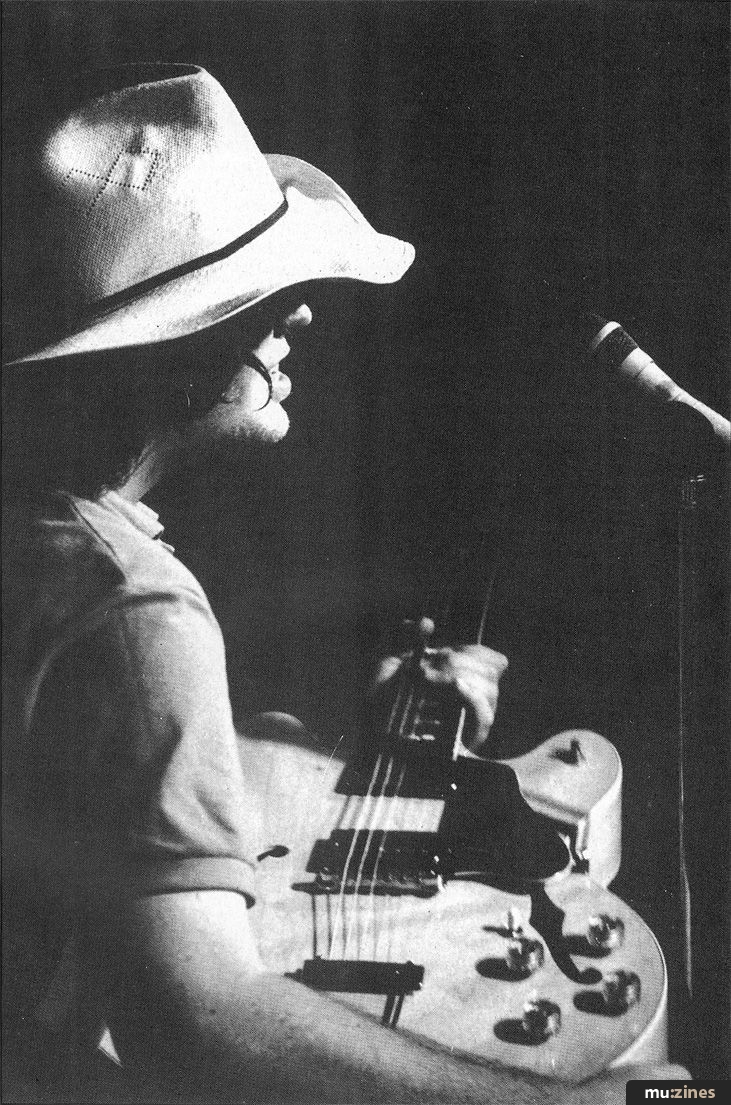
All together now, stetsons on, faded Levis firmly belted up; lean back on the heels of your cowboy boots, slap an E minor chord on the neck of your Gretsch and strum. Now change to G. Now D.
You are now qualified to join Green On Red. At least according to a couple of experts on the subject. One of them is Peter Buck, REM's renowned sultan of strum, who has made a long and involved study of the band from positions including onstage, in the audience and under a table nearby.
The other (and probably even better qualified to judge) is Chuck Prophet IV, the unlikely named but palpably real Telecaster wanger from the band themselves.
Peter Buck was the first to mention the band's penchant for what he dubbed "the California key". In a dazed and more than slightly confused interview a while ago he mentioned that the reason for his semi-stupor was that he'd got up onstage with Green On Red the previous night/early morning at a Midlands university hop. "Everybody was real drunk," he muttered. "So I got up and played along for a while. It was real good fun, because they play everything in that California key: E minor, G, D. You can play those Neil Young solos that sound like you've got your hand caught up in the strings...
"They're a great band, though; good guys and they've got some fantastic songs."
That was something only too few people knew at that time, though, as they were still on a minor American label and tied up in major legal and financial hassles that had kept them from recording and touring for ages.
Now, however, the lights are definitely on 'go' for Green On Red. They've signed to major label Mercury, their first single of the new contract Time Ain't Nothing has belted out of trannies from Loch Ness to The Lizard, and they've played a tour that's kept audiences yelling 'Yeee-haw!' till the lights come up, and now they're doing the obligatory interviews.
"It's great to be talking about guitars at last," he enthuses. "I really don't understand the English Rock press at all. It's all politics and attitudes. What happened to the music?
"That's what we're really about, you know. Getting upon the stage and playing guitars, drums, keyboards and having a helluva good time doing it.
"I started by doing that with tiny bands all over and eventually I found a band that was doing what I wanted and joined. And here I am. Of course, Green On Red had been going for a while before, and I'd supported them a few times with other bands. And I'm not saying that I'll go on and on for ever with them, but this is most definitely my aim in life right now. Have guitar, will travel — that's me."
His fellow travellers on the tour bus are also dedicated wanderers — drummer Keith Mitchell is a veteran of umpteen Los Angeles-based bands and the other three, what one might call the nucleus of the band, have been through their fair share of gigs and musicians before settling on this line-up. Chris Cacavas is the meek-looking keyboardsman, a Ray Manzarek-ish player with a fine line rippling piano runs from his Yamaha CP80 electric grand and sleazy organ fills from the Korg BX3. Jack Waterson is the solid, Fender Precision-equipped bassist. And Dan Stuart is the main man, the songwriter and bandleader. He's got a beaten-up Gretsch semi-acoustic and three good chords which go... you guessed it.
"Yeeah," drawls Chuck hesitantly, "he does tend to write in that sort of key. It's like, classic American songs. There's a lot you can do with that sort of progression. Throw in a C or an F occasionally and there you go. I don't mind. I like it.
For the classic American song, then, you obviously need a classic American guitar.
"I've got a Telecaster, yeah. A real nice Japanese one, you know? It plays great and it sounds good and I've done virtually nothing to it from new except adjusted the action and changed the knobs.
"I used to play a Strat, a stock one which I bought straight off the wall of a music store and played for eight or nine years. Then I went to see The Gun Club one night and it got ripped off from the trunk of my car. I was heartbroken. And I didn't have any money either.
"So I was just scouting around a few shops, looking for something I could afford, when this Japanese kid comes in with a Tokai tele copy. He wanted to sell it but the people in the shop couldn't understand him at all, so I took him outside and said, in sign language, 'hey, real cool guitar!' and I bought it then and therefor 140 dollars. A real bargain.
"When we got our first record advance I went shopping for another guitar and ended up with another Japanese tele — a Squier. And that's the one I still use, just a basic 199 dollar guitar.
"I considered getting another one, a real old Fender, but when I came over here to England where the record company is, I went out to a couple of places and I picked one out, a '59 Esquire. And I looked at the price, and they wanted £1,750 for it. So I thought 'agh!' and went back to the Japanese one.
"As I said, the only thing I've dong to it is to change the control knobs on it. I put the ones with numbers on, like on Fender Twin Reverb combos, instead of the stock silver ones, because you can tell what you've got your volume and tone set at more easily and exactly.
"That's something I find very important. And it's something that not many people know about, either. Just using the knobs on your guitar can give you so much variation in tone and volume, particularly through a valve amp. For instance. I'll usually play a light, jangly rhythm on the back pickup with the volume set on six or seven and the tone on about eight or so.
"Then if I want to play lead lines that stand out without being overpowering I'll wind up the tone and give them more edge. If I want choppier rhythm, more Keith Richards, I'll wind up the volume. And if I want to do that guitar solo type stuff I'll wind up the volume and change to the neck pickup.
"It's all there on the guitar. So many people don't realise that you don't need to step on a pedal to take a lead, just crank up the guitar and go.
"Pedals are things I don't get on with very well, generally. I tried a wah-wah for a couple of gigs once, but with all that changing batteries and plugging in another cord it was too much hassle. Then when you switched it on and you got a load of hiss... eventually I just threw it away.
"I almost always use a Fender Twin Reverb amplifier. They're basically good sounding amps with a bit of versatility. I use everything — except the reverb, of course — on full. Music Man amps are the same as Fenders, really, only a little more so. I occasionally use one of those instead.
"I don't screw around with the amp usually, though — just set it and leave it, do all the volume and tone changes either from the guitar or by varying playing style.
"My favourite playing style is sort of Steve Cropper-like licks, little lead runs that lock in tight to the snare and bass drum and just click in solid with the rhythm. You need to damp the strings a little with the side of your hand to do that properly, just to keep the riffs tight and controlled enough, so I usually play near the bridge for that. Then the flowing, sort of Clapton-style lead breaks sound better right up towards the neck. And then there's Keith Richard's style rhythm... that's all over the place!"
No other tricks, then? The pedal-steel imitation licks that whine through a fair few of Green On Red's songs aren't achieved by tremolo arm tactics or B-bender bravura?
"God, no. I can't get on with any of those things. I bend on the guitar... to give you an example, if it was an open G, you have your little finger on D on the B string and your finger on the A, bending that up. At the same time wrap your right hand little finger round the volume knob and wind it up so it comes in slow and gentle. I tried using a volume pedal for those, but I could never stay in the same place onstage."
That's a very traditional-style Country'n'Western lick.
"Yeah, it is, but at the same time we don't in general play like one of those bands. We're not priests at all, we play more like the Rolling Stones played R'n'B. You've got to keep changing the riffs around and making things interesting or you get set in your ways.
"I think that's happened to English guitar players in a way. For so long it was unfashionable to even play the guitar, unless it was those Steve Jones power chords, over here. Sure, that was fine, stripping down to the basic like that, but things have got so static in England that the modern guitar players like The Edge or whoever don't even bend notes. If you're not careful, you become the thing you were originally rebelling against, and that's happened here. That's why all the American bands who listen to Country and Blues have suddenly got popular, because English guitarists were so stagnant.
"Everybody's flipped out, saying 'Whoo! American Guitar Bands! The Big New Thing!' when it's because of a lack of imagination over here. The Edge didn't start it, I think Keith Levine from PIL was the first to use that hard-edged, jagged style with no bending notes at all, and then everybody started but it's just got to be a dead-end. Bending notes is important, it's the heart of Rock'n'Roll. You slide from note to note and there you are — emotional, real guitar playing. No synthesisers, no effects, just real guitar. The Jesus And Mary Chain understand about guitars. Just get guitars and write some songs. Use the riffs that are there to be used. Classic ones. Ones that make use of the heritage of the music and the guitar instead of ignoring it. There's nothing wrong with them."
Riffs like E minor, G, and D, perhaps?
"Well, that's Dan's songwriting really. We're going to buy him a capo for Christmas..."
Publisher: International Musician & Recording World - Cover Publications Ltd, Northern & Shell Ltd.
The current copyright owner/s of this content may differ from the originally published copyright notice.
More details on copyright ownership...
International Musician - Mar 1986
Donated & scanned by: Mike Gorman
Interview by Chris Maillard
Help Support The Things You Love
mu:zines is the result of thousands of hours of effort, and will require many thousands more going forward to reach our goals of getting all this content online.
If you value this resource, you can support this project - it really helps!
Donations for May 2026
Issues donated this month: 0
New issues that have been donated or scanned for us this month.
Funds donated this month: £0.00
All donations and support are gratefully appreciated - thank you.
Magazines Needed - Can You Help?
Do you have any of these magazine issues?
If so, and you can donate, lend or scan them to help complete our archive, please get in touch via the Contribute page - thanks!
If you're enjoying the site, please consider supporting me to help build this archive...
...with a one time Donation, or a recurring Donation of just £2 a month. It really helps - thank you!

 @mu_zines
 RSS Feed
 Blog
Blog