


Magazine Archive
Home -> Magazines -> Issues -> Articles in this issue -> View
Shredder | |
news from the frontArticle from One Two Testing, March 1985 | |
newsworthy items for your interest
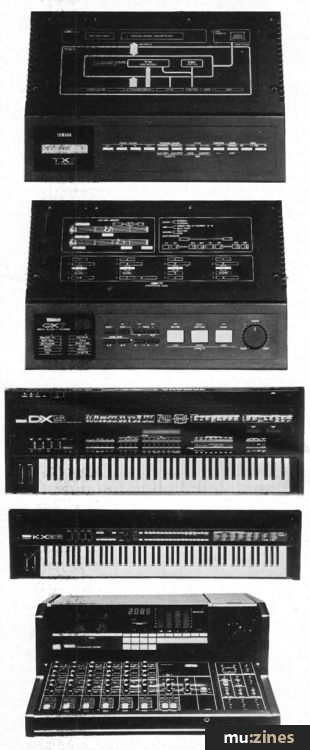
Pictures by the chemist shop load this month, and all advance shots of the gear Yamaha will be delivering to our homes and loved ones later on. There's the KX88 keyboard controller (a mother keyboard job), with 88 weighted keys, initial- and after-touch, two banks of memories (à la DX1), four programmable sliders and a price tag of approx £1500. (Yamaha do say that all prices are early estimates and may change when the gear arrives.)
A DX7 in a stackable box? You did ask and you've now got. The £700 TX7 is a straightforward, keyboardless, expander module. Watch the remaining analogue synthesists run for the wallet.
In a matching case is the QX7, a man-in-the-street's version of the QX1 sequencer. It stores two tracks with 16 note output, in real or step time, 6,000 notes total (8100 if you don't include velocity info), runs up to 16th note steps and will sail in around £500.
Back among the four figure sums is the DX5, actually looking remarkably like the DX1 without the Teak. Spec not certain yet, but it does have a DX7-like keyboard (presumably not wooden nor weighted) and could be between £3,500 and £4,500.
There are four fresh power amps, all fan cooled — the P1150, 150W mono, approx £350; P2150, 2X150W, approx £450; P1250, 250W mono, approx £400, and P2250, 2X250W, approx £550.
The MT44 four track cassette recorder gets a facelift. Now the MT44D, it has a generally improved spec, say Yamaha, and stays around £400. Racking up alongside are the GC2020 stereo compressor/limiter (£250), GQ1031 1x31 band graphic eq (£200), and GQ2031 2x31 band graphic eq (£400).
Yamaha gave the world a sneak preview of their fab packages at a press show in Hamburg at the end of January. Maximum points to them for realising demos are 200 per cent better with singers in front of the machines. Maximum plus points to Miss Jackie Graham (great soul voice, watch for the album) for encouraging the machines and Dave Bristow to dance... well, it looked that way.
Seems that an extensive slice of the 24 new products promised by Roland for early '85 will be rack mounted effects aimed at the home recording market. Big in four track, as they say.
Appearing under the title 'Boss Micro Rack Series', each unit is half the standard 19in length, stands 44mm high and two can be locked together on one RAD-10 Rack Mount Adaptor.
They are as follows:
RDD-10 digital delay with a max of 400ms and 12-bit digital quality.
RCL-10 compressor/limiter with independent attack and release times and a noise gate built in.
RGE-10 graphic equaliser operating at 31, 62, 125, 250, 500, 1K, 2K, 4K, 8K and 16KHz, promising gains of plus or minus 12dB.
RBF-10 flanger with standard rate, depth, level and balance controls.
RPH-10 phaser with three selectable modes of six stage, 10 stage, and paired six-plus-six stage phasing.
Most of the units have what Roland term a Modulation or Polarity bus that allows two devices to be linked for stereo effects.
Another series is baptised MI, short for, yes you guessed it, MIDI interface. The MI-10 converts MIDI information into CV/gate signals to control those older mono synths — a maximum of four at once, with different modes giving you one note to four mono synths, two notes to two mono synths, three notes to three mono synths and four notes to four mono synths. It also features outputs for CV signals corresponding to dynamics, bender, modulation, after touch and volume.
The MI-30 is a MIDI channel filter/converter which takes MIDI info on any channel and bungs it out on another channel of your choice. The MI-40 lets you choose one of five of its MIDI inputs to work with while the MI-50 output selector reverses the roles.
Away from all this small black box stuff is the big black box stuff — free standing digital drum samples, for a start. The DDR-30 is a MIDI driven box of 24 PCM sounds (four bass drums, four snares and 16 tom varieties). They can be controlled by up to 6 pad controllers. An edit function lets you tweak the amplitude, decay time, pitch, pitch bend depth, pitch bend decay, dynamic sensitivity, attack of the sound, and bass and treble eq. The edited sounds can then be memorised.
The SDE-2500 is a digital delay machine that can memorise all the settings on its front panel (except input attenuator) in up to 64 patterns which can be MIDI recalled (like the Yamaha D1500). Max delay is 750ms.
Also MIDI recallable — nice this, one — is the SRV-2000 digital reverb which takes in 24 patterns. Pre-delay time, reverb time, high frequency damping, room size, equaliser, gate time, and output level can all be stored and reconstituted to match your marvellous keyboard twiddlings.
Tascam are about to launch a new 16-track-on-one-inch tape machine, presumably in an attempt to tempt a few people away from the market leader, the Fostex B16. Price will be about £6,000, which still puts it well above the B16's four grand touch. Distributors Harman UK couldn't tell us much more about the MS16, apart from the fact that they were expecting the machines "some time in March or April", and that the machine would have "all the facilities of the 50 Series and more". There have also been hints of an 8-track Portastudio some time this year although, teasingly, Harman couldn't even say yet what tape format it would adopt. We would suspect not standard cassettes — though in the meantime Harman will gladly sell you their new "That's" brand of cassettes if you bring up the subject. The extremely awkward name is attached to a range of new tapes, all of pure metal coating, two to be set at the Metal position (MR and MG) and one at the Portastudio's preset Cr02 position (EM) like TDK's HXS cassette mentioned in our January home recording feature. We're trying them out at the moment and will let you know how we get on.
And still the freelancers continue to rush into print. Mark Jenkins, 'he-who-has-ROM-chips-for-tonsils' has published an A-level novel... er... excellent reference manual on electronic music on the Commodore 64. It's called 'Electronic Music On The Commodore 64'. Brilliant title. It delves into the 64's own sound (SID) chip, what you can do with it, how the Commodore can be tied in with other keyboards, the meaning of MIDI, plus more addresses than the London Telephone Directory. Deep, and not to be missed by musically inclined Commodore owners. All-right Jenko? Now next time give us a plug, you miserable two-part invention. Otherwise we won't tell everyone it's £6.95 and published by Sunshine Books, (Contact Details).
We were up in Air studios the other week to take in the excellent view of Oxford Circus and to chat with Mark and Tony from Big Country who were rhythm-sectioning for Pete Townshend, when we noticed Tony trying out an odd-looking Fender bass. Turned out it's a very new Fender "PJ Bass", and as you'll gather from the monicker it's supposed to be a cross between a Precision and a Jazz. Tony would be an ideal customer as he's recently been using both a Precision and a Jazz on stage with the Country boys. He estimated the PJ's neck nearer a Jazz, but was generally enthusiastic about the feel and sound of the object, which he'd been shoving onto the Townshend stuff. We await the Stratmaster with interest. Come to think of it, we await the future of Fender with interest.
What an utter TV shambles The South Bank Show's stumble through electronic music turned out to be that Sunday night in January. Incomplete (nothing significant between Moog and the Fairlight, apparently), inappropriate (what have close-ups of the Explorers' vocalist to do with modern synthesis?) and ill-considered. After they'd got enough giggles out of electronic music's inelegant beginnings, it was down to the Tempest with a Mohican, therefore meeting the three tenets of London Weekend's art-for-the-masses philosophy. Make it cheap, make it Shakespeare and make it punk. Execrable.
KING FOR A DAY
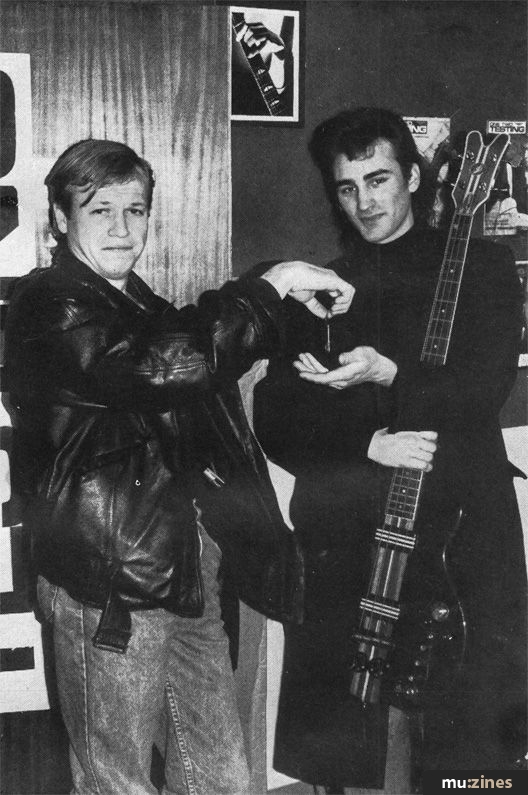
Mark King referred to around these parts as the most generous and generally fabulous bassist in the entire known cosmos, is clearly unhappy in the accompanying picture, snapped the other week here at Testing Towers.
Why could this be?
Because the man on the right in the picture is Mr Crispin Philo, the lucky winner in our Win Mark King's Jaydee Bass competition from the end of last year. Mark is handing over the key to the case for the bass, clutched by Crispin, and is saying bye bye to his very first Jaydee bass, bought in 1980 with part of Level 42's original Polydor £5000 advance.
The equally clearly delighted Mr Philo was almost beside himself with excitement as he lightly fingered several well-known Mark King licks on the much-toured and plenty-studioed bass. It was Crispin who worked out the surnames of the bassists in our competition (Miller, Clarke, Pastorius, Bruce, King, and Berlin) and came nearest to estimating the number of parts needed by John Diggins to make the Jaydee in question. 389.
And how else do we explain Mark King's generosity toward the readers of One Two, other than the already mentioned fact that he's obviously a deeply wonderful human being? And that he loves the magazine? "Well, I've got quite a few Jaydees now, quite a few basses, and you can only play one at a time, can't you?" he shrugged. What a chap.
Those clever bass amp people at Trace Elliot are currently finalising designs for a programmable, rack-mounting 10-band graphic eq. The unit will be made available as an optional front-end preamp for their amplifiers, and the player will be able to recall any of the ten stored settings either from a foot-pedal or a calculator-type keypad on the instrument. TE's close workings with Status basses mean that Status basses should be available with a built-in keypad. The store number zero will remain as a flat setting, but the other nine are user-programmable. In practice you might not find yourself using more than two or three settings, but the set-up will provide an easy way of setting up and recalling instant sound changes. As to price, TE were counting up the cost of the bits when we spoke to them.
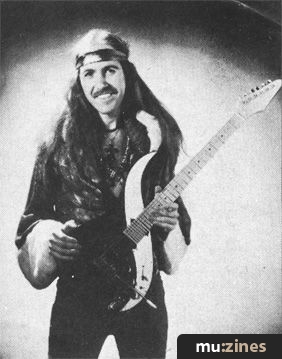
"Uli, here," twanged the line, 'Uli, the guitarist." And so it was, Uli Jon Roth who'd phoned to settle our minds about the very strange instrument he's been pictured with. It has 30 frets, which are not enough apparently. Brighton based Andy Demetreou, the designer of Mk. I is now building another version with a five octave fretboard that extends all the way to the tail pickup (the others are actually underneath the fingerboard). "I always wanted to be able to play in the violin range," crackled Uli down the wire in scant explanation. But it must be murder, the frets can only be a few millimetres apart? "It was difficult to begin with, but now I have learned to play with my fingernails." The results are well worth the effort, he reckons, as it produces an obviously high but very ethereal sound. He's also having the other end of his guitar extended, adding two extra frets to take the E down to a D, but incorporating 'instant capos' to return the six string to normality. A wild and crazy American person.
A couple more off-shoots from the BBC "Rockschool" project have come our way, both based around book-and-tape tutor sets. The first, "The Rockschool Sessions", features the whole Rockschool band — bass, guitar and drums — and is an extension of the Music Minus One idea that's been used mainly in the classical field. It consists of a cassette with various original tunes played as a complete band followed by each of the instruments in turn "missing" so that you can play along, plus a 24-page explanatory book with separate chord/notation charts for the three instruments slipped in. The package will cost you £9.95 (published by Boosey & Hawkes), and seems an effective way of practising different styles alongside good musicians (unless, as usual with Rockschool, you're a keyboard player). The other tutor is Henry Thomas' "Bass Course" published by FCN, consisting of four different-tape-and-book sections in one package, covering Beginners, Speed Licks, Slap & Funk, and Sixty Great Bass-lines. The latter sets assume notational knowledge.
Neat idea for the Commodore 64 from Music Sales. At the moment their music composition software is still in the abacus stages (promise of improvements on the way) but they have arrived at a tidy way of handling the keyboard. A hard plastic cover pops over the top of the 64, leaving space for the function keys at the right and the two bottom rows of typewriter keys. The top half of the cover has two octaves of mini keyboard keys (Casio sized) that press down on certain of the top two rows of Qwerty buttons, making lines and chords far simpler to play. Suggested retail price for the very elementary Music Maker programme, including the overlay, is £29.95.
Publisher: One Two Testing - IPC Magazines Ltd, Northern & Shell Ltd.
The current copyright owner/s of this content may differ from the originally published copyright notice.
More details on copyright ownership...

One Two Testing - Mar 1985
Donated by: Colin Potter
News
Help Support The Things You Love
mu:zines is the result of thousands of hours of effort, and will require many thousands more going forward to reach our goals of getting all this content online.
If you value this resource, you can support this project - it really helps!
Donations for May 2026
Issues donated this month: 0
New issues that have been donated or scanned for us this month.
Funds donated this month: £0.00
All donations and support are gratefully appreciated - thank you.
Magazines Needed - Can You Help?
Do you have any of these magazine issues?
If so, and you can donate, lend or scan them to help complete our archive, please get in touch via the Contribute page - thanks!
Please Contribute to mu:zines by supplying magazines, scanning or donating funds. Thanks!
Monetary donations go towards site running costs, and the occasional coffee for me if there's anything left over!

 @mu_zines
 RSS Feed
 Blog
Blog