


Magazine Archive
Home -> Magazines -> Issues -> Articles in this issue -> View
Slim Lines | |
The MTR SLM82 Line MixerArticle from Home & Studio Recording, November 1986 | |
If you've run out of channels, you might find this little mixer a profitable way to fill up your rack space.
The MTR SLM82 should be considered as an addition, rather than an alternative to your mixer. Paul White decided to investigate what would probably prove a popular model.
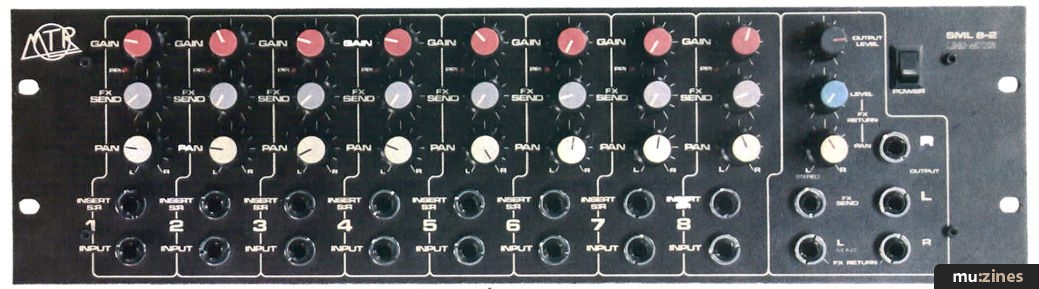
Does it happen to you too? Do you always find that you never have enough mixer channels to cope with all your effects returns or MIDId keyboards and drum machines? This basic line mixer could be a cost effective alternative to buying a bigger desk.
Once you move up from 4-track to 8-track, the restrictions imposed by a shortage of mixer channels become suddenly evident and by the time you move up to 16 tracks, matters get worse. You probably don't have enough dedicated effects returns to handle all the effects units that you have sends for, and that isn't counting those that are mono-in, stereo-out. Add to this any drum machines with separate outputs and synths running from MIDI sequencers and you can see why a basic 18- or even 24-channel mixer just isn't big enough. Buying an even bigger desk might solve your problems but in doing this you might be paying for a lot of facilities that you are unlikely to need. Nine times out of ten a simple and relatively inexpensive line mixer will do the job. An 8:2 mixer plugged into a pair of returns on your desk and panned left and right will give you eight pannable returns instead of the two you started out with. By an amazing coincidence, this is just the type of product that we are reviewing.
A Spicy Mix
MTR are doing their bit for the Keep Music British movement, by building a line of useful audio products in their Shrewsbury factory instead of scouring Taiwan for something cheap to import. One of these useful products is the 82 line mixer.
Occupying just three units of your valuable rack space, this mains powered mixer accepts eight line level inputs (10KΩ unbalanced) and it has enough input gain to deal with anything from keyboards and pedal effects to semi-pro and pro line levels. It doesn't, however accept mic level inputs.
The steel construction is almost utilitarian, but the tasteful brown and cream colour scheme gives it a smart appearance. All the inputs and outputs are located on the front panel; the rear panel sports only the fuse holder and the captive mains lead. Normally this is considered to be bad practice on a rack mounted piece of gear but here it is a big help. By mounting this mixer amongst your patch bays, you can patch your effects directly into it; the only connections which might benefit from being duplicated on the back panel are the main stereo outputs which could then be permanently and unobtrusively plumbed into the rest of the system.
Each of the eight channels has a PPI (peak programme indicator) LED which comes on 8dB before clipping: a very useful feature. Apart from the Input Gain there is an Effects Send control and a Pan control. The need for a pan control is fairly obvious, but you may wonder why you need an auxiliary control. If you are just using the mixer to extend your effects return facilities, then the chances are that you won't, but if you are sub-mixing keyboards or drum machine voices, then they are indispensable. Furthermore, each channel has an insert point in the form of a stereo jack socket, (tip send, ring return) just like the ones on your regular mixer channels so you can patch in compressors, gates, equalisers and the like.
On the master section there are two auxiliary returns controlled by a single level control and these are routed hard left and right in recognition of the fact that many contemporary effects have two outputs. In this mode you should set the effects pan control fully anti-clockwise. However, if you are using a mono effects unit, this may be plugged into the left return only which puts it under control of the effects pan control - good thinking. The main stereo output level is adjusted by means of a single level control, and the mains switch incorporates a useful little red light to let you know that the thing is on.
Plugging this mixer into two effects returns or two channels gives you, in effect, six more channels than you had before but, if you don't need the auxiliary returns on the SLM82, then these too can be used to cope with another stereo effect bringing the total number of inputs up to ten: eight more than you had originally. The noise performance, whilst not being exceptional, is perfectly adequate for the majority of uses and the maximum output level of +21 dB means that you have plenty of gain in hand, regardless of what levels your main desk operates at.
There are some occasions on which EQ would be useful, but then the insert points let you patch in that old graphic pedal that you never knew what to do with; in most cases you can live without it. This mixer is so simple to use that there is very little to say about that aspect. It's one of those pieces of gear that are incredibly useful whilst not particularly exciting.
Conclusions
For its modest asking price, this is a very useful little mixer that will really let you go to town with all your effects units whilst recording and mixing. Its rack mounting format and front panel inputs make it convenient to use, whilst the peak LEDs make it easy to keep a check on levels. It won't give you the same facilities as your main mixer channels and so is something of a compromise but an acceptable one nevertheless. As there aren't many equivalent products on the market, this one should be assured of popularity in the 8- and 16-track studio. It's well thought out, attractively styled and it gets on with the job with the minimum of fuss. What more could you ask?
The SLM82 costs £233 including VAT.
Further details from: MTR, (Contact Details).
Publisher: Home & Studio Recording - Music Maker Publications (UK), Future Publishing.
The current copyright owner/s of this content may differ from the originally published copyright notice.
More details on copyright ownership...
Home & Studio Recording - Nov 1986
Donated & scanned by: Mike Gorman
Review by Paul White
Ads for Gear in this article:


Previous article in this issue:
Next article in this issue:
Help Support The Things You Love
mu:zines is the result of thousands of hours of effort, and will require many thousands more going forward to reach our goals of getting all this content online.
If you value this resource, you can support this project - it really helps!
Donations for September 2026
Issues donated this month: 0
New issues that have been donated or scanned for us this month.
Funds donated this month: £0.00
All donations and support are gratefully appreciated - thank you.
Magazines Needed - Can You Help?
Do you have any of these magazine issues?
If so, and you can donate, lend or scan them to help complete our archive, please get in touch via the Contribute page - thanks!
Please Contribute to mu:zines by supplying magazines, scanning or donating funds. Thanks!
Monetary donations go towards site running costs, and the occasional coffee for me if there's anything left over!

 @mu_zines
 RSS Feed
 Blog
Blog