


Magazine Archive
Home -> Magazines -> Issues -> Articles in this issue -> View
Sound Systems For Synthesizers | |
Article from Polyphony, July 1976 | |
Most people who spend any time at all working with synthesizers quickly become aware of the necessity of a good sound system for the instrument. Unlike other electronic instruments, a synthesizer is capable of creating signals far beyond the extremes of human hearing. Putting together a system to accurately reproduce these signals need not be as costly or cumbersome as first suspected.
Sound systems can be broken down into three classifications of equipment: amplification, speakers and special effects or audio processing equipment. Amplification encompasses the raw power amps to get the little signal voltages converted to BIG voltages which are capable of moving the speakers. Speakers are the device used to change those big dancing electrons into dancing air waves that a human ear can hear. The processing equipment is everything that's left over: preamps, tone controls, equalizers, electronic crossovers, compressor/expanders, mixers and - the list could go on for pages. Hopefully, the following pointers will help you sort all this and put together the type of system you need at minimum expense of time or money.
Speakers are the most important stage of any sound system, because they are what actually connect the sound to our brains (via air and our ears). Unfortunately, they are also the weakest link of any sound system, primarily because they are semi-mechanical devices. They are generally inefficient (much amplifier power is lost in the conversion to motion), and they have a high degree of distortion (the mass of the speaker cone tends to resist musical transients, and the cone may flex unevenly or create standing waves on the surface of the cone, etc.). But, it's the best device we have so far, and acoustics people have found ways to get around most deficiencies, so we use them and hope for a better day. The most important device for making a speaker usable is the speaker enclosure.
When a speaker is set in motion, air waves will be created in front and behind the speaker. If the speaker is hanging in midair, the waves from behind the speaker will bend around and mix with the waves in front of the speaker. Due to the time lag involved, much of the sound will be cancelled because the rear waves will end up being 180 degrees out of phase, or exactly opposite in polarity, to the front waves. The speaker enclosure eliminates this problem by doing one of two things: stopping the rear waves, or routing the rear waves through a mathematically derived passageway and releasing them from the front of the cabinet to reinforce the speaker's front waves. Many sizes and shapes of speaker cabinets have been developed, but they all boil down to a few basic designs. The infinite baffle is a sealed box that only allows the front of the speaker to radiate waves to the listener. These enclosures tend to be inefficient because the pressure of the air in the enclosure works against the speaker cone movement. Also, an infinite baffle must be rather large to have good low frequency response. The ported or bass reflex enclosure is much more efficient because the air in the enclosure is allowed to leave the cabinet to reinforce the front speaker waves. A ported enclosure will produce roughly twice the acoustical output of an infinite baffle with a given electrical input. Ported enclosures also allow more accurate "tuning" of the speaker enclosure which gives a wider, smoother response in the low frequencies. The third basic enclosure style is the horn. These can come in front loaded horns, rear loaded horns, folded horns, reflex horns and more. A horn acts acoustically like a transformer acts in an electric circuit. With a horn system, the speaker is gradually "matched" to the air pressure in the room, so the speaker cone vibrations can produce as broad an area of air motion as possible. Unfortunately, an ideal horn enclosure which would have good low frequency response would need to be very long and have an opening larger than most peoples living rooms. Most commercially available speaker enclosures are a combination of two or more of the above styles. This allows one to have the different advantages of several systems rolled into one. The popular Altec Voice-of-the-Theater system has the low frequency speaker mounted in a horn enclosure which is also a reflex system. The high frequencies are generated separately by a smaller horn system.
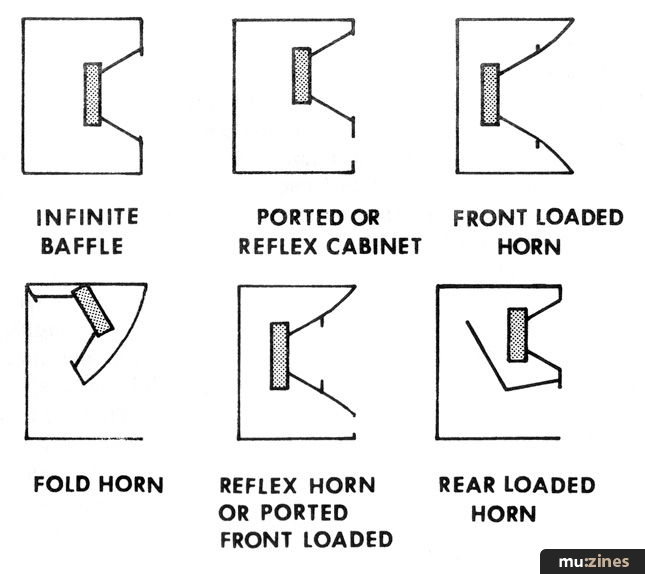
This brings up the point of multiple speaker systems. If a horn or reflex type enclosure is designed to have good low end response, the midrange and high frequencies will not be reproduced because the system will be too large and massive to be able to vibrate at these frequencies. With two speakers, the low frequency unit is called a woofer, and the high frequency unit is called a tweeter. More complex multi-way speakers can also be set up so each speaker can concentrate on an even narrower band of frequencies. It is not uncommon to see six-way speaker systems for use at large high-volume concerts.
Crossover networks are required when more than one type of speaker is driven from one power amp. A crossover is a simple circuit using capacitors and coils to allow only the low frequencies to get to the woofer, and only high frequencies to get to the tweeter. The frequency at which sounds stop going to the woofer and start going to the tweeter is called the crossover frequency and is designated fc. The main problem with L-C (coil-capacitor) type crossovers is that the components must be able to handle the high voltage and current being supplied to it by the power amp. These components are expensive and large in size. Also, when using L-C crossovers, the power amp still needs to work on the complete audio range. This can be a lot of work for the amp and may limit the amount of available power to handle musical transients. The end result could be distortion in the amp, or overheating of output devices. All this depends on the size of the amp, what kind of signals you are amplifying and so on.

Electronic crossovers are devices which have recently become very popular, and are being used more and more in commercial sound systems as well as home stereo systems. And for good reason: The benefits obtained when using these devices are many. First, an electronic crossover is a low power device which is used between the preamp or mixer and the power amp. The circuit is very similar to the filters found in your synthesizer. A full range signal is applied to the input, and the electronic crossover divides the sound into as many frequency ranges as you have speakers for. Being a low power circuit, parts are easy to find, and are cheap. It is also easy to have switch selectable crossover frequencies to add more versatility to the system. After the sound has been divided into various bands, and reinforced with some small amp stages, the outputs are applied to multiple power amps. Each power amp directly drives the appropriate speaker section. Now you may think it's dumb to save some money on a crossover and have to spend a bunch more on power amps - right? Wrong! When electronic crossovers are used, not only is each speaker section working on a separate range, but the power amps are now limited to working on a smaller range of sounds. Thus you can use much lower power amps (which are cheaper) and end up generating more sound than you could with one large amp. If you used two 10 watt amplifiers in a bi-amped system, you could get as much sound output as using one 40 watt amp in a system with an L-C type crossover. That's pretty good - huh? Well, it gets better. If you have a four way speaker system, and a four way electronic crossover, and you use four 10 watt amps, you can get the same amount of sound as using a single 160 watt amp!! Talk about a bargain. And when you consider the fact that you will probably be using amps more in the 50 to 100 watt range, you're talking about a lot of breeze from those speaker systems.

Power amps are a necessity in any sound system, and can be somewhat ambiguous in capability when you first start shopping for them. The main specifications you will see associated with power amps are distortion and power ratings. Distortion you want to be as low as possible, although when you start talking about fractions of a percent (.2% and lower) the ear has a hard time detecting much improvement. So don't overbuy lack of distortion. Power ratings can also be tricky in the following sense. Doubling the amp power will not double the amount of volume you can get from a system. This fact is commonly misunderstood. Perception of sound intensity by the human ear varies logarithmically. Loudness perception also varies with changes in frequency and harmonic content. This is evident when you listen to a triangle wave and a ramp wave from your synthesizer. Although both signals are of the same amplitude, the ramp sounds louder due to the complex harmonic content. Also, when you mix two identical waveforms together, you can hear an increase in volume, but by no means is the resultant sound twice as loud. Yet the signal amplitude IS producing twice as much power from the amp. So now you are asking why everyone is so concerned about high power amps. Two reasons primarily - If an amp is driven at a lower output power, the amp isn't working as hard, it will produce less distortion in addition to not putting a strain on the components in the amp. Also, if you have a high power amp and have it operating at a lower power level, when a musical transient comes along (cymbal crash, attacks of brass or plucked string instruments) the amp will have enough reserve power to reproduce the transient without being pushed into an overload condition and causing distortion.
Accessory units are available to do about anything you have in mind, and can vary from foot pedals for volume control to a 36 channel studio type mixing console. Of course all of these units aren't necessary (thank goodness, we'd all be broke) but some of them can be a big help. A mixing system of some type is important to most keyboard players since you may have a synthesizer, electric piano, organ, maybe a string synthesizer and more. A basic mixer should have separate level controls for each input, tone controls for each input, output assignment (if the unit has more than one output channel), and some master level and tone controls.
Tone controls on a multi-keyboard mixer are fairly important and shouldn't be overlooked. The standard treble/bass controls leave a lot to be desired, and will tend to limit your capabilities as much as helping. Parametric equalization is a much better choice, but of course they cost a little more. Parametric EQ is usually divided into three sections: low, mid, and high. In addition to adjusting the amount of cut or boost in these areas, you can also select the frequency at which the tone control will have it's effect. Master output levels are important, but the master tone controls can be eliminated if you have input tone controls or an equalizer on output. Graphic Equalizers are getting more popular, and prices are going down as filter technology increases.
If you are going to get an equalizer, don't bother with less than five bands. These give one control for each two octaves of audibility, and invariably the frequency you want to adjust will be right between two of the controls and you will need to alter four octaves to adjust the frequency you are working with. Nine or ten bands, on one octave centers, is about optimum and these units can be found for under $100. Some companies make equalizers with as many as 30 bands, and while a very detailed tonal adjustment can be made, they are tedious to use and are more trouble than they are worth. Another handy device is a noise gate or a compressor/expander. A noise gate grounds the audio signal line whenever there is not a signal present that is greater than a preset threshold level. This eliminates hum and hiss from your system when you aren't playing anything. A compressor/expander can do the same type of thing plus more. When in an expansion mode, it will make your loud signals louder, and your soft passages even softer. Thus when your keyboards aren't being played, the volume will be turned down somewhat, and noise will not be as apparent. When a loud signal is played, it will come out a little louder than usual. Transients from the synthesizer or the percussion on your Hammond will be accentuated, and your overall dynamic range can be increased by as much as 100%. In the compression mode, exactly the opposite will occur. Loud sounds will be decreased in volume, and soft sounds will be amplified. The overall sound will then be at a more consistent setting all the time. This effect is good for vocalists in bands, because once the volume is set on the PA system, the vocalist can whisper or shout and will always be heard above the band.
Well, by now you should know a little more about what to consider when developing a sound system for your synthesizer. Sadly, though, we have only scratched the surface of this subject. Following this article is a rather extensive bibliography of material covering in detail the things mentioned in this article. Some of the magazine articles have construction projects explaining how to build and use the items mentioned. Some are more technical discussion of acoustics, speaker design, and other subjects. Also listed are names of some manufacturers that have good info available on what their products will do.
Good luck putting together your personalized sound system, and may all the subtlety of your creative musical expression be accurately reproduced.
SPEAKERS
How to Build Speaker Enclosures, by Alexis Badmaieff and Don Davis, Howard W Sams & Co, Inc., Indianapolis, IN. This book gives good background on the types of enclosures and how to build them.
Loudspeaker Enclosures - Their Design and Use, $2.00 from Altec, (Contact Details). Also ask them for information on their raw speaker components.
The JBL Enclosure Construction Kit, $5.00 from local JBL dealers or James B. Lansing Sound, Inc., (Contact Details). The kit includes material dealing with enclosure design, theory and construction methods. Also included are construction plans for five of JBL's enclosure designs. Also, ask them for information on their raw speakers for both monitor and instrument use.
Speakerlab, (Contact Details). These guys put out stereo type speakers in kit form, and sell enclosure plans and raw speakers. Although I haven't had an opportunity to do business with them (yet), their catalog implies a concern for the customer and high quality merchandise.
Audio Systems Handbook, by Norman Crowhurst, Tab Books, (Contact Details). A good generalized book covering all angles of audio reproduction.
Electronic Projects for Musicians, by Craig Anderton, $6.95 from Guitar Player Productions, (Contact Details). This book has plans for building mixers, preamps, tone controls, compressors, etc.
Southwest Technical Products Corporation, (Contact Details). Send for this catalog for sure! They have the absolute best buys on kits for power amps, equalizers, compressor/expanders, and a lot more.
The Audio Amateur (magazine), (Contact Details). This magazine is a continuing source of excellent, high quality audio circuits. They have just started a four part article on mixers you can build, and in the second issue of 1972, they had an excellent circuit for electronic crossovers complete with theory, modifications, and applications.
Modern Recording (magazine), 15 Columbus Circle, New York, NY 10023. In the June/July '76 issue they printed the first of a three part article entitled "P.A. Primer". This article covers important material with much detail and technical analysis. This article is recommended.
There are many other magazines which also cover sound system equipment periodically. Some of my favorites are:
Audio Magazine, (Contact Details).
db - The Sound Engineering Magazine, (Contact Details).
Journal of the Audio Engineering Society, (Contact Details).
Radio-Electronics Magazine, (Contact Details).
The following companies have equipment available from local music dealers. Write to the companies for literature.
Acoustic, (Contact Details).
Sunn Musical Equipment Co., (Contact Details).
(The above companies have keyboard mixing systems and full range amps and speaker systems.)
Heil Sound Ltd., (Contact Details).
(Power amps, mixers and speaker enclosures.)
Gately Electronics, (Contact Details).
(Equalizers, mixers, etc. Also in kit form.)
Musical Pro Shop, (Contact Details).
(Name brand equipment and accessories sold at really low prices. Instrument amps, P.A. cabinets and mixers, microphones, power amps and mike stands.)
McGee Radio Company, (Contact Details).
(This company has lots and lots of raw speakers at excellent prices. Also, miscellaneous electronic parts and supplies.)
More from these topics
 The Rough Guide To Choosing Microphones |
 Urban decay - Part wall |
 Making waves - Acoustic diffusers |
 A Shiftin' air affair - Bass Traps |
 The Stuff That Rooms Are Made On |
 Building a Home Recording Studio - Acoustics |
 Sound Spaces - Getting Studio Acoustics Right |
 Speaker's Corner - CHOOSING & USING: studio monitoring |
 Room EQ, Myth or Legend? (Part 1) |
 Small Studio Acoustics |
 The Secrets of Timbre |
 Ears |
Browse by Topic:
Acoustics
Sound Fundamentals
Publisher: Polyphony - Polyphony Publishing Company
The current copyright owner/s of this content may differ from the originally published copyright notice.
More details on copyright ownership...
Polyphony - Jul 1976
Donated & scanned by: Vesa Lahteenmaki
Feature by Marvin Jones
Help Support The Things You Love
mu:zines is the result of thousands of hours of effort, and will require many thousands more going forward to reach our goals of getting all this content online.
If you value this resource, you can support this project - it really helps!
Donations for April 2026
Issues donated this month: 0
New issues that have been donated or scanned for us this month.
Funds donated this month: £0.00
All donations and support are gratefully appreciated - thank you.
Magazines Needed - Can You Help?
Do you have any of these magazine issues?
If so, and you can donate, lend or scan them to help complete our archive, please get in touch via the Contribute page - thanks!
If you're enjoying the site, please consider supporting me to help build this archive...
...with a one time Donation, or a recurring Donation of just £2 a month. It really helps - thank you!

 @mu_zines
 RSS Feed
 Blog
Blog