


Magazine Archive
Home -> Magazines -> Issues -> Articles in this issue -> View
Splicing for Effects | |
HSR InsightArticle from Home & Studio Recording, April 1984 | |
How to achieve tape splicing effects.
Any creative recordist who combines patience with tape splicing skill can create effects and sounds which though only costing pence to achieve can be, and often are, the match of those sounds produced on effects units costing hundreds of pounds. The main advantage of electronic signal processors is their ability to create the effect in real time and permit instant adjustment; tape splicing by comparison is laborious and time consuming.
Basics
Getting down to basics, tape splicing is simply the act of joining together the ends of two pieces of tape. It is usually done after a section has been either removed or inserted, and occasionally to repair a snapped tape. The techniques by which the joint is made vary, on the one hand there is the method in which adhesive tape is wrapped around the ends, do not laugh it happens, on the other hand there is the proper method which uses an accurately machined splicing block, cutter and adhesive tape manufactured for the purpose.
Why there is a need for special equipment and materials is obvious when the nature of tape recording is considered - first, it is a magnetic system and anything which affects the tape's magnetic state will affect the final quality, hence the use of non-magnetic materials such as aluminium for splicing blocks. Second, because the tape follows a strict path with the head gap at right angles to the tape edge, joints which do not align exactly will affect the head/tape angle relationship and perhaps snag against something on its way through the machine, reducing the quality in yet another way. The third and final consideration is the splicing tape itself, which should be smooth, thin and exhibit powerful adhesive qualities - many 'sticky' tapes are suitable in those respects, however, a splicing tape must possess two other qualities. The base material must be stable, any stretching would create a minute gap at the joint, exposing the adhesive which must be 'non-ooze', because if adhesive on either the face or edge of the tape contacts anything along the tape path it will slur the tape and affect the reproduction. Unwanted adhesive will also bond together layers of tape on the reels and interrupt the smooth feed as the tape snatches when the bond is being broken. It is false economy not to use proper splicing tape.
Skills
Buying the correct tools for the job is easy, but skill and patience cannot be bought and must be acquired with on the job practice. Probably the best starting point for the beginner is with a speech recording. A single voice with reasonable wordspacing permits easy identification of words when the tape is 'rocked' slowly past the playback head. 'Rocking' is the technique of drawing a short section of the tape back and forth across the playback head to find the exact edit point. The edit point is marked on the tape back, usually with a Chinagraph pencil or a fine felt tip pen, the second edit point is found and marked in the same way, then the edit is completed by removing the portion between the two marks and joining the ends. The joint is made with both sections of the tape aligned properly in the splicing block. As a means of practice, the beginner could remove the 'urns', 'ahs' and cliches from a recording of a local radio DJ's voice, but unless a few minutes are recorded there may be nothing left to splice!
Timing
The results of an editing exercise, such as suggested, will probably highlight the need for timing, a need even more important when working with music, which when badly edited sounds at best like a scratched record. In the case of speech, the wordspaces must be identified and cuts made within them to maintain consistent spacing, thus ensuring a smooth flow to the edited work.
Here is a simple splicing exercise which should serve as an easy introduction into the art of cutting to time. A ruler will be required in addition to the other splicing equipment.
Exercise
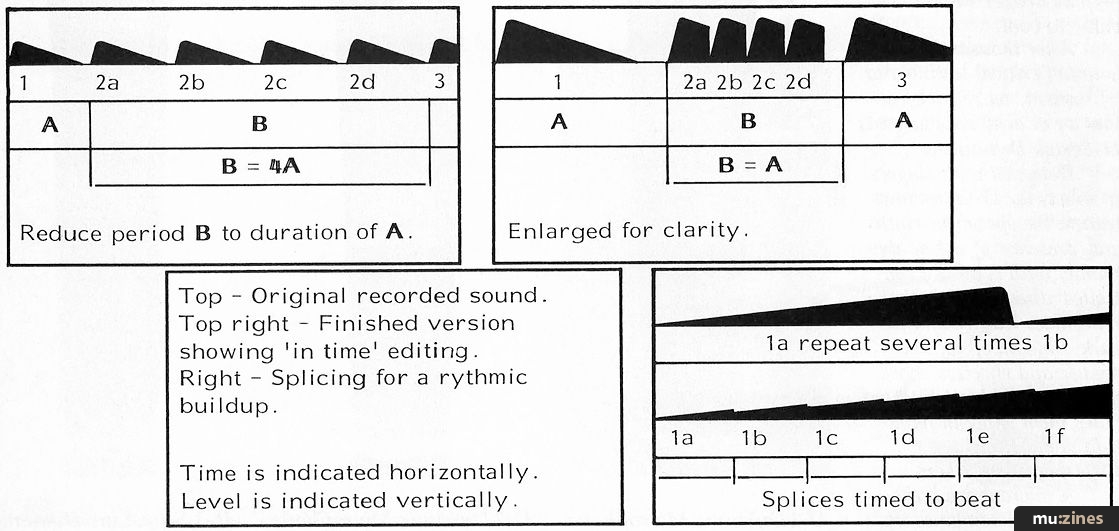
The diagrams will make the idea quite clear, the recordist can apply the principle to any sound, musical or otherwise. The aim is to produce a rapid fire percussive effect. In its most basic form it may be achieved as follows - sounds on counts 2 and 4 are to be repeated, and must therefore be recorded as many times as repeats required. On a four repeat effect the sound or notes of 1,2,3,4 must be recorded as 1,2,2,2,2,3,4,4,4,4 (see first diagram).
For the early attempts it is advisable to use extended sounds or notes, because the increased length of tape required for each sound will aid tape handling during editing.
Once recorded, the distance between sound 1 and 2 is identified by rocking and marking the tape, which is then measured. On the finished tape that distance must be the same as from 2 to 3, which means that sections of 2,2,2,2 must be removed to attain this. Exactly how this is achieved is shown in the second diagram. The process is repeated for 3 and 4 and the end result could be spliced into a rhythm loop or perhaps be reproduced in reverse.
An alternative effect, using the same condensing principle, could be created to provide a distinctive build-up on the introduction to, or decay on the fade of, a piece of music.
The technique requires the recording of a series of extended slow rise sounds, a section of each is removed, with each successive section being removed from further along the sound. The third diagram illustrates how the portions are brought together to produce a single sound, decays may be achieved by a reverse of the technique.
If readers have any recording tips of their own that they would like to pass on to others, then we would be pleased to feature them in future instalments of 'HSR Insight'.
More with this topic
 DIY Music - All You Need To Know About Making Your Own Records |
 Tape Dates |
 When Is A Tape Recorder |
 Tape Manipulation |
 From Studio To Street - The Story Of DAT |
 Tape Line-Up (Part 1) |
 How It Works - Tape Machines (Part 1) |
 Doing That Digital Thing |
 EZ CD UC |
 Tape Rap |
 Optical: Illusion Or Reality? - Optical Media Explained |
 Hands On: Casio DA7 DAT Recorder |
Browse by Topic:
Tape, Vinyl, CD, DAT
Publisher: Home & Studio Recording - Music Maker Publications (UK), Future Publishing.
The current copyright owner/s of this content may differ from the originally published copyright notice.
More details on copyright ownership...

Home & Studio Recording - Apr 1984
Donated & scanned by: Mike Gorman
Feature by Steve Taylor
Help Support The Things You Love
mu:zines is the result of thousands of hours of effort, and will require many thousands more going forward to reach our goals of getting all this content online.
If you value this resource, you can support this project - it really helps!
Donations for July 2026
Issues donated this month: 0
New issues that have been donated or scanned for us this month.
Funds donated this month: £0.00
All donations and support are gratefully appreciated - thank you.
Magazines Needed - Can You Help?
Do you have any of these magazine issues?
If so, and you can donate, lend or scan them to help complete our archive, please get in touch via the Contribute page - thanks!
If you're enjoying the site, please consider supporting me to help build this archive...
...with a one time Donation, or a recurring Donation of just £2 a month. It really helps - thank you!

 @mu_zines
 RSS Feed
 Blog
Blog