


Magazine Archive
Home -> Magazines -> Issues -> Articles in this issue -> View
Stratospheric! | |
Zoom 9002 Advanced Guitar Effects ProcessorArticle from Sound On Sound, December 1990 | |
Six digital effects at once from a Walkman-sized box? Ian Gilby gets turned on by technological progress.

Thirteen years ago I used to spend my winter evenings huddled around the kitchen table, strumming my electric guitar on cue whenever my father wanted me to test the effectiveness of the capacitor or resistor he had just surgically implanted into the wedge-shaped custom pedalboard that he was building out of old Coloursound, Ibanez, and MXR effects pedals, plus a few of his own designs based on modified Tim Orr circuit diagrams published in various electronics magazines. This chipboard monster, coated in black leather cloth and ribbed rubber for nonslip foot contact, measured almost three feet in length and two feet deep, and weighed an absolute ton! It employed the very latest electrical relay switches to select any combination of its six internal effects, and was connected to a modified HH VS Musician combo amp via a military standard Amphenol connector and multicore cable, from which it also drew its life-supporting power.
Thirteen years on I find myself sitting at that very same kitchen table (nowadays it forms an integral part of my home studio), staring in wonderment at the Zoom 9002 Advanced Guitar Effects Processor I hold in the palm of my hand and marvelling at the staggering technological progress we take so much for granted these days.
The Zoom 9002 effects processor hails from the land of miniaturisation, is roughly the size of a Walkman, and weighs about as much. It comes with a rechargeable battery, for standalone use, or may be powered from the 7.5 volt AC adaptor supplied. Two buckle-like 'ears' allow it to be mounted sideways on a guitar strap for convenient operation of its flush-mounted pushbutton controls and sliders. The unit accepts a mono 1/4" jack input from a guitar (or keyboard) and can be set to high or low gain, via a tiny slider switch on the casing edge, for use with either humbucking or single coil pickups. Output is via a stereo jack socket, although a jack-to-phono splitter cable is provided to permit direct connection to a cassette recorder, hi-fi, or mixing desk. A small, fiddly thumbwheel governs the master output volume (and headphones level), although all effects have an individually programmable output level.
In keeping with its Walkman-like styling, the 9002 offers stereo mini jacks for connecting two sets of headphones, though the main output jack drove my Beyer headphones competently with no side-effects. The Mix In mini jack permits an external sound source, such as a Walkman or CD, to be fed into the Zoom unit so that you can play along with your favourite tracks — handy for working out guitar licks. Even handier are the built-in tuning oscillator (440, 441, or 442Hz) and the programmable internal metronome (40-250 bpm), both of which have a fixed output level, unfortunately.
The 9002 packs one heck of a sonic punch. Up to six different effects may be chained together to create a patch, and you can store 20 patches (as five Banks of four) within the non-volatile User memories. A further 20 patches are permanently stored in the Preset memories, which cover a wide range of guitar styles and include something for everyone.
The Compressor and Distortion effects sensibly employ analogue circuitry, whilst the Equaliser (High/Low EQ or Exciter), Modulation section (+/-1 octave Pitch Shifter, Phaser, Flanger, Chorus), Delay (1 sec maximum repeat echo), Reverb (Ping-Pong Delay; Large Hall, 4 seconds; Small Room, 160 milliseconds), and SFX (Sample & Hold, Dynamic Wah, Ring Modulator) all rely on 16-bit digital conversion — and it shows. The Zoom 9002 is remarkably free of unwanted background noise, so much so that I suspect there is also some form of noise gate acting upon the audio output.
A patch is activated by incrementing the Bank parameter in the large 60x30mm LCD window to the required number (User 0-4; Preset 0-4), using the Bank Down/Up buttons, then pressing one of the four Patch buttons. The adjacent red LED indicates the current selection. The four Patch buttons are duplicated on a small, plug-in remote control unit, which is designed to attach via a Velcro strip to your guitar's body (rather yours than mine, buddy!) for more convenient patch selection during a live performance.
Effects may be added to or removed from the patch using the Effect on/off button, and the current selections are shown by a dot appearing alongside the effect names in the LCD window. Certain effects permutations are not possible due to processor limitations: you cannot have Flanger and Chorus in circuit simultaneously, for instance, though you hardly notice such restrictions in practice. Each effect has up to three programmable parameters (shown in the LCD), whose values are easily set using the three slider controls: When happy with your new creation, the Store button lets you save the patch in one of the User memories.
The quality of the Zoom effects is exemplary, and the range of Distortion presets are amongst the best I have ever encountered. The modulation treatments all offer healthy degrees of pitch variation and depth, whilst the octave tracking capability of the Pitch Shifter is a match for any dedicated unit. The Reverb adds a welcome perspective and the Chorus is capable of truly shimmering treatments. As a multi-effects processor for guitar, the Zoom 9002 is good value for money, covers all the bases with consummate ease, and should not disappoint any electric guitarist. Apart from the lack of a backlit LCD, it's a technological miracle. Brilliant!
FURTHER INFORMATION
£369 inc VAT.
MCMXCIX, (Contact Details)
Publisher: Sound On Sound - SOS Publications Ltd.
The contents of this magazine are re-published here with the kind permission of SOS Publications Ltd.
The current copyright owner/s of this content may differ from the originally published copyright notice.
More details on copyright ownership...
Sound On Sound - Dec 1990
Review by Ian Gilby
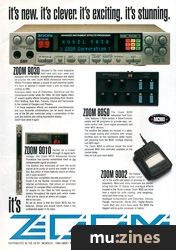
Ads for Gear in this article:

Previous article in this issue:
Next article in this issue:
Help Support The Things You Love
mu:zines is the result of thousands of hours of effort, and will require many thousands more going forward to reach our goals of getting all this content online.
If you value this resource, you can support this project - it really helps!
Donations for May 2026
Issues donated this month: 0
New issues that have been donated or scanned for us this month.
Funds donated this month: £0.00
All donations and support are gratefully appreciated - thank you.
Magazines Needed - Can You Help?
Do you have any of these magazine issues?
If so, and you can donate, lend or scan them to help complete our archive, please get in touch via the Contribute page - thanks!
If you're enjoying the site, please consider supporting me to help build this archive...
...with a one time Donation, or a recurring Donation of just £2 a month. It really helps - thank you!

 @mu_zines
 RSS Feed
 Blog
Blog