


Magazine Archive
Home -> Magazines -> Issues -> Articles in this issue -> View
Suzuki Dynamic Mikes and Instrument Leads | |
Article from Music UK, August 1983 | |
Suzuki mikes plus Eelectriks leads — new mikes, new leads.
Although relative newcomers on the British scene, Japanese manufacturers Suzuki have established a significant reputation for themselves in the USA, the market they chose to exercise their talents in before coming to the UK.
Now Suzuki, via importers Craftmaster Ltd, are all set for a major assault on our market and it looks as if we'll be seeing a considerable number of their products in the shops - time for a test of their abilities, we thought. A call to the importers elicited three mike samples and several instrument leads. The usual MUSIC U K 'They shall be tortured' tests were conducted - the results follow....
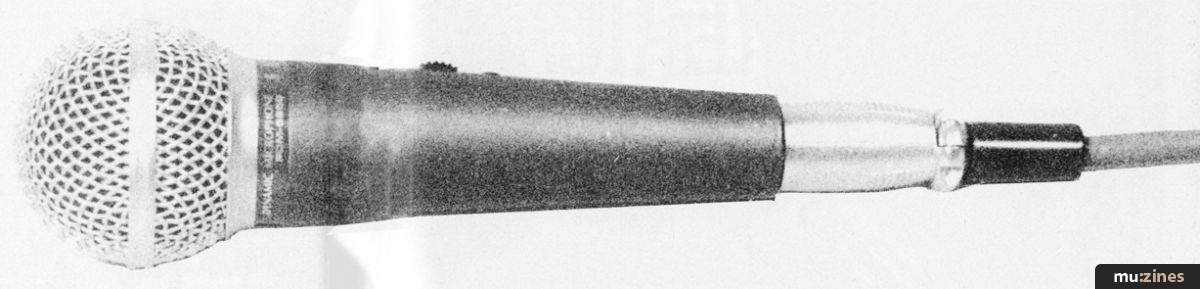
SUZUKI DYNAMIC MIKE PDM-5820 (RRP £39.95 inc VAT)
A ball headed unit, the inexpensive PDM-5820 is claimed to be suitable for 'general purpose' use. The mike's output impedance is properly classed as 'low' (which means that you can use it with long cable runs without fear of interference in the high frequency regions) although it does mean that you'll have to use the mike with a suitable mixer and/or mixer amp. Generally speaking, low impedance mikes are to be preferred for normal stage use, and this one has a rated impedance of 400 ohms.
A line-transformer is available from the range for buyers who wish to use this low impedance mike with equipment only capable of high impedance working.
The mike comes well packaged, with XLR connectors at both ends of a generous length of good quality cable. The sort of market these mikes are likely to appeal to would tend to prefer XLR connectors at one end and standard ¼" jacks at the other, but changing the connector over is no problem, and a spare XLR is always useful!
The PDM-5820 seemed reasonably sturdy, although testing to absolute destruction was beyond the scope (if not the natural tendencies!) of our review team. The mike appeared, however, to be well engineered, was fitted with an on/off switch on its slate grey barrel, with a dull (non-reflective) wire-mesh covering on the ball head.
Frequency range quoted for the 5820 is a reasonable 70-16,000 Hz, which compares favourably with similar priced mikes from the major established manufacturers. The Suzuki has a very adequate frequency range to enable the mike to cope with most instrument and all vocal applications.
Tests conducted on the 5820 showed it to be a good performer for the price. Direct comparisons with the major competitors (for example, the Shure Unisphere 518) were not possible, but we feel that the Suzuki offers an operating quality which is well up to par. In absolute terms, the mike was inclined towards a somewhat muddy bass and mid response but the top frequencies were well defined and the mike had a good deal of presence. High frequencies were, in fact, this mike's real area of success and it would seem to be particularly useful for back-up vocals, some instrument miking roles and general purpose use in most semi pro bands.
SUZUKI RDM-5850 DYNAMIC MIKE (RRP £49.95 inc VAT)
Similar in appearance to the 5820, the Suzuki PDM-5850 is another 400 ohm, low impedance mike. Like its cheaper brother, it's obviously well made, fitted with an on/off switch, provided with a claret-coloured anti-pop 'sock' and has an overall pleasing appearance to it.
This model seemed to us to be fairly sharp sounding, with really excellent response in the high frequency range - although it did have a tendency to run over into some harshness at times.
The Suzuki PDM-5850 doesn't have the creamy smoothness of response in the mid, lower mid and bass that, say, many Shures have, but it is an 'alive' sounding mike with good articulation of top responses, making it specially suitable for Rock vocal use and some backline amplification purposes. For the money, the 5850 is a very good buy indeed - it would suit many bands for back-line use and/or vocal reproduction, providing you weren't looking for a smooth response in the bass/lower mid - a good Rock mike, of course.
SUZUKI PDM-5870 (RRP £57.95 inc VAT)
This really is a fine mike. It may look superficially like the other two but its performance level is well up with some of the best mikes around - and the price being asked for it makes it an impressive bargain. Frequency response is quoted by the manufacturers as 70-18,000 Hz - a figure which, if genuinely achieved (and we have no reason to assume that it hasn't been) would suit this mike to a wide range of applications.
Once more the physical details resemble the 'family' look of the other two Suzukis, but the performance level really is high. We tested this mike extensively and found it ideal for vocal use, both for 'live' and recording applications. The 5870 offers a level of performance considerably below the price of competing units. Tests conducted show it to be well suited for both vocal and back-line work (although we are inclined to feel that the latter would be almost a waste of this mike's qualities).
Any lead vocalist looking for a first rate vocal mike, or any band where the backing vocalists fancy their chances, would be recommended to check this mike out.
In ultimate terms it would seem as if there is a shared tonal characteristic between all three of the mikes we tested here, because even this model has its major strengths around the upper frequency range, which gives it, once more, a 'forward' sound. If this is the kind of tone you like then, subject to a robustness which we couldn't check (although the Suzukis seemed OK in this respect) we would strongly advise you to give it a try. Once more, this Suzuki is particularly good value for money.
SUZUKI EELECTRIKS LEADS
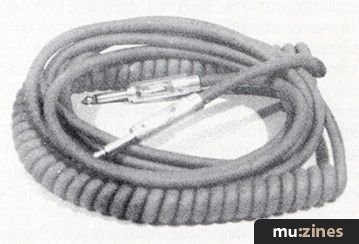
There's probably no single more frustrating experience for a musician or singer than having his or her otherwise flawless performance ruined by a duff instrument lead. We've probably all had it happen to us at some time or another - that crackle, splutter - nothing. The wise ones among us (not that we've ever met any!) are supposed to take their leads to pieces every few gigs or so and give them a check-over for poor connections. Not that this, of course, is the only cause of problems. Bad insulation and broken-up wires won't show unless you test your leads on a meter or lead tester and, honestly, how many players bother?
Hopefully, buying better quality leads and plugs will alleviate many potential areas of disaster. Throw out those guitar lines which come with your instruments (yes, those moulded jack plug types with cable no thicker than sewing cotton!) and get yourself some decent leads and plugs.
Few manufacturers have specialised in this area, so Suzuki are about to have a 'go' at a largely untouched market with a line of quality leads which we should be seeing in local music shops soon.
'Eelectriks' currently comprise a wide range of leads; 10' and 20' straight and coiled cables, 'Y' cords, mike leads, a 6" straight lead (ideal for patching effects etc) plus male to female jack converters.
Instrument leads from the Suzuki range are 3/8" thick and terminate in what the makers describe as 'military style' solid brass (chromed) jack plugs. We're dubious about the use of the word 'military' in this context, as it originally came from the States and refers specifically to equipment manufactured to US Army specifications. It isn't really a term which should be used as loosely as this because those specs, are tremendously high.
Nonetheless, the plugs on the Suzuki leads (both jack and XLR types) which we saw were quite heavy duty and the male ¼" jacks have a unique (and welcome) feature in that they are shrouded in a thick perspex material which lets you see the condition of the soldered joint, an early-warning facility which could well save your gig!
The cords themselves seem to be particularly supple, employing neoprene covering (finished in an attractive grey with a burgundy coloured 'Suzuki' logo repeated down the cable length) and are double shielded. We tortured a sample set of leads; stretching them, exposing them to powerful interference signals, jumping on them (really!) but they stood up to this manic abuse well, showing no tendencies towards microphony or static break-up.
The brochure which comes with the Eelectriks cords does make a few claims which we would be inclined to be a bit sniffy about: "It's the best, the ultimate, the only premium product of its kind you'll ever be satisfied with." Frankly that's overdoing it. The Suzuki Eelectriks are good — and their prices are fair. They just don't need to indulge in that sort of hyperbole to sell them. It's too off-putting because the leads are perfectly good enough to sell without that nonsense and, anyway, there are, we'd suggest, better ones around - it's just that they cost far more than most of us can afford! The Suzuki leads offer excellent performance characteristic at first class prices (see below). That's good enough for anyone and we'd suggest you ignore the exaggerated claims and just give them a try on their own merits - we don't expect you to be dissatisfied.
Prices range from £6.99 for a 10' straight lead, through £8.99 for a 20' version, £8.50 for a coiled 10' type, £10.50 for a 20' coiled. Mike leads range from 20' low impedance with X ER-type connectors at £12.50 to £16.99 for a 40' version. All prices quoted are RRP's including VAT.
Further details of all Suzuki products from Craftmaster (UK) Ltd, (Contact Details).
Also featuring gear in this article

Publisher: Music UK - Folly Publications
The current copyright owner/s of this content may differ from the originally published copyright notice.
More details on copyright ownership...

Music UK - Aug 1983
Gear in this article:
Microphone > Suzuki > PDM 5820
Microphone > Suzuki > PDM 5850
Microphone > Suzuki > PDM 5870
Gear Tags:
Review
Previous article in this issue:
Next article in this issue:
Help Support The Things You Love
mu:zines is the result of thousands of hours of effort, and will require many thousands more going forward to reach our goals of getting all this content online.
If you value this resource, you can support this project - it really helps!
Donations for June 2026
Issues donated this month: 0
New issues that have been donated or scanned for us this month.
Funds donated this month: £0.00
All donations and support are gratefully appreciated - thank you.
Magazines Needed - Can You Help?
Do you have any of these magazine issues?
If so, and you can donate, lend or scan them to help complete our archive, please get in touch via the Contribute page - thanks!
Please Contribute to mu:zines by supplying magazines, scanning or donating funds. Thanks!
Monetary donations go towards site running costs, and the occasional coffee for me if there's anything left over!

 @mu_zines
 RSS Feed
 Blog
Blog