


Magazine Archive
Home -> Magazines -> Issues -> Articles in this issue -> View
Suzuki Guitar transceiver | |
Article from One Two Testing, May 1984 | |
Throw away those leads
The first time radio mikes appeared in this country, they were something of a handful. Toupé bearing types like Bruce Forsyth could be seen clutching what resembled a small fire extinguisher with a shoelace at one end. They were heavy, long and unwieldy – but that's always been the way with toupés. The mikes weren't much better.
Now that the problems of size, reliability and interference have largely been tamed, the battle is on to produce cheaper versions for the mass market. Ibanez had a prototype at Frankfurt last year, Yamaha are said to be working on a system, but for the time being, it's Suzuki who have plunged into the market place with their "wireless guitar transmitter, strap and receiver set".
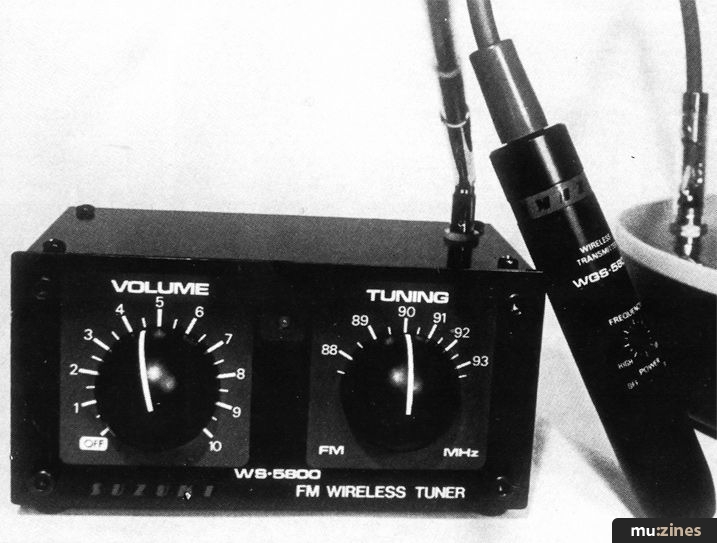
The title supplies an accurate breakdown of what's inside the box. Travelling backwards, the receiver is a black metal box powered by four penlight batteries and carrying a built-in telescopic aerial, rising to about two foot. This half of the package sits on or near the amp, connecting to it via a single output jack at the rear. There are also sockets for an external aerial, presumably to help you increase the range, and a 6volt DC supply. Round the front are volume and tuning controls, but we'll come to them later.
The transmitter is a black tube not unlike a grossly overweight Biro, with a short length of cable leading to a jack socket that slips into your guitar output in a perfectly normal manner. This end is powered by a mini 6volt battery (4LR44) in a compartment not unlike that of a standard mike. There's an on/off switch and a tuning control to match the receiver, but this time it's on a small screwdriver adjusted pot submerged in the body.
Finally you need a transmitter aerial. Looked in the box, nothing there except this red plastic strap – aha, damn cunning that. The strap itself forms the aerial. There's a small pocket at one end to hold the transmitting tube, a wire runs most of the length of the strap beneath the surface, ending in a small plug that fits into the end of the tube.
Unfortunately, unless you know someone with an O-level in needlework who can unpick the aerial and sew it into a strap of your own choice, you're stuck with the Suzuki one which, though it may be a reasonably attractive wine red, is not a masterpiece of design. The buckle kept digging into my left shoulder and you can't turn the strap round because then the transmitter would be at the wrong end. Still, what's comfort when you're mobile, and at least the deal includes all the batteries needed and a miniature screwdriver for fine tuning adjustments.
The Suzuki's chosen bandwidth can also pick up taxi firms and local FM stations. Should you find at the soundcheck that frequent requests for "4-10 for P.O.B. to the Horse and Feathers" interrupts the ballad it's possible to shift the transmitting frequency in 0.5MHz steps to find yourself an air space. Similarly, if there are TWO of you on stage using radio mikes, you'll need to be tuned apart. Again Suzuki say that a separation of 0.5MHz should suffice.
The receiver is really no more than an FM radio, similar in design to that you'd find in a hi-fi. Push the tuning control up around 90-93MHz and Radio Two etc, will beam in. There is a muting system which cuts down noise between stations and opens the receiver fully when the incoming signal is at maximum.
You'd have to be blind, deaf and daft not to find your own signal on the dial. It bursts through loud and clear, and an LED in the centre panel lights to show it's locked onto the frequency. The volume control then directs the level going to your amp but, importantly, the Suzuki reflects exactly what your guitar is doing. If you turn the guitar volume down, then you hear that at the amp WITHOUT the signal breaking up, WITHOUT extra noise developing. All bowing effects etc. remain intact.
Talking about noise, this is the Suzuki's major drawback – it's hissy, at least as much as a couple of effects units in line, and possibly more. But surprisingly I found few hums, buzzes or whistles, even when the receiver was at close quarters with amps and other gear.
Outside broadcasts are another matter. In the couple of hours I tried the Suzuki I only got one taxi broadcast but several inexplicable, silent 'shut downs' of ten seconds or so, almost as though the signal was being jammed. Twiddling the receiver's tuning control made no difference. Perhaps the neighbours really are spies.
The range is more than adequate for the average Marquee/pub stage and I was pleased that the angle at which I stood (therefore, the angle of the transmitter aerial) made no difference to the signal strength. Suzuki do not supply info on how far the transmitter can send, but it would get you to the mixing desk and beyond. At home I was down several flights of stairs and out in the garden before it gave up, and wisely, the Suzuki doesn't allow your signal to fade, it cuts off dead.
The full frequency range of the guitar is transmitted intact, perhaps there's a tiny loss of top end but nothing compared to what the average effects unit would suck out. The feeling of freedom, to be able to stroll anywhere without a dangling lead behind you, is uncanny and magnificent. Now I know what a dog feels like when you let the lead off.
Radio mikes tend to drain their batteries quickly – roadies will tell you that most pro-bands will replace the cells for every performance. The Suzuki transmitter tube is also microphonic – clonk it with so much as a fingernail and a resounding click will issue from the amp. But in normal use there are no stray noises. On a fussy point, once the tube is in its sleeve, it's fiddly to reach to turn on and off.
Warning: The 88MHz (FM) band Suzuki have selected is officially reserved for hospital bleepers. You can buy the transceiver, sell the transceiver, no problem, but if you USE it you stand the chance of being prosecuted. You're the one taking the gamble that its short, 60ft range won't be picked up.
£99
Publisher: One Two Testing - IPC Magazines Ltd, Northern & Shell Ltd.
The current copyright owner/s of this content may differ from the originally published copyright notice.
More details on copyright ownership...

One Two Testing - May 1984
Gear in this article:
Review by Paul Colbert
Help Support The Things You Love
mu:zines is the result of thousands of hours of effort, and will require many thousands more going forward to reach our goals of getting all this content online.
If you value this resource, you can support this project - it really helps!
Donations for May 2026
Issues donated this month: 0
New issues that have been donated or scanned for us this month.
Funds donated this month: £0.00
All donations and support are gratefully appreciated - thank you.
Magazines Needed - Can You Help?
Do you have any of these magazine issues?
If so, and you can donate, lend or scan them to help complete our archive, please get in touch via the Contribute page - thanks!
Please Contribute to mu:zines by supplying magazines, scanning or donating funds. Thanks!
Monetary donations go towards site running costs, and the occasional coffee for me if there's anything left over!

 @mu_zines
 RSS Feed
 Blog
Blog