Synthesizer Design
(ES Sep 83)


Magazine Archive
Home -> Magazines -> Issues -> Articles in this issue -> View
Synthesizer Design (Part 3) | |
Article from Electronic Soundmaker & Computer Music, January 1984 | |
Jezz Woodroffe's page
Signed, sealed and delivered — this month Jezz Woodroffe explains Envelope Generators
Once again this month's article is being written in a hotel room, this time in down town Chicago, Illinois. I've just finished five concerts with the Robert Plant band in six days — the smallest crowd was 5,000 and the largest 18,000 here in Chicago with the whole place going crazy and three encores. Playing to that many people under those masses of boiling hot spotlights has been taking its toll, not to mention the excess alcohol (which I won't mention). Anyway, back to this month's subject which is Envelope Generators or ADSR's.
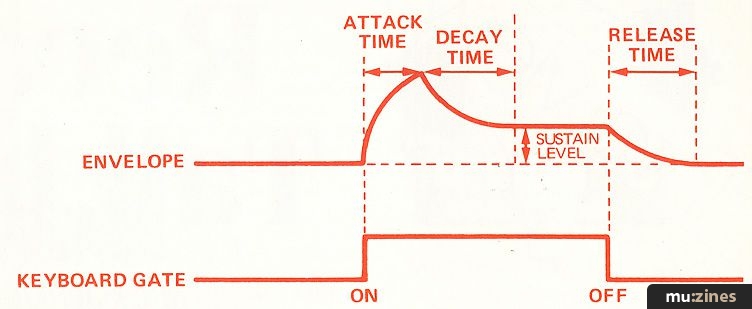
Envelope state related to key position
Envelope Generators
The main function of the envelope generator, EG or ADSR is to create a control voltage to send to the filter, amplifier or even oscillator. Some synthesizers have two EG's, one for the filter and one for the VCA — some have only one and occasionally you'll find a synth with one and a half. That may sound silly but it won't once I explain the main components of the device.
Quite often envelope generators are known as ADSR's because their four main controls are Attack, Decay, Sustain and Release. Although most musicians know this, there is often confusion between Decay and Release or about the exact nature of Sustain, so let me clarify this by explaining each section in a little more detail.
Attack
A French Horn played gently would have a slow attack as the sound begins quietly and gradually becomes louder. A vibraphone or snare drum has a fast attack as the sound begins at full volume almost instantly — so long or slow attack refers to a sound which takes some time to build to its full level and short or fast attack to a sound which comes on almost instantly. Since instruments have all sorts of attack lengths we need to have a variable control on the envelope generator to create any attack we wish, and most attack controls on synths are variable from 1-10 — 1 being instant (or measured in milliseconds) and 10 being so long that you'd get bored waiting for the sound to arrive.
From a technical point of view, the Attack control is producing a delay in allowing the output voltage to reach its full level, beginning from the moment the keyboard sends its trigger signal after a key is pressed down.
Decay
Decay is the time a sound takes to reduce to its Sustain level, which in a synth means the time required for the voltage produced by the ADSR to fall from maximum to the sustain level. The exact difference between sustain and decay can be a source of confusion because sustain means very different things to a guitar player and a keyboard player. Even sustain on a piano is not the same as sustain on a synth — approached from a synth player's point of view it's actually a Release pedal.
When playing a note on a piano there is a very fast (short) attack. While the key is still held down the sound decays (grows fainter) but holds on for quite a time (sustain). If during this period the key is released the sound dies away almost immediately (short release) to nothing. But if you put your foot on the 'sustain' pedal before you let go of the key the sound will continue after you've done so, which represents release time to us lot — so you piano players have technically got it wrong!
Sustain
By explaining decay we are already halfway to understanding sustain — I think that this control is the most important on the envelope generator. With attack, decay and release turned completely off and any sustain up you'll always get a sound to work with. This sound will continue as long as a key is held down, with the level (volume) being determined in relation to the full volume by how far the decay allows the voltage to fall. Remember that sustain is a level, not a time like the other three EG controls, and the envelope stays in its sustain phase as long as you hold a key down. If no sustain level is selected the envelope will attack, then decay or release depending on whether you release the key, and become silent whether you hold a key down or not, but with a little sustain level you'll always hear something.
As soon as the key is released the sustain is ended and the EG goes into Release phase.
Release
Release time is fairly straightforward — if you want the sounds to end as soon as you release a key then use a zero release time, and if you want them to fade away gradually a high release value is required — it's as simple as that. A bell or thunderclap or cymbal sound would have a long release, a plucked bass guitar or gunshot would have a short release.
Assignment
I hope I have made fairly clear what an envelope generator is and now we can look at what it does. One of the most important controls on a synth is the EG depth control, usually found near the filter's frequency and resonance controls. The EG depth or amount of influence on the filter is crucial to creating sounds exactly as you want them. The slightest alteration of EG depth can drastically alter the effect of the envelope generator — try moving this control about and you'll be amazed at the difference it can make.
The envelope generator on most synths is permanently routed to the VCA so that the volume of each note follows the course of the A, D, S and R sections. The amount of influence on the filter is usually variable though, from a very mild 'twang' or 'wah' effect (depending on the exact settings) to a very dramatic influence. Some EG's can also be routed to affect the pitch of an oscillator or two, resulting in 'disco drums' (long decay/release with deep effect) or 'space sounds' (quick attack/decay sounds repeated). Some synths don't have this facility at all though, such as the Wasp.
Earlier I mentioned that some synths had one and a half envelopes — that is, a full ADSR and a simpler AD/ASR. The full EG is usually routed to the filter and the half EG to the VCA. This gives you greater control over the sound and enables you to give, say, the volume a fast attack and the filter a slower attack for a slowly developing and expressive note. Synths I can think of that do this include the Moog Prodigy and Roland SH-1.
Well that's it for this month — next time I hope to tell you how I have unravelled the very confusing story of the Roland MC-202 and MC4A MicroComposers which I've just purchased last week. Oh yes, and there's an album I've been listening to which is great, Thomas Dolby's 'Golden Age Of Wireless' (EMI) — great application of keyboards here, give it a spin!
Series - "Synthesizer Design"
This is the last part in this series. The first article in this series is:

All parts in this series:
More with this topic
 Patches |
 The Synth Is Dead: Long Live The Synth |
 A Programmer's Guide to the Roland D110 (Part 1) |
 The Lazy Guide To Good Synth Sounds |
 Hands On: Korg M1 |
 Bio Music |
 Sounds Natural - The Acoustic Guitar (Part 1) |
 The Future of Synthesis |
 Advanced Music Synthesis - Inside the Yamaha GS1 & GS2 |
 Music Modules for NON-Keyboardists |
 Synth Computers |
 Understanding the DX7 (Part 1) |
Browse by Topic:
Synthesis & Sound Design
Publisher: Electronic Soundmaker & Computer Music - Cover Publications Ltd, Northern & Shell Ltd.
The current copyright owner/s of this content may differ from the originally published copyright notice.
More details on copyright ownership...

Electronic Soundmaker - Jan 1984
Donated & scanned by: Mike Gorman
Feature by Jezz Woodroffe
Help Support The Things You Love
mu:zines is the result of thousands of hours of effort, and will require many thousands more going forward to reach our goals of getting all this content online.
If you value this resource, you can support this project - it really helps!
Donations for August 2026
Issues donated this month: 0
New issues that have been donated or scanned for us this month.
Funds donated this month: £0.00
All donations and support are gratefully appreciated - thank you.
Magazines Needed - Can You Help?
Do you have any of these magazine issues?
If so, and you can donate, lend or scan them to help complete our archive, please get in touch via the Contribute page - thanks!
Please Contribute to mu:zines by supplying magazines, scanning or donating funds. Thanks!
Monetary donations go towards site running costs, and the occasional coffee for me if there's anything left over!

 @mu_zines
 RSS Feed
 Blog
Blog