


Magazine Archive
Home -> Magazines -> Issues -> Articles in this issue -> View
Tascam GS-30 | |
Guitar Amp SimulatorArticle from Home & Studio Recording, March 1989 | |
With packaging similar to the MTS-30, Tascam's latest gives us a decent attempt at getting a guitar amp sound in a box.
Tascam have joined the race to create a DI device that sounds like a miked-up guitar amplifier.
There's no doubt in my mind that there is still no substitute for putting a good amp in a sympathetic room along with some nice mics and just recording what comes out of the speaker. But guitar amps tend to sound their best when at their loudest setting, and that kind of sound level might be out of the question in the home studio. Add to this the fact that you might not have a room available that suits the amp and that you might have a limited choice of microphones and the case for the DI approach starts to look a lot stronger.
Tascam have taken a very sensible approach - they have acknowledged that most studios already have reverb units, compressors, delays, chorus effects and suchlike, so they've stuck to providing the basic essentials. This in turn has kept the price down which is always welcome news.
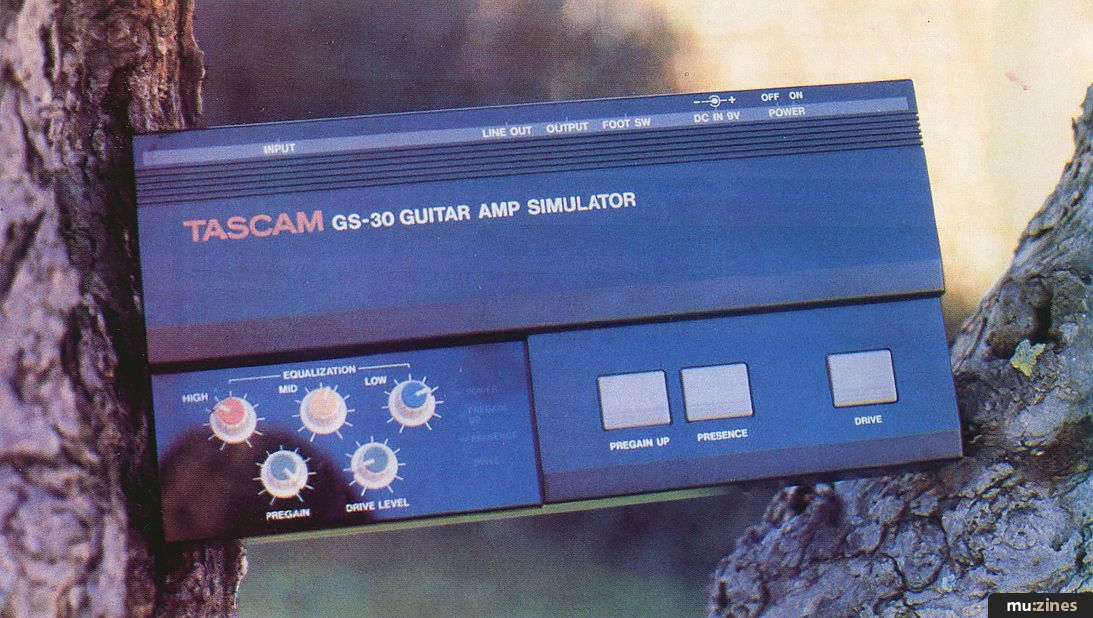
Physically, the GS-30 looks very, very similar to the Tascam MTS-30 MIDI Tape Synchronizer - and that's hardly surprising as they've used the same basic case for both machines. Does that mean that we can expect more exciting processors in the 30 series I wonder?
Power can be provided from a single PP3 type 9V battery or from an optional mains unit, but because of the lack of on-board digital processing, the battery life is reasonably long. And so to the elements that make the GS-30 what it is. In essence we have a guitar preamp with similar facilities to the ones found on regular guitar amps: overdrive, three-band EQ plus presence and of course some kind of electronic filtering to simulate the way a guitar speaker colours the sound played through it.
Concept
The unit is a mono in, mono out device which provides a choice of two output levels at -36dBu and -20dBu so that it can be connected either to the input of a guitar amp or to a recording mixer. The level is a little on the low side for mixers operating at +4dBm so it may be better in this case to feed the GS-30 into the mixer's mic input.
The in and (two) out jacks are located on the rear panel along with the power switch and a socket for the external power adaptor. Additionally, there is a footswitch socket for bringing in the overdrive effect using an external footswitch (not supplied).
In the control department, things couldn't be simpler - there are just five knobs, the top three of which control the EQ and the bottom two the preamp gain and the drive level which sets the amount of overdrive.
Interestingly, the EQ is a passive High, Mid, Low design similar to those found in Marshal and Fender amps as these are generally accepted as being the most musical for use with electric guitar. A further button on the front panel allows Presence to be turned on or off at a preset level, and like its guitar combo counterpart, this seems to add a little upper mid bite to the sound. Another button brings the Drive effect in or out (just the same as doing it via the footswitch) and finally, a button labelled Pre-gain switches in a preset level of preamp boost. As you can see, everything is pretty straightforward so how does it sound in practice?
The Sound
Initially, all DI guitar techniques tend to sound a little lifeless but that's simply because what you're hearing is devoid of any acoustic ambience - If you miked up a Mesa Boogie in an anechoic chamber you'd probably experience a similar thing. In order to make the sound workable, some degree of artificial reverb is absolutely essential, even if it's only a small room setting to take away the dry, clinical edge.
"Adding a little reverb to the GS-30 and trying out the clean sounds first proved quite effective in creating a wide range of rhythm guitar sounds though you don't get that slightly jangly edge that you might expect from a top flight valve combo."
Adding a little reverb to the GS-30 and trying out the clean sounds first proved quite effective in creating a wide range of rhythm guitar sounds though you don't get that slightly jangly edge that you might expect from a top flight valve combo. I suppose you might compare the result to a good transistor amp - plenty of useful tonal variation but a little short on sparkle, even with the presence switched in. Still, a few other processing tricks such as compressing the output or adding a bit of artificial top from an Exciter really helps to bring the sound alive.
Kicking in the Drive circuit proved particularly interesting. Most guitar processors including the Axxeman and Rockman give a highly produced but somewhat artificial effect - but the GS-30 is quite different. For a start, you don't really get any more overdrive than you would from a decent guitar combo so if you want to use a really long sustaining fuzz, you need to patch in a fuzz box. What you do get is a late sixties, early seventies kind of rock sound with plenty of clunk at the bottom end and the kind of distortion you can use on chords without the sound disintegrating into a dreadful mess. At full distortion, there is some noise evident but this is probably no more than you'd get from a miked-up combo and it could be argued that amp noise and guitar handling noise are an integral part of the rock sound.
Using a Strat or similar single-coil guitar, you need to use pretty much all the distortion that's on offer to get as much as you might like for solo'ing, but for chords or raunchy R&B it works pretty well.
Humbuckers fare a little better in the power department and here you can develop quite a searing lead sound, though without the nice harmonic response you get from keeping the guitar on the edge of feedback all the time. Perhaps you could get this if you dare turn up your monitors really loud but that would defeat the object to some extent wouldn't it?
Verdict
This is one of the better devices I've tried out for getting a good basic clean or overdriven guitar sound though it should only be considered as a starting point and further processing may be necessary, particularly reverb. What I really liked was the down-to-earth overdrive sound which didn't try to glamourise the miked-up combo sound but simply tried to emulate it as well as possible. Particularly successful was the low-end punch which went some way towards emulating the resonant effect of an overdriven speaker in a guitar valve combo.
I think it will be a while yet before we get a DI'd sound we're totally happy with but the GS-30 comes up with a range of both clean and dirty sounds that can be worked on to give more than respectable results. I must say at this point that the model reviewed was a pre-production prototype and that Tascam intend to make a few subtle improvements to the models that will find their way to the shops. What those will be I'm not really sure so take your own guitar along to the shop and give the unit a good thrash to see if the sound you're after is in there somewhere. The GS-30 is a nicely presented product that really works so check it out if you can't handle live guitars in your recording setup.
The Tacam GS-30 costs £129 inc VAT.
(Contact Details)
Publisher: Home & Studio Recording - Music Maker Publications (UK), Future Publishing.
The current copyright owner/s of this content may differ from the originally published copyright notice.
More details on copyright ownership...

Home & Studio Recording - Mar 1989
Review by Paul White
Previous article in this issue:
Next article in this issue:
Help Support The Things You Love
mu:zines is the result of thousands of hours of effort, and will require many thousands more going forward to reach our goals of getting all this content online.
If you value this resource, you can support this project - it really helps!
Donations for September 2026
Issues donated this month: 0
New issues that have been donated or scanned for us this month.
Funds donated this month: £0.00
All donations and support are gratefully appreciated - thank you.
Magazines Needed - Can You Help?
Do you have any of these magazine issues?
If so, and you can donate, lend or scan them to help complete our archive, please get in touch via the Contribute page - thanks!
Please Contribute to mu:zines by supplying magazines, scanning or donating funds. Thanks!
Monetary donations go towards site running costs, and the occasional coffee for me if there's anything left over!

 @mu_zines
 RSS Feed
 Blog
Blog