


Magazine Archive
Home -> Magazines -> Issues -> Articles in this issue -> View
Technics SV260 | |
Portable DAT RecorderArticle from Sound On Sound, June 1989 | |
As the market prepares itself for an influx of DAT recorders from the giants of the hi-fi world, Mark Jenkins takes a brief look at a new portable offering from Technics, the SV260.

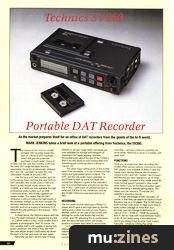
The release of the Technics SV260 portable DAT recorder marks the start of a flood of DAT machines which will give the potential purchaser a much wider choice of models over the next few months. Until now, the Sony DAT range has been the only reasonable choice for professionals, whereas the Casio DA1 portable has been the only 'affordable' model, at around £700.
Like the Sony and Casio models, and the forthcoming Aiwa machine, the new Technics DAT recorders (the SV260 costs £1500 and there's a rack-mount studio version, the SV360K, at £1400) are only available through professional audio outlets such as HHB Communications, who kindly supplied our review model. This means that the DAT revolution is still not hitting the high streets or the domestic market, so we must consider the Technics machine on its merits as a mastering recorder, and not as a piece of domestic hi-fi (despite the jolly greeting in the manual, "Dear Stereo Fan"!).
In these terms, the Technics shares with the Casio the slight limitation of appearing toy-like - at 228mm wide it is tiny, much smaller than it appears in photographs. And, of course, the DAT cassette itself is still capable of giving fully grown producers the jitters if they feel their two-year album project could easily slip down the back of a chair and never be seen again. Naturally, we don't let this type of thing disturb us, do we? Large video-size boxes are now available for storage and transport of important DAT tapes anyway, and one favourable point about the size of the SV260 is that it sits very easily on your mixing desk (not something you could say about a Revox or Tascam 32).
The other major selling point of the SV260, apart from portability, is its use of balanced XLR inputs and gold-plated phono outputs. The XLR's are the only audio inputs available, so you'll have to wire up some XLR leads (the connection diagram is given in the manual) if you're a committed jacks-and-phonos fan like me. In fact, I used a pair of unbalanced jack to balanced XLR line-to-mic convertors, and set the SV260's Mic/Line input level selector to 'Mic'.
RECORDING
The first audio source I tried was a Philips CD player, which gave a very high level on the Mic setting and a rather low one on Line. There's another switch on the side of the SV260 with settings for Audio Pad, Audio Pad and Mic Limiter, and Off; adjusting this in combination with the Mic/Line level switch will usually produce a suitable input level to record with.
In the grand tradition of DAT recorders, the playback sound on the SV260 was virtually indistinguishable from the input. No problems there. The recording level is set with a dual concentric pot on the front panel, which moves smoothly - perhaps a little too smoothly for some tastes. Metering is via an LCD ladder with peak hold.
FUNCTIONS
Once you've made your basic recording the SV260 offers various options, common to most DAT players now available (it doesn't have the handy track naming feature, which remains unique to the Casio DA1 model). Fast Forward and Rewind are silent operations, at 15 times normal speed if pressed in Play mode and at 60 times normal speed if pressed in Stop mode (even faster if you hit the Rewind button again while rewinding is already taking place). This means you can rewind a 75 minute DAT cassette in around a minute.
A major advantage of DAT recorders, of course, is that they can search to tracks in much the same way as a CD player. The SV260 puts a track number code down on tape every time it spots a silent passage of more than four seconds; you can change its definition of 'silence' from -40dB to -60dB (by pressing Auto P. No) to cope with noise between tracks on an LP, but when using a microphone to record you always have to enter track numbers manually - simply by hitting Play while recording. Track number codes have to be at least nine seconds apart.
The LCD display, which has a backlight that can be switched on permanently on mains transformer power or for 20 seconds at a time on battery power, is fairly clear and gives an indication of track number and of how many tracks you wish to skip over if you press the Skip buttons on the top panel. The front panel control buttons are small touch tablets which are quite pleasant to use, although the labelling of the Play button is in a rather indistinguishable shade of green. End Search - a smaller button, again on the top panel - will find the last recorded piece of tape on any particular DAT cassette, although you may not end up where you expected if it's a tape that you've used many times.
Memory/Recall will allow you, in conjunction with the Skip buttons, to programme a series of tracks for playback in any order, as shown by the Playing and Next indicators, which could be useful for reassembling DAT masters. A resettable four-digit tape counter (with no real-time function) is provided and a low battery power indicator-the rechargeable battery supplied has a quoted minimum power reserve of 2½ hours, though it usually gives more. The battery is automatically recharged whenever the SV260 is powered from the mains, using the supplied mains transformer. Unfortunately, this transformer has a non-standard connector, so if you lose it you can't just plug in any old 6V guitar pedal adaptor. Technics' own recharge adaptor costs £66.60 and additional batteries cost £28.50.
On the hardware side, the SV260 has gold-plated phono line outputs, a mini jack coaxial digital output for which a gold-plated lead is supplied, and a battery compartment cover with a cunning little lock which does nothing to make up for the fact that the cover comes completely away from the casing, and so stands a fair chance of being lost. The headphone socket is a standard quarter-inch stereo jack with a rotary level control just above it, and delivers plenty of level (an important factor when undertaking location recordings).
One final front panel function is Record Mute, which inserts a four second silent passage on the tape and then sets the machine into Record/Pause mode; if you want a longer silence, you can hold the Rec Mute button down, and if you want a shorter one, you can hit Play or Pause before four seconds has elapsed. Erasing a tape by recording over it with no audio input present or with the record level controls turned down will wipe the sound, but not the track numbers; therefore you won't be able to use the End Search function on an erased tape.
Like many early video machines, the Technics DAT recorder comes complete with dire warnings about the effects of dew on the machinery. The battery indicator has a Dew Warning just below it, and if the machine or DAT tapes played in it are moved from a cold atmosphere into a warm one, then you may have to wait a short while until any condensation evaporates. If the machine gives a dew warning whilst on mains transformer power, an internal heater automatically switches on to help.
Being a portable unit, the SV260 comes complete with a case and carrying strap; for some bizarre reason, the carrying case is designed to fold over the machine from the underneath rather than the top, so if you want to use the machine whilst it's slung over your shoulder (hardly an unreasonable request), you really have to remove the top of the case completely (another item to be lost).
COMPARISONS
So how does the Technics SV260 compare with the competition? Well, it is smaller and lighter than the Sony portable but heavier than the Casio DA1. Its balanced XLR inputs are a plus, although a parallel set of unbalanced phono inputs would have been welcome as well; the Casio DA1's stereo mini jack inputs are a pain, despite the adaptor supplied. Unlike its larger (and cheaper!) brethren, the SV360, the Technics SV260 can only record at a sampling rate of 48kHz; the 'industry standard' 44.1kHz modification which HHB can make to their Sony models is not thought possible on the Technics unit - this may well deter the more professional studio customer from choosing the SV260, although the digital output socket makes direct digital transfer to a suitable 44.1 kHz machine feasible.
The Technics model lacks the track naming facility of the Casio machine and cannot record at low speed, although it can replay low speed tapes recorded on other machines. Most important of all, the SV260 is a true 16-bit performer - word has it that the Casio offers non-standard 15-bit digital conversion of the input signal, but 16-bit playback. The lack of a real-time tape counter is an oversight and really ought to be provided on a professional machine of this calibre.
VERDICT
TECHNICS SV260 PORTABLE DAT RECORDER
- Rotary-head DAT recording mechanism
- 48kHz record sampling rate
- 44.1 or 48kHz playback sampling rate (automatically switched)
- 16-bit linear decoding
- Frequency response: 10Hz-22kHz (+0.5dB-1.5dB)
- Dynamic range: over 87dB
- Signal-to-noise: 88dB
- THD: under 0.05%
- Wow & flutter: unmeasurable
- Line input: +4dB/-10dB switchable
- Impedance: 10 kOhms
- Mic input: -60dB/-74dB switchable
- Headphone output: 20mW/ch into 16 Ohms
- Digital output: 50 Ohms coaxial
- Tape playback speed: 8.15/12.225 mm/sec (automatically switched)
- Power supply: 6VDC
- Weight: 1.45kg with battery
To sum up, the Technics SV260 has a lot in its favour and a few minor points against. I disliked the lack of phono inputs, real-time tape counter and track naming, the non-standard mains transformer connector, and the easily mislaid carrying case lid and battery cover. I liked the size, overall performance, control buttons and provision of balanced XLR inputs.
Like most DAT recorders, the SV260 isn't ready to become a complete replacement for a good analogue mastering machine in a professional environment. The sound quality is undeniably better, but you can't edit the tape with a razor blade, and like any rotary-head machine it takes a second or so to commence recording, so you have to take care not to cut off the start of your mixdown.
However, the SV260 has a lot going for it as a high quality mastering machine and location/sample recorder, and shows all the signs of giving years of satisfactory service. On the whole, it receives a pretty substantial thumbs up.
Thanks to HHB Communications Ltd ((Contact Details)) for the review model and to Giulia Ovidi at Panasonic UK.
FURTHER INFORMATION
SV260 portable £1500, SV360 rackmount £1400 (both inc VAT).
Technics/Panasonic UK, (Contact Details).
Also featuring gear in this article

Publisher: Sound On Sound - SOS Publications Ltd.
The contents of this magazine are re-published here with the kind permission of SOS Publications Ltd.
The current copyright owner/s of this content may differ from the originally published copyright notice.
More details on copyright ownership...

Sound On Sound - Jun 1989
Donated by: Rob Hodder
Gear in this article:
Review by Mark Jenkins
Help Support The Things You Love
mu:zines is the result of thousands of hours of effort, and will require many thousands more going forward to reach our goals of getting all this content online.
If you value this resource, you can support this project - it really helps!
Donations for April 2026
Issues donated this month: 0
New issues that have been donated or scanned for us this month.
Funds donated this month: £0.00
All donations and support are gratefully appreciated - thank you.
Magazines Needed - Can You Help?
Do you have any of these magazine issues?
If so, and you can donate, lend or scan them to help complete our archive, please get in touch via the Contribute page - thanks!
If you're enjoying the site, please consider supporting me to help build this archive...
...with a one time Donation, or a recurring Donation of just £2 a month. It really helps - thank you!

 @mu_zines
 RSS Feed
 Blog
Blog