


Magazine Archive
Home -> Magazines -> Issues -> Articles in this issue -> View
Article Group: | |
Three Sax Players | |
Stephen TrierArticle from Sound International, January 1979 | |
Adolf Sax invented the saxophone in the early part of last century. It promptly sank without trace. Sax intended his instrument for the classical orchestra, but it has increasingly become used as a popular instrument, especially in Britain. Stephen Trier is a classical musician trying to realise the instrument's potential.

As well as playing third and bass clarinet with the London Philharmonic Orchestra, Stephen Trier also plays and teaches the sax. He regrets lack of improvisatory flair among saxophone players. This feeling is not rare among orchestral musicians, who can usually read brilliantly and possess an almost complete technical mastery of their instruments.
'There are times when I hear people play just one jazz phrase,' he explains, 'and I think: Here we straight saxophonists are, trying to reproduce accurately what's stuck down on paper, though not without a certain amount of imagination. But it isn't saying: Here it is, folks, I'm telling you how it is. A lot of orchestral musicians, not just saxophone players, think that reproducing printed music is slightly like a museum business.'
But that's not to deny their fiendish technical ability. Trier recalls an evening gathering after a hectic day at the World Saxophone Congress. He was speaking to a player who was staggered at the proficiency of some of the performers. That player turned out to be none other than Lee Konitz, not the meanest of horn blowers himself.
There is a large gap between the orchestral and jazz worlds, and a further rift still between straight music and rock. This is something that Trier regrets. He sees the saxophone players of whatever style aiming at one standard of excellence. Konitz confided to Trier that if he'd possessed the sheer expertise of some of the performers at the WSC, then allied with his own musical imagination the sky would be the limit.
At the Royal College of Music, Trier tells his jazz-oriented pupils: 'I don't know much about jazz, and I can't teach you anything about that. But what I expect is that you will gain thorough and total control over your instruments. And that skill is grounded in the classical idea that you must be able to play anything that you may ever be asked to do.' And this, for Trier, is the common ground between straight and jazz players.
But his realistic vision of the future is something different again. The need to diversify will mean that many musicians will play two or three instruments well, and none superbly.
Most saxophonists, and not just classical players, are able to play more than just the horn. This is because, in Britain, people tend to drift into the saxophone from other territory, mostly clarinet. As, indeed, did Trier: 'I started life as a clarinet player at school, many years ago. I attended the Royal College of Music and somehow wound up as the guy who specialises in all the odd job instruments, like bass clarinets and so on. I drifted into the saxophone in this sort of way.'
There isn't an enormous repertoire of saxophone music in symphony orchestras, but there are one or two important pieces. As they crop up every now and again somebody had to be able to play them.
'There were quite a lot of commercial players who would have been able to play them,' explains Trier. 'But they felt totally unhappy in a symphony orchestra environment. They were used to playing in big band sections and that sort of thing. There were only two saxophone players for symphony orchestras then — one was Walter Lear and the other was the late Michael Crine - and if any of those couldn't do a job then there was a problem. So I thought that it was about time that somebody else began to think about saxophone from the straight point of view. So I did.'
Trier sees the growth of the saxophone quartet in the British Isles as a step in the right direction. 'For a long time there was only one saxophone quartet in Britain. That was run by Michael Crine. It still exists under the name of the Michael Crine Saxophone Quartet. There are at least three saxophone quartets in London, now. Two of them are making records at the moment, and the other, The London Saxophone Quartet, has been making records for some time. General awareness of the sax as an instrument in its own right is growing all the time.'
But there is a danger that Trier is very aware of as more and more people try to play the sax. In his opinion it is an instrument that is very easy to play badly. Proper tuition for beginners, especially in country areas, is difficult to find. Usually teachers for these beginners are wind musicians who've never really played the saxophone. Consequently bad habits spring up.
'One of the worst things that can happen to a beginner is if he goes along to a dealer and asks for the same sort of mouthpiece that Sonny Rollins (or any other hero) blew on, and he's given an object that has a lay like the jaws of hell,' says Trier. 'I think that it would be a tremendous step forward if we could get at beginners and prevent them from buying these mouthpieces. Because there shouldn't be that much effort put into blowing. A close lay with a soft reed is quite adequate. The effort should go into producing a big sound or a good quality sound, rather than squeezing away at a diabolical mouthpiece.
'If you give a player a different mouthpiece to play every week for five weeks, then at the end of each week he would be playing his way. On a close lay, that player would probably be getting the same sound as he does on a big lay, but with less effort. I have a Selmer metal mouthpiece on my tenors, for example, that is incredibly docile, and which I use for orchestral work. Yet a lot of people would say that a metal mouthpiece isn't any good for playing in a symphony orchestra.'
Trier makes the point that concert hall music is the only music left that is listened to with no electrical devices coming between the instruments and the ear of the listener. Acoustic instruments depend for their sound to a great extent on the room that they're in, and as most music is recorded in 'upholstered sewers' around the country, none of it gets away without being electronically enhanced.
Apart from this 'insidious' influence being exerted on the country's musicians, Trier again lays stress on the importance of reeds and mouthpieces, or rather the lack of them. He thinks that personally he probably couldn't get a note out of a 3½ strength reed. He much prefers softer wood between his lips, as it aids immediacy of attack. He isn't happy with American reeds, and tries whenever possible to get hold of Olivieri reeds, made by an old Italian living in Majorca. Failing that, having tried making his own reeds, he is now content to doctor them for his needs.
Publisher: Sound International - Link House Publications
The current copyright owner/s of this content may differ from the originally published copyright notice.
More details on copyright ownership...
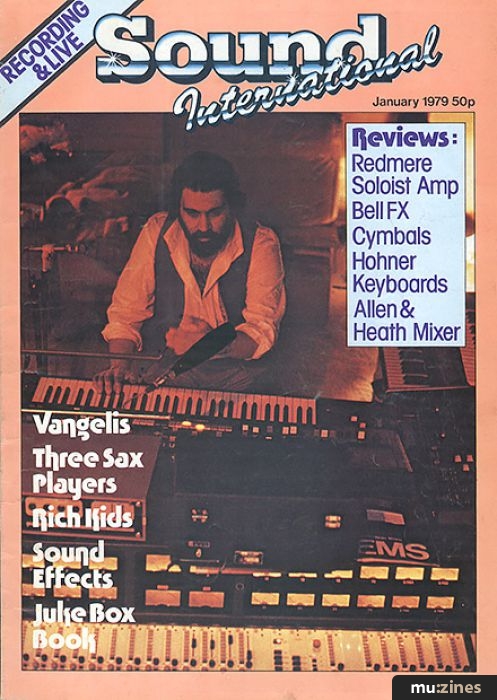
Sound International - Jan 1979
Donated & scanned by: Mike Gorman
Three Sax Players
Interview
Help Support The Things You Love
mu:zines is the result of thousands of hours of effort, and will require many thousands more going forward to reach our goals of getting all this content online.
If you value this resource, you can support this project - it really helps!
Donations for December 2025
Issues donated this month: 0
New issues that have been donated or scanned for us this month.
Funds donated this month: £0.00
All donations and support are gratefully appreciated - thank you.
Magazines Needed - Can You Help?
Do you have any of these magazine issues?
If so, and you can donate, lend or scan them to help complete our archive, please get in touch via the Contribute page - thanks!
Please Contribute to mu:zines by supplying magazines, scanning or donating funds. Thanks!
Monetary donations go towards site running costs, and the occasional coffee for me if there's anything left over!

 @mu_zines
 RSS Feed
 Blog
Blog