
Magazine Archive
Home -> Magazines -> Issues -> Articles in this issue -> View
Article Group: | |
Three Sax Players | |
Raphael RavenscroftArticle from Sound International, January 1979 | |
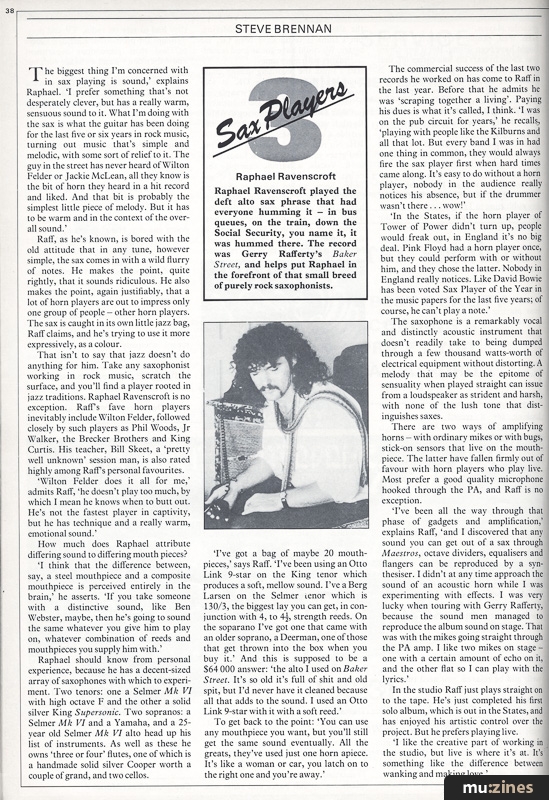
Raphael Ravenscroft played the deft alto sax phrase that had everyone humming it — in bus queues, on the train, down the Social Security, you name it, it was hummed there. The record was Gerry Rafferty's Baker Street, and helps put Raphael in the forefront of that small breed of purely rock saxophonists.

The biggest thing I'm concerned with in sax playing is sound,' explains Raphael. 'I prefer something that's not desperately clever, but has a really warm, sensuous sound to it. What I'm doing with the sax is what the guitar has been doing for the last five or six years in rock music, turning out music that's simple and melodic, with some sort of relief to it. The guy in the street has never heard of Wilton Felder or Jackie McLean, all they know is the bit of horn they heard in a hit record and liked. And that bit is probably the simplest little piece of melody. But it has to be warm and in the context of the overall sound.'
Raff, as he's known, is bored with the old attitude that in any tune, however simple, the sax comes in with a wild flurry of notes. He makes the point, quite rightly, that it sounds ridiculous. He also makes the point, again justifiably, that a lot of horn players are out to impress only one group of people — other horn players. The sax is caught in its own little jazz bag, Raff claims, and he's trying to use it more expressively, as a colour.
That isn't to say that jazz doesn't do anything for him. Take any saxophonist working in rock music, scratch the surface, and you'll find a player rooted in jazz traditions. Raphael Ravenscroft is no exception. Raff's fave horn players inevitably include Wilton Felder, followed closely by such players as Phil Woods, Jr Walker, the Brecker Brothers and King Curtis. His teacher, Bill Skeet, a 'pretty well unknown' session man, is also rated highly among Raff's personal favourites.
'Wilton Felder does it all for me,' admits Raff, 'he doesn't play too much, by which I mean he knows when to butt out. He's not the fastest player in captivity, but he has technique and a really warm, emotional sound.'
How much does Raphael attribute differing sound to differing mouth pieces?
'I think that the difference between, say, a steel mouthpiece and a composite mouthpiece is perceived entirely in the brain,' he asserts. 'If you take someone with a distinctive sound, like Ben Webster, maybe, then he's going to sound the same whatever you give him to play on, whatever combination of reeds and mouthpieces you supply him with.'
Raphael should know from personal experience, because he has a decent-sized array of saxophones with which to experiment. Two tenors: one a Selmer Mk VI with high octave F and the other a solid silver King Supersonic. Two sopranos: a Selmer Mk VI and a Yamaha, and a 25-year old Selmer Mk VI alto head up his list of instruments. As well as these he owns 'three or four' flutes, one of which is a handmade solid silver Cooper worth a couple of grand, and two cellos.
'I've got a bag of maybe 20 mouthpieces,' says Raff. 'I've been using an Otto Link 9-star on the King tenor which produces a soft, mellow sound. I've a Berg Larsen on the Selmer tenor which is 130/3, the biggest lay you can get, in conjunction with 4, to 4½, strength reeds. On the soprano I've got one that came with an older soprano, a Deerman, one of those that get thrown into the box when you buy it.' And this is supposed to be a $64 000 answer: 'the alto I used on Baker Street. It's so old it's full of shit and old spit, but I'd never have it cleaned because all that adds to the sound. I used an Otto Link 9-star with it with a soft reed.'
To get back to the point: 'You can use any mouthpiece you want, but you'll still get the same sound eventually. All the greats, they've used just one horn apiece. It's like a woman or car, you latch on to the right one and you're away.'
The commercial success of the last two records he worked on has come to Raff in the last year. Before that he admits he was 'scraping together a living'. Paying his dues is what it's called, I think. I was on the pub circuit for years,' he recalls, 'playing with people like the Kilburns and all that lot. But every band I was in had one thing in common, they would always fire the sax player first when hard times came along. It's easy to do without a horn player, nobody in the audience really notices his absence, but if the drummer wasn't there... wow!'
'In the States, if the horn player of Tower of Power didn't turn up, people would freak out, in England it's no big deal. Pink Floyd had a horn player once, but they could perform with or without him, and they chose the latter. Nobody in England really notices. Like David Bowie has been voted Sax Player of the Year in the music papers for the last five years; of course, he can't play a note.'
The saxophone is a remarkably vocal and distinctly acoustic instrument that doesn't readily take to being dumped through a few thousand watts-worth of electrical equipment without distorting. A melody that may be the epitome of sensuality when played straight can issue from a loudspeaker as strident and harsh, with none of the lush tone that distinguishes saxes.
There are two ways of amplifying horns - with ordinary mikes or with bugs, stick-on sensors that live on the mouthpiece. The latter have fallen firmly out of favour with horn players who play live. Most prefer a good quality microphone hooked through the PA, and Raff is no exception.
'I've been all the way through that phase of gadgets and amplification,' explains Raff, 'and I discovered that any sound you can get out of a sax through Maestros, octave dividers, equalisers and flangers can be reproduced by a synthesiser. I didn't at any time approach the sound of an acoustic horn while I was experimenting with effects. I was very lucky when touring with Gerry Rafferty, because the sound men managed to reproduce the album sound on stage. That was with the mikes going straight through the PA amp. I like two mikes on stage — one with a certain amount of echo on it, and the other flat so I can play with the lyrics.'
In the studio Raff just plays straight on to the tape. He's just completed his first solo album, which is out in the States, and has enjoyed his artistic control over the project. But he prefers playing live.
'I like the creative part of working in the studio, but live is where it's at. It's something like the difference between wanking and making love.'
Publisher: Sound International - Link House Publications
The current copyright owner/s of this content may differ from the originally published copyright notice.
More details on copyright ownership...
Sound International - Jan 1979
Donated & scanned by: Mike Gorman
Three Sax Players
Interview by Steve Brennan
Help Support The Things You Love
mu:zines is the result of thousands of hours of effort, and will require many thousands more going forward to reach our goals of getting all this content online.
If you value this resource, you can support this project - it really helps!
Donations for December 2025
Issues donated this month: 0
New issues that have been donated or scanned for us this month.
Funds donated this month: £0.00
All donations and support are gratefully appreciated - thank you.
Magazines Needed - Can You Help?
Do you have any of these magazine issues?
If so, and you can donate, lend or scan them to help complete our archive, please get in touch via the Contribute page - thanks!
Please Contribute to mu:zines by supplying magazines, scanning or donating funds. Thanks!
Monetary donations go towards site running costs, and the occasional coffee for me if there's anything left over!

 @mu_zines
 RSS Feed
 Blog
Blog