


Magazine Archive
Home -> Magazines -> Issues -> Articles in this issue -> View
Using Microphones | |
Recording The PianoArticle from Home & Studio Recording, February 1985 | |
This month 'Recording The Piano'; where best to place microphones and what type to choose for optimum results.
Microphone positioning for correct piano sound pick-up is a complicated matter. On stage, it's a continuous fight against feedback; in the studio, the drums (as well as bass and guitars, if not DI'd) will leak into the piano channels. The development of high quality pick-ups was an improvement, though still a compromise sound-wise. Today, there are two major alternatives for amplifying a piano.
Most rock piano players seem to go for electric pianos like the Yamaha CP70, CP80, Kawai or Helpinstill. These are feedback-safe and, more or less, portable. This enables the musician to bring his own familiar instrument along to a gig or recording session. The sound of these units, which is different from that of an acoustic piano, has come into its own right after all.
When used for 'traditional' piano sounds eg. ballads, these electric pianos require a slightly modified playing technique. The trick seems to be to avoid heavy bass accents or octaves in the bass range as they reinforce the instrument's tuning instabilities in the bass. To compensate for this, right hand chords are played in a lower inversion, ensuring a fuller sound and even tonal balance. An excellent example of this is Richard Tee's Fender Rhodes accompaniment of Art Garfunkel in the live version of "Bridge Over Troubled Water".
Grand Piano
To obtain the real piano sound you do need a grand piano, good microphone technique and if possible a 'live' recording room. It is a truism that a good instrument is the best basis for a good sound on tape. To upgrade your piano, it may be worthwhile to have the action readjusted or partly replaced. A grand piano may work fine for 60 years or more, but the action tends to wear out much earlier. An important factor for the sound quality is the condition of the hammers, which determine the brightness of the attack. (See Paul Airey's comments Got A Piano For Fifty Quid Mate?)
Tuning
I've always tuned all my keyboards myself, but never the grand piano and would not advise anyone to do so. Tuning is more than simply looking at the scale of your Korg electronic tuner. In fact, I've never seen a good piano tuner use an electronic tuning aid. A piano is normally tuned to A4 (440 Hz), A5 (880 Hz) and so on (each octave above means doubled frequency). 'Stretched tuning' means that higher tones are tuned a few cycles higher, and bass notes lower than with normal tuning; thus octaves are slightly enlarged. This makes for a somewhat brighter sound. Stretched tuning is recommended by Yamaha for their electric grand pianos; for acoustic pianos eg. Bosendorfer here in Vienna deliver their products in normal tuning unless otherwise requested.
One thing you can do yourself is to tune a small number of strings if they go slightly out of tune. A sure sign of this is a vibrato effect on single-played notes. Listen to the strings of a note one by one, damping the other(s), and you'll find the one that is out of tune. When tuning it, always tune a little higher first, then by slightly moving the tuning key and hitting the note, fine tune the string.

Figure 1. Miking up the grand piano.
Mic Placement
The grand piano produces sound through vibrating strings that are amplified by the resonating soundboard below the strings. Low frequencies are radiated uniformly, but above 1000 Hz (1kHz) the sound becomes more directional. For a superior piano sound, the lid should be open, allowing it to reflect the mid and treble frequencies to the side of the piano. Closing or removing the lid reduces the sound projection.
Figure 1 shows the positioning for a round, balanced, 'classical' piano sound (Mic 1). The rather large working distance makes for a smooth attack, balanced sound, and good pick-up of room ambience (reverb). There is, however, strong leakage. Mics 2 and 3, used together and pointed at the area around note C2 for the bass and around note C6 for the treble, will produce a brighter and more percussive sound due to their closer working distance. This placement will emphasise the touch and attack of the player. As with all mic placement these positioning suggestions should be used as a starting point for experimentation.
Listen and move your microphones around accordingly. Microphones used for piano should have a wide frequency response (frequency range of the grand piano is 30 Hz to about 11kHz). Neumann U87, AKG C414, D202, D224, Sennheiser MD441 and the various PZMs are often used. The position of Mic 1 also works fine for a stereo pair or mic.
Fighting Leakage
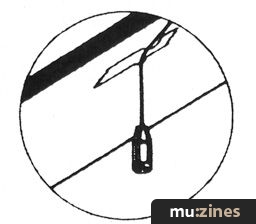
Figure 2. Small electret mic attached to the piano lid.
To resolve sound leakage problems, it is often necessary to either close the piano lid or keep it open only a few inches using the short stick and covering the gap with a blanket or the like. The mics then go inside. This can be easily done by using miniature electrets (omnis are wonderful here). Attached to the lid with Gaffa tape, they hover above the strings when the lid is closed (Figure 2). However, you must be careful of lid vibration noises, so check the tightness of all hinges thoroughly.
If only 'regular' mics are at hand, they can be placed in the soundholes of the cast-iron frame. When mics are placed inside the piano, I do recommend you experiment with positions until the sound balance is right. You might try employing three mics, two placed on the frame with the third above the treble strings pointing towards the action.
Miniature electrets inside the piano may also be used to pick up the acoustic signal of a Yamaha CP70 electronic piano. Mixed with the electronic output signal, it adds an interesting, percussive quality to the sound. (A piano tuner gave me the hint by telling me that the CP70 of the James Last Big Band is full of little microphones).

Figure 3. Miking the upright piano.
Upright Piano
An upright piano, though second choice compared to a grand, will deliver good rock piano sounds if used to the best of its potential. Position mics according to Figure 3 and balance the sound by moving or angling the mics more to the centre or the side. Placing them too far inside, however, will result in a 'boomy' sound.
To turn your upright into an old honky-tonk piano, try deliberately putting some strings out of tune, either mechanically or by use of a chorus pedal device or pitch-changer. Interestingly, this technique was also used by Frank Zappa on his recent world tour to brighten up the attack of the Yamaha CP70.
Effects
With mics placed inside, with a pickup, a C-ducer contact strip or with electronic pianos like the CP70, reverb should be added for best results.
Other popular effects for treating the piano include harmonizers and exciters, but these should be used very carefully. Too much of any effect will kill the piano sound. For a truly professional piano sound, no effect is necessary at all - just a good piano to begin with.
Next month, I will say a few words about PZMs, which are especially valuable for piano miking.
Got A Piano For Fifty Quid Mate?
The basic design of pianos has not changed much; they are still played by hammers striking strings by way of a key being pressed. Soundboards are still made of spruce wood, and, with due regard to an iron frame, they are still very heavy! However, the modern luxuries of central heating, double glazing, air conditioning, all created to make this brave new world for us, have removed moisture and fresh air from our environment. Thus, the use of mainly solid wood and animal glues in the manufacture of pianos, previously the watchwords of any good piano, have had to come to terms with modern living.
This has involved the use of laminated timber in many parts such as the wrest plank, the bridge, parts of the case, and even in the soundboard on many smaller upright pianos. Chemical glues have largely replaced animal glues, lacquer and polyester-based wood finishes have now superseded French polishes. You can even get a grand piano with a clear perspex case if you want one.
Many of the gluing and wood-curing processes, once the domain of vast periods of time and metal clamps, are now being performed with the aid of microwave ovens and computerised humidity control booths. On a recent visit to the USA, I was fortunate enough to visit two major piano factories both belonging to the Baldwin Piano Company (America's largest single piano producer). The first, at Greenwood, Mississippi, covers over 600,000 square feet and until recently has produced all their upright pianos. The second, at Trumann, Arkansas, and only completed three years ago, can produce the same number of pianos in a factory less than half the size of the first using this new technology.
Of course, there are many old pianos around the world that are still in pristine condition. But this is only because they have been protected from the rigours of central heating etc via the use of humidifiers and other localised devices. Failing this they are kept away from central heating altogether.
It should therefore be of little wonder to anyone that a good upright piano (which incidentally has approximately five thousand moving parts in it) costs at least thirteen hundred pounds. A concert grand piano (which has approximately twelve thousand moving parts) will set you back a cool twenty thousand pounds or so. But at least you know that when you turn up the central heating in the house, or up the temperature in the studio, or perform to ten thousand people at Wembley Arena under a huge bank of lights, your modern piano will stay in tune, its frame won't crack, the notes won't stick down, the soundboard won't split, and the strings won't sound like bananas hitting the garden fence... Need I say more?
Sorry. We ain't got any pianos for fifty quid!
More from these topics
 Monitoring - Sound Workshop |
 We Can't Go On Metering Like This! |
 At Home in the Studio - Living Dangerously with 'Doors' |
 Step by Step |
 Doing the Business - Demos |
 Using Microphones - Recording the Bass |
 Using Microphones |
 Miking Music |
 Live for the Record |
 First Take |
 Basic Microphone Technique |
 Oddballs & Out Takes - Studio tales |
Browse by Topic:
Microphones
Recording
Publisher: Home & Studio Recording - Music Maker Publications (UK), Future Publishing.
The current copyright owner/s of this content may differ from the originally published copyright notice.
More details on copyright ownership...

Home & Studio Recording - Feb 1985
Donated & scanned by: Mike Gorman
Feature by Wolfgang Staribacher, Paul Airey
Help Support The Things You Love
mu:zines is the result of thousands of hours of effort, and will require many thousands more going forward to reach our goals of getting all this content online.
If you value this resource, you can support this project - it really helps!
Donations for June 2026
Issues donated this month: 0
New issues that have been donated or scanned for us this month.
Funds donated this month: £0.00
All donations and support are gratefully appreciated - thank you.
Magazines Needed - Can You Help?
Do you have any of these magazine issues?
If so, and you can donate, lend or scan them to help complete our archive, please get in touch via the Contribute page - thanks!
If you're enjoying the site, please consider supporting me to help build this archive...
...with a one time Donation, or a recurring Donation of just £2 a month. It really helps - thank you!

 @mu_zines
 RSS Feed
 Blog
Blog