


Magazine Archive
Home -> Magazines -> Issues -> Articles in this issue -> View
Vesta-Fire Dig-410 DDL | |
Article from Electronic Soundmaker & Computer Music, July 1984 | |
The latest
Trevor Lyon-Brown tries not to repeat himself...

An internal view of Dig-410
With the ever decreasing price of digital technology and memory chips, digital delays are rapidly becoming the only way to fly. Far easier to set up than using tape recorders with fussy level controls and tapes which are forever having to be rewound or loops that tangle and better quality than noisy analogue devices, machines such as the Dig-410 by Vesta Fire are taking over in studios and on stage. Professional studios have benefited from digital luxury for some time; but it is only in the past year or so that it has fallen within reach of the amateur musician and home studios.
Home and Away
The Dig-410 is designed to be used both in the studio and on stage. It is very rigidly constructed to the 19" rack, 1U height standard and it also comes fitted with rubber feet of a wide diameter which are very handy for free-standing use in conjunction with equipment of other shapes and sizes. Often, the feet on equipment seem to follow the law that they will always line up with irregularities in the piece of equipment on top of which they would be best situated resulting in a Leaning Tower of Pisa syndrome.
A marvellous plus for stage use is that there are no controls on the rear panel. All too often this gem of design wisdom seems to slip through on some equipment, giving the poor stage musician a much harder time than is necessary, it is often a nuisance in the studio too if you have got to get behind your rack of outboard effects for a little twiddle in what is already a confined space. There is, however, a well chosen collection of standard ¼" jack sockets on the rear panel of the delay unit, the functions of which I will explain in conjunction with their associated controls on the front panel.
Up Front
The front panel from left to right, comprises firstly of two standard jack sockets labelled 'mic' and 'instrument' inputs. 'Mic' input level is from -50dBm to +6dBm maximum at an impedance of 10k ohms and 'instrument' from 20dBm to +21dBm at 470k ohms. This input is also duplicated on the rear panel labelled -20dB, and is normally used in the studio. The first rotary pot is the level control and allows you to match microphone levels and use the 'instrument' channel for any level of signal from guitar pickup through keyboards to home recording equipment. Between the input sockets and the level control is a bank of five rectangular LEDs arranged to form the usual bar graph type display. The lowest green LED is, somewhat unusually, the mains on/off indicator. This had me fooled a few times, first looking to the opposite end of the panel to where the mains switch was to see whether the thing was actually switched on or not, and secondly checking the inputs to find out where the signal was coming from, a signal which of course did not exist. This is, however, only a minor criticism, and the system would be easy enough to adjust to as one became more familiar with the unit. The next three LEDs on the way up are designated -20dB, -10dB and 0dB respectively and are also coloured green, whilst the final one, +6dB, is coloured red. Above this last LED is the word 'headroom' and there did actually seem to be a fair amount of headroom spare in practice even with the red LED alright. This is of good value to musicians working live who do not always have the time to optimise levels and also in the studio when coping with enthusiastic vocalists.
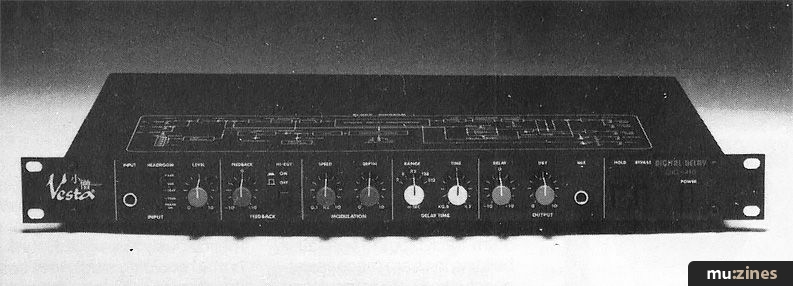
The Dig-410, designed for both studio use the live performance.
Along The Front
The next control we meet is a centre detent rotary pot 'feedback'; this returns a degree of the delayed output back to the input to generate the repeat effect. This will also thicken the phasing and flanging effects created by the modulation of short delay timings. The unusual thing about the Dig-410 feedback control is its centre 'off' position with positive feedback occurring when the control is rotated clockwise and negative feedback being generated when turned to the opposite side of the centre position. This rather clever idea does away with the need for the 'delay invert' switch more commonly seen in this application.
On the right of the 'feedback' control is a 'hi-cut' switch. This rolls off the high frequencies above 10kHz. Before testing this unit I assumed that this inclusion was probably necessary to cut quantisation noise produced by the digital circuitry. Quantisation noise is most noticeable on signals consisting principally of low frequency components such as those from a bass guitar. It is the unwanted harmonics produced when the output voltage from the digital-to-analogue converter is quantised into steps. In most cases it is masked by the input signal and consequently passes unnoticed. However, in such cases as a bass guitar an extra degree of high frequency attenuation may be required. Not using the 'hi-cut' filter, to my delight, I was able to get a really thick chorus effect on the bass without the noise becoming too apparent. It is partly the fact that the higher harmonics of the bass notes are able to be left in that gives such a satisfying sound.
Wobble It About
The next section on the front panel deals with the modulation of the delayed signal. The LFO (low frequency oscillator) rates, governed by the 'speed' control, is not given in the specification sheet supplied but it operates slow enough to achieve a good sweeping 'phase' as well as the speed necessary for vibrato effects. The 'speed' adjustment however, is rather critical at the slow end, as is the 'depth' control at the shallow end. For the modulation effects using longer delay times, such as chorusing, only a little depth should be used or the resulting output sounds out of tune and I felt the depth control especially to be a little harsh, this is not too much of a problem in the studio but on stage it could prove a little awkward.
The next pair of controls select the length of delay. There is a five position rotary switch 'range' with positions for 2, 8, 32, 128 and 512 millisecond delays. This is used in conjunction with the next control 'time'. The time is continuously variable from 'X0.5' through '1 ' to 'X2'. This system enables any delay between 1 and 1024 milliseconds to be selected and all at 16kHz bandwidth! I was very impressed by the clarity of the delayed signal even at the longest setting. On many current digital delays, achieving the longest delay times often involves cutting the bandwidth. Not so on the Dig-410, a full 16kHz is maintained right up to the 1024 millisecond delay. The choice of the switched delay settings, although probably chosen for technical reasons, lend themselves well to speedy selection of different categories of time manipulation effects:
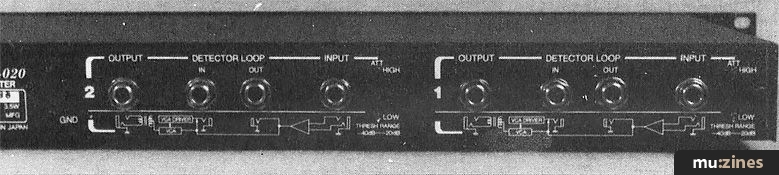
About turn... rear view showing output/input jacks.
| Phasing | approximately 2 milliseconds |
| Flanging | 8 milliseconds |
| Automatic Double Tracking | 32 milliseconds |
| Slap Back | 128 milliseconds |
| Timed Repeats | 512 milliseconds |
Putting It Out
The final pair of pots control the 'delay' and 'dry' output from a standard ¼" jack socket on the front panel labelled 'mix out'. This socket is also duplicated on the rear panel. Again, centre detent pot is used, this time for the delay output control. To the right of its centre off position the delayed output is produced in-phase with the dry output and to the left it is produced out of phase. This system is highly versatile when used in conjunction with the positive and negative feedback control. Other makes of digital delay, as mentioned earlier may have a phase inverting switch but also being able to change phase again for the regenerated signals opens up the range of creative possibility to encompass everything from deep swooshing phases to subtle tonal alterations on flanging. It also enhances the effect of the unit when used in stereo with the original signal.
On the rear panel there is a delay only output primarily for use as echo return in studio applications although many backline amps these days have effect loop facilities. Its signal is not affected by the delay output control and is in phase with the dry output.
To the far right of the front panel are three push switches. The last one is the mains on/off and the other two are designated 'hold' and 'bypass': the 'bypass' switch, when pressed, allows only the dry signal to pass at the 'mix out' sockets and cancels the output from the 'delay' only socket. When the 'hold' switch is pressed there is an infinite repeat of the memory contents without decay or degradation of the signal. This facility only operates at the 512 millisecond setting. It can be used to good effect for setting up rhythmic backings. It is not so good for sustained phrases as a glitch becomes audible each time the memory recycles. This is by no means a fault of the Vesta Fire unit - as it is common to all this level of digital delay equipment. Deglitch circuitry does not come cheap, and is usually found only in the most expensive harmonizers. Both the 'hold' and 'by-pass' facilities have associated footswitch sockets on the rear panel (footswitches are not supplied). This is another facility that makes this unit suitable for stage use, not forgetting, of course, that many home studio owners do complete productions on their own and any extra operations that can be performed by foot instead of by hand are a valuable asset.
Summing Up
The Vesta Fire Dig-410 digital delay is a very capable piece of equipment, its ability to alter signal phase coupled with its wide bandwidth make it very versatile soundwise and its input, output and footswitch facilities make it as viable a proposition on stage as in the studio. My reservations on the harshness of the feedback and modulation controls are of little consequence in comparison with its overall performance.
In a match of price versus facilities it scores very highly indeed. It has only become available recently and at a Recommended Retail Price of £249 it should capture a good share of the market.
Featuring related gear

Publisher: Electronic Soundmaker & Computer Music - Cover Publications Ltd, Northern & Shell Ltd.
The current copyright owner/s of this content may differ from the originally published copyright notice.
More details on copyright ownership...

Electronic Soundmaker - Jul 1984
Donated & scanned by: Mike Gorman
Review by Trevor Lyon-Brown
Ads for Gear in this article:

Help Support The Things You Love
mu:zines is the result of thousands of hours of effort, and will require many thousands more going forward to reach our goals of getting all this content online.
If you value this resource, you can support this project - it really helps!
Donations for May 2026
Issues donated this month: 0
New issues that have been donated or scanned for us this month.
Funds donated this month: £0.00
All donations and support are gratefully appreciated - thank you.
Magazines Needed - Can You Help?
Do you have any of these magazine issues?
If so, and you can donate, lend or scan them to help complete our archive, please get in touch via the Contribute page - thanks!
Please Contribute to mu:zines by supplying magazines, scanning or donating funds. Thanks!
Monetary donations go towards site running costs, and the occasional coffee for me if there's anything left over!

 @mu_zines
 RSS Feed
 Blog
Blog