


Magazine Archive
Home -> Magazines -> Issues -> Articles in this issue -> View
Washburn G2 Guitar | |
Article from One Two Testing, December 1985 | |
quite cheap and wang-ish
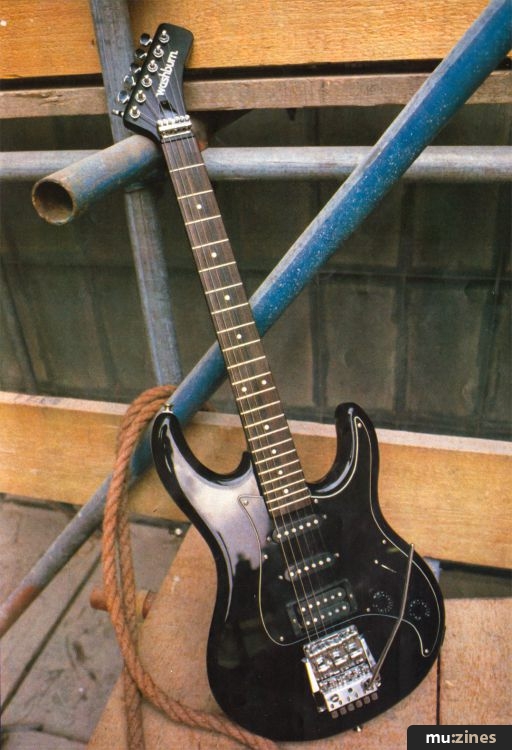
IF THIS GUITAR was a shark, it would be a Hamer-head — that angular headstock, the strings splaying seductively out from the lock-nut. And yet while it lacks the fusiform body (more of a Strat shape, really) and lateral gill slits of the more voracious of the elasmobranchs, there is definitely something fishy about this particular Washburn G2.
This involves the stigma of PROTOTYPE. The prototype can be either the forerunner of a range, the one guitar that has personal attention lavished upon it before the production lines start rolling, or it can be an excuse for poor finishing and general not-got-it-together-yetness.
This particular Washburn G2 leans towards the latter, with a wrongly wired pickup selector and buzzy fret.
Which is a shame, as this Japanese-made, Korean-built instrument is otherwise a very good guitar for the price.
Observe the six Washburn machine heads protruding from the upper edge of that angular hockey stick thing; that cheaply chromed but functional lock-nut; note the genuine nut handcrafted from genuine black plastic at no cost to the guitar's excellent sustain.
Follow the strings down the 22 fatter-than-Fender frets, ignoring the high 12th and subsequently buzzing top E-string at the 11th; admire instead the slick matt black finish of the maple neck, the shallowness of its profile emphasising the width of the useable playing area. Feel how comfortable it comes to hand.
To the left and right of the 17th fret we observe the glossy black bulk of the alder body, with its firm four-bolt fixing. The Stratocaster-shaped body, down to the slimline contouring, sports a triple-ply black/white/black scratchplate on its upper surface, and a blemish-free back — no holes through this guitar.
The scratchplate sports the now standard layout of two single coil pickups married to a humbucker in the bridge position — controlled by a five-way selector — and overall volume and tone controls. The more observant amongst you will note the height of the cylindrical knobs, and will be expecting a push/pull coil-tap for the humbucker. This you do not get: the knobs are simply mounted too high.
If we trace the strings through to their source, it will be noted that they vanish into the nooks and crannies of a vast metallic monstrosity. Banish the thought that Washburn have provided the G2 with its own foundry for a continual supply of fresh string — this is the Washburn Wonderbar.
While the Wonderbar lacks the glorious sophistication of Fender's System III, it actually works rather well. The use of a torsion bar design does away with the need for springs, and a whole host of other problems, not least being the tendency to practice open-cast mining on the surface of your expensive guitar — the Wonderbar sits on top, held in place by four measly screws.
No longer does the bridge "sit up and beg" whenever you bend a note, spilling the strings all over the neck. The bridge is now firm enough to rest your hand on (it's difficult not to) without inadvertent changes in pitch, yet you don't have to be Rambo to tug the tremolo arm.
Naturally there are fine-tuners, and there's even a way of adjusting the relative amount each string changes pitch when the tremolo is used. Comprehensive, yeah? And changing strings causes no sweat.
Sadly, like the guitar in toto, the Wonder Bar isn't perfect. When I eventually worked out how to get the arm to stay where I wanted it, it still had an annoying wobbliness — you don't expect any play in a tool of this sophistication.
Talking of play: it was fun, ignoring the dodgy fret and the fact that pickup selector position two was so out-of-phase as to be virtually inaudible. The single coils gave a suitably piano-like hollow tone, and the humbucker supplied that fatter, harder sound without an inordinate leap in volume. Tone and volume worked smoothly throughout their travel, and fell easily to hand when they were needed.
The tremolo was efficient, and hardly disturbed the tuning at all. Even with the enormous weight of the Wonderbar, the G2 sat quite comfortably on my knee, and hung happily around my neck for a while; I even began to suppose that I could get used to having that bridge under my right hand, providing I was allowed to keep the left firmly clamped about that svelte and elegant neck.
But enough of these seductive pleasantries; they don't alter the fact that this guitar was faulty. Buzzing frets and incorrect wiring are simple, easily correctable errors that should have been put right before the guitar left the factory. And if they can happen in a prototype, then there's even more chance they could happen in a production model. Obviously not a guitar to be bought mail order.
WASHBURN G2: £249
CONTACT: Washburn UK, (Contact Details).
Publisher: One Two Testing - IPC Magazines Ltd, Northern & Shell Ltd.
The current copyright owner/s of this content may differ from the originally published copyright notice.
More details on copyright ownership...

One Two Testing - Dec 1985
Donated by: Neil Scrivin
Review by Jon Lewin
Help Support The Things You Love
mu:zines is the result of thousands of hours of effort, and will require many thousands more going forward to reach our goals of getting all this content online.
If you value this resource, you can support this project - it really helps!
Donations for June 2026
Issues donated this month: 0
New issues that have been donated or scanned for us this month.
Funds donated this month: £0.00
All donations and support are gratefully appreciated - thank you.
Magazines Needed - Can You Help?
Do you have any of these magazine issues?
If so, and you can donate, lend or scan them to help complete our archive, please get in touch via the Contribute page - thanks!
Please Contribute to mu:zines by supplying magazines, scanning or donating funds. Thanks!
Monetary donations go towards site running costs, and the occasional coffee for me if there's anything left over!

 @mu_zines
 RSS Feed
 Blog
Blog