


Magazine Archive
Home -> Magazines -> Issues -> Articles in this issue -> View
Welcome | |
Article from Sound On Sound, December 1990 | |

A few weeks ago I spent some time with a friend in New York, and one day we wandered into a music shop off Bleeker Street. The reaction of the store owner to the arrival of potential customers made quite an impression on me, probably because it was in such sharp contrast to that of the electronics salesman who had just threatened to "***ing bury" us, merely for not accepting his best price on a Walkman that neither of us wanted anyhow.
"Greetings, music lovers! Take a look round, play all the instruments, just ask if you need anything." By the time we got around to leaving, Cole had tried all the acoustics on display, and the store owner had been only too happy to let him play a rather special Gibson Les Paul — deep red, gold plated everything, and obviously way out of his financial reach.
It was the "music lovers" bit that struck me — Cole wanted a new guitar not because he loves guitars but, more importantly, because he loves music. I love music — listening to it, creating it — and I believe that so do all of you reading this column now, but sometimes that simple fact gets lost in the recording process. Technology makes so much possible for us, but it brings its own problems, and it creates pitfalls that we must avoid if our creativity is to be allowed a free rein.
One problem that has dogged me recently is that of reliability. The computer that sits at the heart of my studio has broken down again, for about the sixth time in a year. I have lost a considerable amount of work and I simply don't trust the damn thing any more — if you cannot rely on a vital piece of equipment, it is worse than useless, and that computer is on the way out as I write this. I therefore read with interest the British Record Producers Guild's comments on reliability (see Edits). Let's hope that in future manufacturers will bring fewer products to the marketplace that are not fully de-bugged, and consequently use customers as unsuspecting beta-testers. Of course, there's another side to this, which is that we must be prepared to wait a little longer for our new toys to appear, and not scream for more features now!
Some of the pitfalls that I mentioned are related to the 'new toy' syndrome. Almost everyone who has a MIDI setup will at some time have experienced a minor revelation when they realise just how much the seductive technology of today's instruments can distract from the business of making worthwhile music. The next stage is consolidation: spending more time using what you have to the full, and making sure that new additions to your equipment list integrate with your existing setup and, more importantly, with your method of working. In this issue, the Wally Badarou interview and Martin Russ's Enhancing Your Computer article contain both interesting visions of how the hi-tech recording process can be organised around the individual musician, and some practical ideas on how to enhance and even 'personalise' the performance of the computers that are the nerve centres of MIDI recording systems (when they work properly).
So, as soon as this issue has been put to bed, I'm going to go home, fire up my trusty K5 and just play, and work on a few sounds. But then again, much as I love music, I do love the technology for its own sake — I'm just a sucker for flashing lights. And I could really use a new sampler, and perhaps another effects processor wouldn't go amiss. I'd need a new mixer of course... pathetic, isn't it?
Publisher: Sound On Sound - SOS Publications Ltd.
The contents of this magazine are re-published here with the kind permission of SOS Publications Ltd.
The current copyright owner/s of this content may differ from the originally published copyright notice.
More details on copyright ownership...
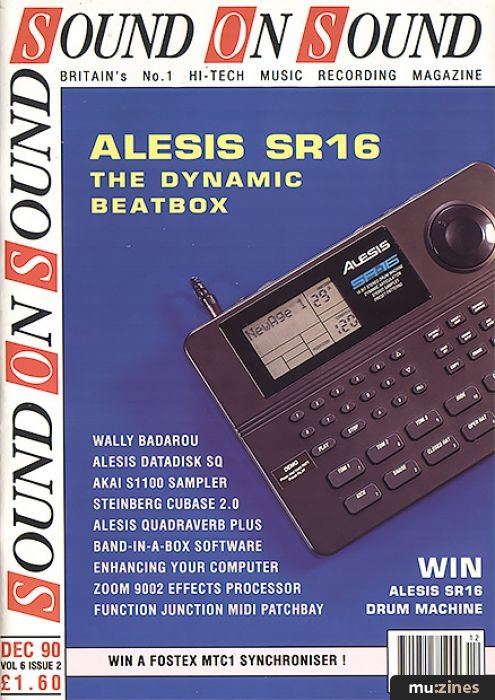
Sound On Sound - Dec 1990
Editorial by Paul Ireson
Next article in this issue:
> Edits
Help Support The Things You Love
mu:zines is the result of thousands of hours of effort, and will require many thousands more going forward to reach our goals of getting all this content online.
If you value this resource, you can support this project - it really helps!
Donations for April 2026
Issues donated this month: 0
New issues that have been donated or scanned for us this month.
Funds donated this month: £0.00
All donations and support are gratefully appreciated - thank you.
Magazines Needed - Can You Help?
Do you have any of these magazine issues?
If so, and you can donate, lend or scan them to help complete our archive, please get in touch via the Contribute page - thanks!
If you're enjoying the site, please consider supporting me to help build this archive...
...with a one time Donation, or a recurring Donation of just £2 a month. It really helps - thank you!

 @mu_zines
 RSS Feed
 Blog
Blog