


Magazine Archive
Home -> Magazines -> Issues -> Articles in this issue -> View
When The Wave Forms | |
Depeche ModeArticle from One Two Testing, November 1982 | |
NAME: new album/new equipment/sound techniques/change of style/gig horrors... LIST
Basildon Boys Depeche Mode are among the brightest of the new pop technologists. Old dullard Paul Colbert rudely interrupted a recording session for their latest album to handle some speech and spelling on synths and sounds.
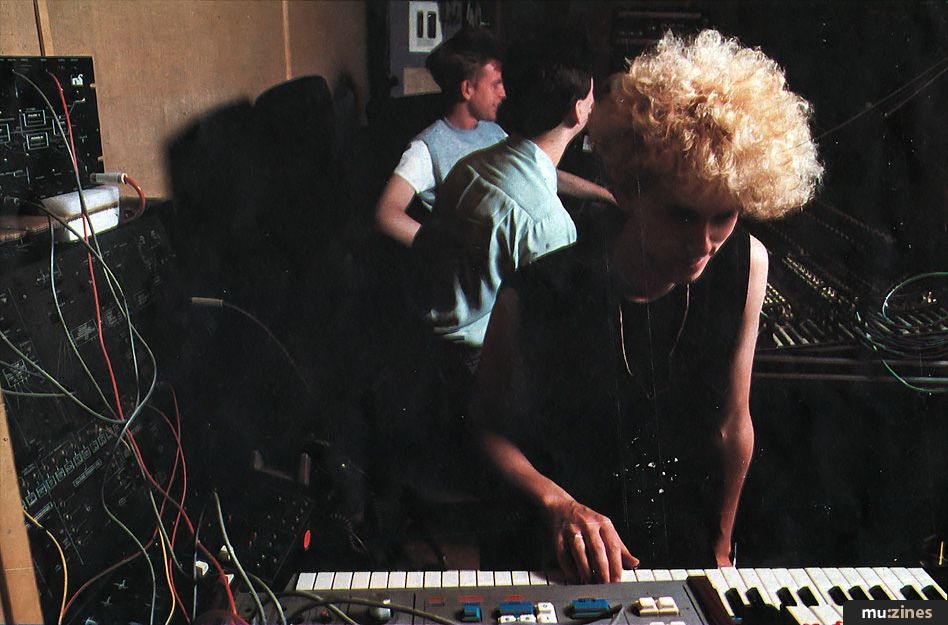
Image credit: Tom Sheehan
We were in the pub, as it happens, no more than two minutes from Basildon Station as the drunk staggers and already deep in the heart of Depeche country. The band had signed every beermat within a 10-yard radius, and an ardent fan had been plugging his life savings into the jukebox to keep the Depeche tracks coming.
David Gahan and Andy Fletcher were on lager, Martin Gore was hitting the Coke with ice and lemon and reminiscing about his first synthesiser...
"It was a Yamaha CS5 — it was the first time I'd ever seen a synth and I knew nothing about them. I didn't find out how to change the sound for a month... actually I still don't know. Every sound I had was either a long one or a short one and I didn't even realise you could change the waveforms."
Amazing how the fizzy drinks bring out the truth in people, though three days earlier it would have been a very difficult story to believe. Martin, Dave and Andy were in Blackwing Studios round the back of Waterloo, partway through recording their second album with producer/mate Danny Miller at the helm of the mixing desk.
Blackwing has been their regular recording spot ever since a young and innocent Depeche were signed up by Mute Records in 1981. They were a four-piece with three synthesisers and a tape recorder between them, building a fanatical following around their home town, down on the South Coast, and at a few far-seeing gigs on the edge of London.
It was a blend of irresistible, joyous pop and a clean cut synthesiser sound that bounced from one note to the next. Singles 'New Life' and 'Just Can't Get Enough' broke them into the charts and 'Top Of The Pops' appearances, and were soon followed by the first album 'Speak And Spell' which stayed solidly on the upper decks of the album charts for many weeks.
Then towards the end of the year, main songwriter Vince Clarke decided he'd seen enough of life on the road and left to pursue his solo career in Yazoo, two high spots of which were getting to number one with his first single 'Only You' and being asked to write for One Two Testing (ahem). But we digress.
Depeche Mode passed the music writing on to Martin Gore (who Vince had always said was a better songwriter than him, anyhow) and they took on Alan Wilder to fill Vince's shoes at gigs.
But the band continued to rehearse and record as a three-piece — that's if you discount the army of synths, sequencers and sound sources that tumbled across chairs and carpet at Black wing. From snatches of the new album it was obvious that Depeche Mode had grown considerably in their songwriting skills and their application of technology. The fresh material was darker in mood than 'Speak And Spell', but also more varied, in many places harder, leaner yet still with that poppy knife edge which sinks into the brain.
To start with it seemed a smart idea to note down what equipment they were playing now, both on stage and in the studio.
Andy took the reins: "I'm using a Moog Source which is a programmable monophonic." Oh yea, that's the digital one with lots of "dayglo" touch switches and just one knob. What do you like about it?
"Er... the colours. No, I do like the sounds, they're really fat. Moogs are great for bass lines. I used to use a Prodigy and I still carry that around as a back up. The Source is in hospital at the moment. It's got an arpeggiator in it and I'm having some work done so that can be linked up with other sequencers and synths."
Martin has come some way since his initial battle of wits with the Yamaha CS5. He now uses one of the most advanced computer hybrid keyboards on the market, the German-made PPG Wave. It's a polyphonic, split into two sections. On the right-hand side of the panel is a small alpha-numeric pad that calls up one of the hundred stored voices and makes changes to the built-in computer, and on the left-hand side are a set of knobs and switches to control filters, envelope generators, etc, the same as a normal synth. It's an intriguing crossover and costs around three grand.
"It's unique. There's nothing else that seems to make sounds like it. They're very clean and bell-like, though it can also do good brass and choir sounds. And I find it easy to use. You get a sound using the keypad and then modify it with the other analogue controls. It can play up to eight notes at once and there's a sequencer built in.
"You might not believe this, but Daniel 'Anti-Rock' Miller has been encouraging me to play chords. Sometimes we go out of the studio for a while and come back into the room to find him playing chords on the PPG."
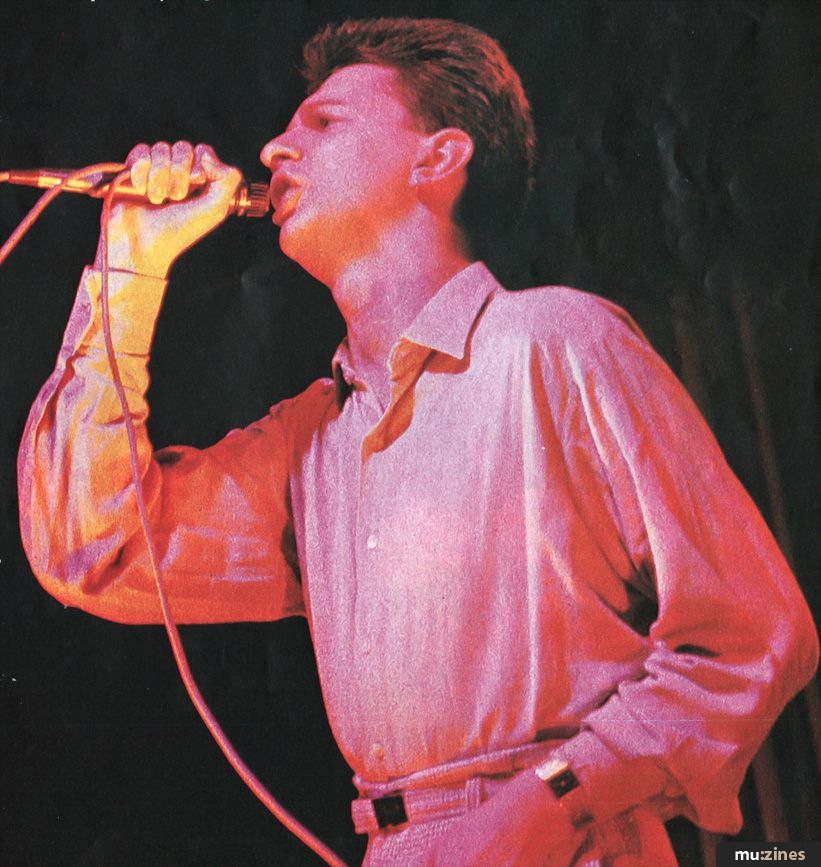
Image credit: Tony Mottram
Alan uses a Roland Promars on stage and apart from their trusty 3340 four track Teac, that's the only live gear they employ. In the studio it's a different matter. An old and battered ARP 2600 which Danny Miller got cheap from Elton John swarms with jack plugs and leads.
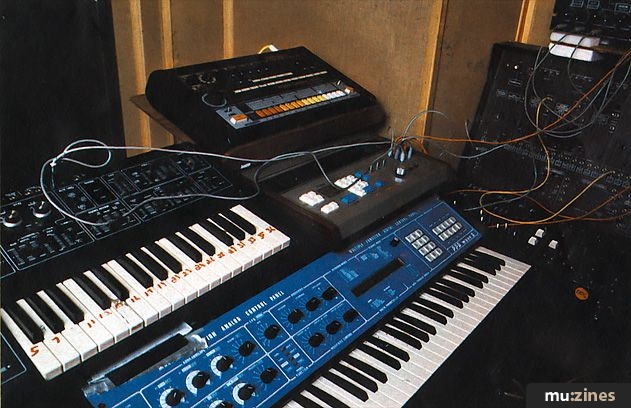
It's one of the older ARPs — a huge slab of black control panel where all the separate filter and oscillator sections are patched together using leads, giving the player many more options over the controls than a normal mono synth where the connections are already made for him, deep in the electronics. Depeche use it consistently for their bass drum sound, and for studio bass lines operated by a sequencer.
A less common name is Kobol; a French-made synth similar in many characteristics to Moog. In fact Kobol once made their own programmable version of the Minimoog. Andy says the Kobol has a great deal of depth behind it and again makes a good sequenced synth. "It's sort of... lumpy," he explains, adding that they've been using it since 'See You'.
The one improvement they'd all like to see is in reliability on the road. There's not one synth in the collection that hasn't broken down at some time. In fact there was a gig at Hamburg on a recent tour when EVERY keyboard packed up at once.
Andy: "The Roland, Moog, PPG, they were all causing trouble. We had to hire another Source and Danny programmed it in 45 minutes before the gig started. And then when we went on stage there was a big crash and we thought the PPG had blown up. It was the PA — even that had gone wrong.
"In Philadelphia we went off after the set and they were all shouting for more and suddenly the Source started up on its own going 'eep, urp, oop, oop' and making noises. The crowd thought it was the encore."
"The PPG does that as well," offers Dave. "Suddenly it will go 'aarrrruuuppPPP!!!'. It sounds really sad."
Obviously it's a piece of misbehaviour they've got to know fairly well since all three members of the band were able to join in the vocal imitation.
Time to change the subject. What's been the greatest advance in the studio?
Martin: "I think probably the Roland MC4, that was a big breakthrough."
The MC4 is the second in Roland's series of Microcomposers — very sophisticated computer-based sequencers that are able to control several synthesisers at once. Information is fed into them via a keypad on the front and with the right numbers you can dictate timing, pitch, duration and dynamics of each note, rub out the ones you don't want or rearrange whole sections to make up a song.
"We use it in the studio to run sequences and Danny has an old Roland SH-1 synth where each key has a number written on it in red. That's the number you put into the MC4 to get that note. It's also useful because I can take it home and work on a song, then bring it to the studio and play it back. Even if you don't use any of the riffs or sequences you've still got the length of the song programmed in.
"One of the disadvantages is that it won't run the PPG."
"Yea," continues an irate Andy. "It's annoying that different synthesiser makers won't put in the right clocks and gates so you can use their equipment with someone else's. They all want you to carry on buying their gear, but every firm is good at some things and not at others so you'll always want to swap around."
It's true that PPG are planning to bring out their own computer to operate the Wave, but right now, in Blackwing studio, that's no great help. Depeche did consider using the MC4 for live work, either alongside or possibly in place of the Teac tape. But it's the fear of road failure that keeps them off the idea.
"We have to be our own roadies at the airports. We each get a trolley," explains Dave, "and we see how the stuff comes down the chute: CRASH! I don't think the MC4 could stand it. If that went wrong on stage, you've had it. At least with a tape you can rewind and start again."
And what exactly goes on their notorious tape that has been whirring in one form or another at the back of the Depeche line-up for a couple of years?
"A hard sequencer line to play, some percussion or something you can only get the sound for in the studio, not live," says Andy. "A lot of people think everything is on the tape, we're just singing or miming, but that's not true. Ever since we started as a band our aim wasn't to come across as good musicians! If people don't like the idea of having a tape, they won't come to see us."
"Anyway," continues Martin, "you always feel as if you have to be playing something. We could never put everything on tape. Even the times when I'm not playing now I feel a right idiot. I don't know what to do with my hands... shove them in my pockets, or something."
The tape is a large secret in the Depeche Mode sound, but not because it's filling in all the tricky stuff they can't manage to play. In fact it's usually just adding percussion or background lines. The reason for its success is that it's still Depeche Mode.
There's not a drum machine or a sequencer ticking over at the back of the stage; the spool contains a Depeche Mode performance. They've recorded the rhythm track, putting in the bass drum and synth sounds, and they've recorded the fills. That's how it manages to retain the human element.
There are a couple of drum machines in the studio - a Roland TR808, a Korg KR55 and a new Linn is on the way — but those usually contribute only snares or hi hats. The bass drum, responsible for a lot of the feel, comes from the doughty ARP 2600.
"We did mess around with a Movement computer drum machine at one time," says Dave. "The bloke who was doing the programming for us took the ARP bass drum sound and said he could get the Movement to sound exactly like it, but when it came back it wasn't like it at all. We stick to the 'famous Miller fat bass drum'. It's got real thump to it, a real bottom end, much better than all the drum machines."
There are noises like the 'Miller drum' which they've perfected and are holding on to, but each time a new track comes around it's time to create a fresh set of sounds. How do they go about finding the right ones?
Andy: "We'll have a rough idea, like we think there should be a 'shush' at this part of the track, so we'll get something along those lines up on the synth and Danny will help us refine it. He can say 'turn that knob there' and we will — it won't sound any different to us, but he knows it's better."
Dave: "We'll explain to Danny what we'd like and he says 'just a moment' and it's there. We could be playing around for five hours and still not get it... so we read the papers instead."
Andy: "Danny would read a synthesiser manual, he reads them at home, probably on the toilet or something. That's his hobby. Everybody else would be reading a paper and Danny would be looking through the MC4 manual.
"Don't ask me why we choose a particular sound, it's just right. If you played it in another track it would sound horrible."
Dave: "When we start a track we're mostly playing around with the stuff. Maybe we'd get a sequence to begin with, then put on the drums and build it up from there. It's changed a lot from when we started. When we first recorded we'd just go into a room and play along live.
"We used to practise in a church and Vince would come along with a song and it would go from there. Andy would put on a bass line — at that point he was still playing a bass guitar — and then Mart would put on another synth.
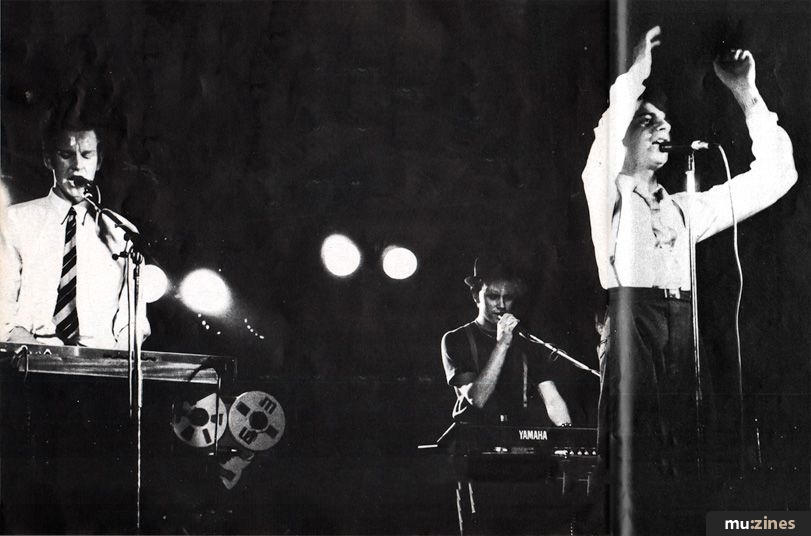
"When we went in to do the first album all the songs and the sounds were worked out because we'd been playing them for years. The new album is different, some of the stuff is very poppy, but other songs are completely opposite.
"Every time we did a practice we used to tape the songs and take them home. 'Listen to this, Mum, we're really proud of it'; 'Oh that's nice, dear, nice tune'. When we listen to it now it sounds so bad, but that's what made us, I suppose."
Andy: "When we started playing live we used to make loads of mistakes like singing flat."
Dave: "We still do."
Andy: "But I think we've become more professional. We used to be stilted in front of an audience, now if there's a mistake you look at the person who made it and laugh."
Martin: "And programmable synths help. You don't hear the 'urt, urt' before each song to make sure you've got the sound right. I don't know how we got away with what we did. We used to come on stage and tune up then go off again and come back five minutes later to play the gig. We thought of wearing masks. Now we've got silent electronic timers."
Andy: "The live sound is a lot meaner than the studio sound... the people behind the sound desk are very mean... In Pasedena we had all the needles pinned at one gig — it was really loud, like a punk gig. We couldn't hear a thing we were doing."
But for all the advances in equipment and the experience in gigging and song writing, Depeche's ideas about sounds — the right sounds — have stayed much the same. They go for bright, clear and uncluttered synth settings, not the firework night displays that other synth bands prefer. "Those sort of noises don't achieve anything," says Martin. "They just muddle things up."
David reckons the new album will show a progression in their use of synths. In what direction?
"Er... forward, I suppose. Some of it is quite atmospheric and at the moment there are not two tracks that sound the same. I think the audience will always want to change, they don't want to carry on listening to the same thing. If you don't progress they'll go and listen to something else."
There's even a suggestion that one of the B sides might contain... gulp... guitars: Sometimes when you're in the studio and you've listened to hours of sequencer riffs you think it might be better to have Andy playing bass guitar, just slightly out of time."
The original plan was to write fresh material while on the road during the last tour, but somehow things like food, sleep, gigs got in the way, though that might be an advantage. David reckons that bands who fall to scribing while touring end up with their 'American' album once they finished in the States, an 'oriental' album first time they go East, and so on. At least Depeche have already got the Basildon album out of their blood stream.
Whatever happens on Depeche Mode 2, it will preserve the band's talent for economy. Nothing on a Depeche Mode track is ever there because of laziness. Each riff or line has been carefully designed to fit into a space, do a job and contribute to the melody or the rhythm. It's what makes their music such a refreshing experience.
Dave: "Daniel always says that it's easy to put strings or a string machine into a track when you feel there's something missing. That's the lazy way and a lot of bands still do it, even now. It hides up all the gaps. We try to get away from that. It's more exciting to think of other ways of doing it."
One of the challenges they recently faced was making a 12in version of 'Meaning Of Love' — a trickier business than it sounds. Some tracks are easy to extend — riffs and runs can be lifted, echoed, patched together into middle sections while the rhythm track keeps going. Straight songs are harder to work with. You can extend the end or the beginning, Dave reckons, but after that you're on your own.
They decided to augment 'Meaning Of Love' with a 'Stars On 45' chord change that spins out of nowhere, and plenty of weird percussive noises. "It was a good laugh, but some of our fans wrote in saying what was wrong with our new records. They were going a bit strange."
That was nothing. You haven't heard the 30-second punk jingle they did for an American radio station which ends with everyone collapsing in fits of giggles.
When I spoke to them, Depeche had just fixed dates for a countrywide tour at the end of the year, about 20 concerts in all, the longest stretch of playing they'd ever gone in for. And they were looking forward to it.
"That's the best part of it all," confides Dave. "When you're playing live and you see the audience reacting."
And with that, the Basildon pub audience did its own bit of reacting — and put down one more beermat for the Speak and Spell pen.
More with this artist
 Depeche Mode (Depeche Mode) |
 The Basildon Bond (Depeche Mode) |
 Recording Mode (Depeche Mode) |
 Modes of Operation (Depeche Mode) |
 Mode-Al (Depeche Mode) |
 |
More from related artists
Depeche Mode (Daniel Miller) |
 The Miller's Tale - Mute Records (Daniel Miller) |
 Downstairs At Erics (Vince Clarke) |
 Reset For Success (Vince Clarke) |
 Sounding Off (Vince Clarke) |
 Waiting For The Perfect Song (Vince Clarke) |
 |
 In Clarke's Shoes (Vince Clarke) |
 Vince Clarke’s Wall Of Sound (Vince Clarke) |
 Home is where the art is (Vince Clarke) |
Publisher: One Two Testing - IPC Magazines Ltd, Northern & Shell Ltd.
The current copyright owner/s of this content may differ from the originally published copyright notice.
More details on copyright ownership...

One Two Testing - Nov 1982
Donated by: Angelinda
Interview by Paul Colbert
Help Support The Things You Love
mu:zines is the result of thousands of hours of effort, and will require many thousands more going forward to reach our goals of getting all this content online.
If you value this resource, you can support this project - it really helps!
Donations for May 2026
Issues donated this month: 0
New issues that have been donated or scanned for us this month.
Funds donated this month: £0.00
All donations and support are gratefully appreciated - thank you.
Magazines Needed - Can You Help?
Do you have any of these magazine issues?
If so, and you can donate, lend or scan them to help complete our archive, please get in touch via the Contribute page - thanks!
If you're enjoying the site, please consider supporting me to help build this archive...
...with a one time Donation, or a recurring Donation of just £2 a month. It really helps - thank you!

 @mu_zines
 RSS Feed
 Blog
Blog