


Magazine Archive
Home -> Magazines -> Issues -> Articles in this issue -> View
Article Group: | |
White LW100 Amp | |
Article from International Musician & Recording World, October 1975 | |

TEST ON: White LW100 Amp
DATE Sept
PRICE £158.55 Ex VAT
INTRODUCTION
The white LW100 is an "old valve" amplifier top of traditional design which is suitable for use with guitars, bass or keyboards. As is the case with most valve amplifiers, only one input channel is provided but there are two input sockets. One socket is a high sensitivity input and the other is of lower sensitivity.
The controls provided are (i) a slide switch which selects bright or normal tone, (ii) a volume control which is placed before the preamplifiers stages, (iii) a six position switched bass cut and boost control, (iv) a normal variable bass control, (v) a treble cut and boost control (vi) presence (middle) control, (vii) master volume which is placed after the preamplifier and (viii) power off-on switch and a pilot light.
The fitting of a master volume control on a system with only one channel may, at first sight, seem strange. There is, however, a good reason for this, if the first volume control is set high and the master set low, a normal guitar level input will overdrive the pre-amplifier and give a fuzz effect. Setting the first volume low and the master high gives a clean sound.
The effects of the two bass controls interact so that when both controls are at maximum boost or maximum cut the overall effect is quite dramatic.
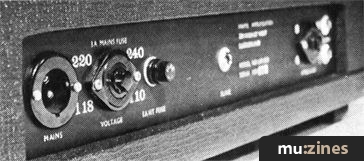
The back panel carries two speaker output sockets, a slave output jack, three fuses, speaker impedance selector and mains voltage selector. The speaker and mains fuses are designed into the centre of the appropriate selector such that the selector mains voltage or speaker impedance cannot be changed without first removing the fuse. All fuses are of the standard 20mm size.
CONSTRUCTION
The unit is constructed on a heavy steel chassis with, all the valves and transformers on the top surface and controls along the front edge. This is housed in a very strongly made vinyl covered wooden case. The quality of construction and standard of finish is extremely good.
The transformers and other major components are all of adequate size and most of the small components are of a higher quality than one normally finds in musical equipment. These small components are mounted on a single glass fibre printed circuit board.
The wiring is very tidy the soldered joints are good and there is evidence of careful attention to detail: for example, the use of jack sockets with gold plated contacts.
PERFORMANCE
| RESULT | TEST CONDITION | COMMENTS | |
| Output | 130Watts r.m.s. | at 10% total harmonic distortion | |
| Distortion | 3.8% | at 120 watts | Not bad for a valve amplifier |
| 2.6% | at 100 watts | ||
| 0.84% | at 10 watts | ||
| 0.2% | at 1 watt | ||
| total harmonic distortion measured at 1 KHz. | |||
| Sensitivity | 4.8 mV. r.m.s. | Hi input for 100 Watts output | Ample sensitivity for most purposes |
| 9.6 mV. r.m.s. | Lo input with tone controls central | ||
| Tone Controls | Bass Switch — 26.7dB. @ 50Hz. | Good tone control range | |
| Bass — 25.4dB. @ 50Hz. | |||
| Treble — 29.5dB. @ 10KHz. | |||
| Presence — 13.2dB. @ 3.8KHz. | |||
| Bright Switch | The amount of treble boost depends on the setting of the first volume control and is zero when the control is at maximum. | ||
| Output Protection | Open circuit - OK | ||
| Short circuit - blew fuse. No spare fuse provided. The amplifier worked correctly when the fuse was replaced. | |||
| Noise | -66.1dB. below 100 Watts | Volume controls at max and other controls central. | Good |
| Capacitive Load Test | OK | 1 uF and 8 ohm load on 1 KHz. and 10 KHz. square wave | Good stability margin |

CONCLUSION
In most sections of the electronics industry, valves are only of historical interest. However, in the music field, valve amplifiers not only survive, but new designs are continually coming on the market. This indicates that the "valve sound" has a strong following.
The two features which distinguish "valve" sound" from "transistor sound" are the large amount of second harmonic distortion and the gentle clipping characteristics of valve amplifiers. This amplifier, like most valve amplifiers, has plenty of valve sound. The clipping characteristics are surprisingly sharp and more similar to those found in transistor designs than in valve designs.
The quality of construction is excellent but the facilities are fewer than one would expect on a transistor amplifier of the same price. The performance is good compared with other valve designs and maintenance and spare parts should present no problems. Although six valves are used, they are of only two different types and spares can therefore easily be carried. After the short circuit output test, I found myself having to do what any musician on the road would have to do if the OP fuse blew. That is, short it across with a piece of wire until I could get another fuse. Obviously, this is unsatisfactory and spare fuses should be provided, or better still, replaced with another form of cut out.
The amplifier comes in a very practical transportation case and also with a canvas cover. The true value of these I am sure will be appreciated by the time the amplifier has worked hard for a year or two.
Publisher: International Musician & Recording World - Cover Publications Ltd, Northern & Shell Ltd.
The current copyright owner/s of this content may differ from the originally published copyright notice.
More details on copyright ownership...

International Musician - Oct 1975
Donated & scanned by: Mike Gorman
SoundCheck
Gear in this article:
Review by Bruce Gibbs
Ads for Gear in this article:

Help Support The Things You Love
mu:zines is the result of thousands of hours of effort, and will require many thousands more going forward to reach our goals of getting all this content online.
If you value this resource, you can support this project - it really helps!
Donations for April 2026
Issues donated this month: 0
New issues that have been donated or scanned for us this month.
Funds donated this month: £0.00
All donations and support are gratefully appreciated - thank you.
Magazines Needed - Can You Help?
Do you have any of these magazine issues?
If so, and you can donate, lend or scan them to help complete our archive, please get in touch via the Contribute page - thanks!
If you're enjoying the site, please consider supporting me to help build this archive...
...with a one time Donation, or a recurring Donation of just £2 a month. It really helps - thank you!

 @mu_zines
 RSS Feed
 Blog
Blog