


Magazine Archive
Home -> Magazines -> Issues -> Articles in this issue -> View
World Beating? | |
Real Drum Company Masterkit CD-ROM Vol. 1Article from Sound On Sound, May 1993 | |
The Real Drum Company want to show the world just how good sampled drums can be, and their new Masterkit CD-ROM for Akai samplers has already won the plaudits of leading drummers. Wilf Smarties finds out what all the fuss is about.
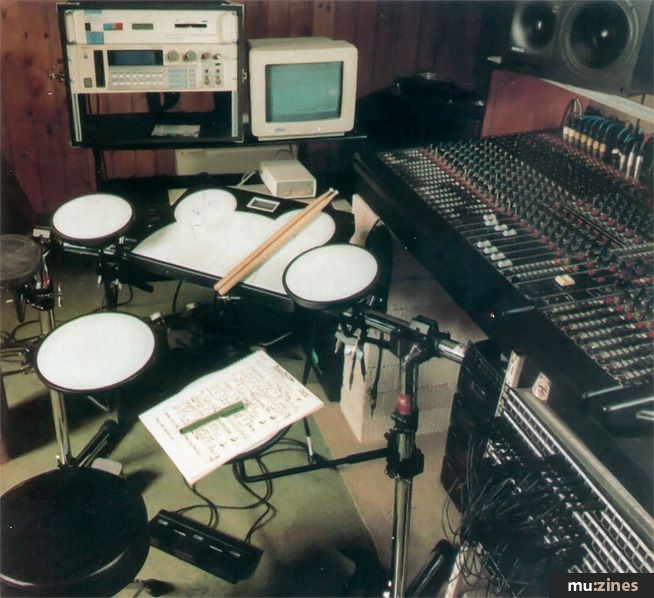
It's not often that I get a British product to review. Then again, strictly speaking, the digital drum workstation concept being promoted by The Real Drum Company, isn't entirely British. Although the innovative content of the whole is the work of Paul Brook, David Skipper and Mike Trim (sic), assembling the complete system will also require you to buy a Japanese sampler, an American MIDI drum pad set, and a CD-ROM drive.
Drum programming is easy. Good drum programming is not, and realistic drum programming well-nigh impossible. Until now that is. The trouble with 'drum machine' kits is two-fold. Firstly, a single sample played over and over does not sound like a drum being repeatedly hit. The use of MIDI velocity to vary dynamics, filtering, envelopes, sample start times etc. goes some way towards simulating the kinds of variation in tone a single snare can produce, but you can't beat the real thing. (Ouch!) Think of it as comparing simulated with real stereo. Secondly, how can you effectively input drumming performance data.
What the Real Drum Co. have done, with the aim of creating the ultimate sampled drum experience, is to produce a library of outstanding sampled kits on CD-ROM (Akai format files) — complete Volumes, all ready to load in. There's more to this than just good samples, however. Although you can use a keyboard as you controller, this is a drummer-oriented product, fine-tuned to work with a particular drum controller.
HARDWARE INVENTORY
The problem of inputting drum performance data has been addressed by a number of companies over the years, notably Simmons and Roland. RDC have chosen to build their live kit around the drumKAT, an American device which is not too well known on the streets here (probably due to its 4-figure price tag), but which is generally considered among pros to be the best around.
If you're not a drummer, but still want to use RDC's sounds, you can input data piecemeal from a MIDI keyboard. Quite honestly, this will not be particularly easy if you can't play in the beats with some degree of feel. There are so many samples making up a single kit that to try to map out a rhythm solely on a drum edit page would take forever. A much better prospect would be to take some pre-recorded MIDI file drum patterns from the expanding RDC library, and edit them.
The samples are presented as Akai format files on CD-ROM — that means that if you don't already own an Akai sampler, then you'll need to buy one. In fact, I suspect that most potential buyers of this product — that is most people who are prepared to pay £270 for a CD-ROM of high-quality drum samples — will already own one. The acquisition of a CD-ROM drive is another requirement. For those that aren't familiar with CD-ROM drives, they are general purpose mass storage devices which read data (an awful lot of it) from special CDs. Many professional samplists already use them.
The excellent DAC rackmount drive which is shown in the product literature is fairly expensive — cheaper, slower alternatives are available, however. Paul Brook says that the DAC drive is recommended because of its particular suitability for drummers who want to take their equipment on the road: DAC drives are tops for reliability and backup.
I CAN'T BELIEVE IT'S NOT BUTTER
The history of the Masterkits goes like this... Once upon a time Paul Brook was doing some work for Big Life Records, and when label boss Jazz Summers heard his programming he could not believe it wasn't real drums. He then suggested that Paul produce a CD-ROM of his sampled kits. Big Life paid for all the recording, and will recoup on a royalty basis. This is, to my knowledge, the first time ever a record company has released a CD-ROM.
So what's so great about these samples? Consider digital recording. We all know that four bits is toytown, eight bits retro (that classic Fairlight sound), 12 bits passe, and 16 bits merely adequate for today's discerning listener. Audio quality depends on sampling frequency.
We can make an analogy here with drum samples and drum programming. Take a single snare sample and your programming will probably sound sticky. Take two and velocity switch between them — one sound for hard strokes, one for soft — and you might fool some of the people some of the time. Take four different velocity samples for each stick — four left-handed strokes and four right-handed — and it's obvious that you can, in theory, get closer to the real thing than anyone has attempted before. Obviously a high degree of craft and judgement on the part of the user would be required to ensure that all that sampling, mapping and velocity switch level setting was not going to be a huge waste of time. That, in a nutshell, is how RDC did it.
At first glance it might seem that Masterkit Volume 1 is somewhat scant in sample opportunities. There are, after all, only three basic kits on show. However, each is covered with a breadth and depth not seen before in sampled drums. There are also a few extras, such as boombams, a gong, a 'gong drum', rototoms, cowbells, other percussion, and FX. Even so, only around one half of the CD-ROM format's total capacity of 600MB has been used.
I'm going to concentrate on the kits. Each comes with a selection of three massively multi-sampled classic snares; some offer a choice of kick drum or hi-hats. Don't be fooled by the same snare names cropping up in more than one kit: they were all different sized models. (In fact over £20,000 worth of drums were used for the recordings.) Around 20 files are offered with each kit, including flagship Keyboard and Pad 'Turnkeys'. RDC's standard map for drums necessarily occupies most of a 5-octave keyboard. Future kits will conform to it. RDC do offer GM standard options on the CD-ROM (including GM percussion), but these cannot convey the realism of the full RDC map which uses several notes for some instruments in order to capture differences between hitting different parts of a drum.
Recordings were made using full kit set-ups to maintain sonic integrity. (An isolated snare sounds different from one next to sympathetically resonating tom-toms). As a concession to cleanliness, cymbals were removed while sampling the drums, and if a drum's resonance proved particularly troublesome the tea towels were brought out.
THE KITS
The Power Kit is a six tom-tom, double bass drum Tama Grandstar power depth kit (it says here), with a choice of Noble and Cooley, Zildjian alloy, Sonor Signature, or 6.5" Ludwig Black Beauty snares. The double bass drums are sampled dry and ambient, and flat and EQ'd (ostensibly to compensate for the inherent LF roll-off of the S1000). As well as providing a healthy range of single hits, several Performance files are included — live takes of those difficult-to-program-at-any-price snare presses, drags and rolls, plus tom flams and rolls.
The Studio Kit features rim-mounted 'Drum Workshop' toms, superbly detailed cymbals and classic Snares. The perfect all-rounder. The Funk Kit is recorded in a dry studio acoustic, and the drums are taped to produce "that classic funky sound".
Sample auditioning was carried out on a Roland SP700 (which reads Akai format files) with 8MB of RAM installed. This, by the way, is not enough RAM to load all the files, some of which are up to 20MB in size. I tested Funk Kit 1, Power Easy, Studio GM Kit, and Studio Loops.
FUNK KIT 1
The bass drum comprises four samples taken at different velocities. The acoustic was dry, the beater not hard. I set my Roland PC200 keyboard for low/medium velocity sensitivity. This proved to be about right for getting the 4-way velocity switching to work. I left the PC200 there for the rest of the audition. A warm sounding kick.
The snares are altogether more complex. Two are offered. Snare 1 occupies seven adjacent keys. Starting from F2 (Roland-speak: why can't manufacturers agree where C4 lies on a MIDI keyboard?) we have a velocity stack of four left hand snare edge samples. On the next key lies a single rim shot, followed by another 4-way velocity stack, this time of left hand snare centre samples. On the next black note is a single rim click. The next three keys offer the inverse of the first three, this time for the right hand. Playing press rolls by strumming my fingers on the four white snare keys gave a surprisingly (considering my cack-handedness) real result — very convincing. I can think of no more telling test of a sampled snare's realism than a press roll. I would describe the snare sound as being crisp but thick. Eminently usable, in fact.
Snare 2 followed the same mapping formula, meaning that a pattern recorded perfectly on Snare 1 should play perfectly on Snare 2. This was a lighter, brighter higher tuned snare, again taken in a dry acoustic. Rappier, and less general purposefully useful than the former, for some reason the press rolls sounded stickier this time.
Funk Hats cut a swathe from F3 to D#4 (alright, E flat: look — I don't have a flat symbol on my Atari's word processor, OK?). Bottom to top we find two velocities of left hand open, three left hand edge, three left hand centre, one foot pedal, three right hand centre, three right hand edge (should this be on a black note, I ask myself?), and two right hand open hi-hat samples. These are augmented by three 'slurps' (hit open then foot-closed) of different lengths, each to its own key. For keyboard programming, I would be tempted to take off the decay envelopes and use the sequencer to determine the gate times. On their own, the hi-hats sounded not extraordinary. Quite a heavy and expensive set, I should think.
There are three Fat Toms, each with two levels of dynamic. Live and dry, tuned pretty low. Two ride samples, bell and edge, each on separate keys, were over-filtered in the SP700. Also, for some reason their velocity ranges were 81-127. Below 81 nothing sounded — probably something to do with the fact that the files weren't actually being loaded into an Akai machine. Again, you've probably heard good 16-bit cymbals. These are not intrinsically any better than the best of the rest. Their real value, like the hats, lies in the fact that they were sampled at the same time and place as the kit. I'll skip the rest of the detail from Funk Kit 1 and move on to...
POWER EASY
In this simplified kit, velocity switching is forgone in the pursuit of memory saving. There are five hard boomy kicks, two with snare rattle and one with a gated reverb. There are five snare samples, all recorded in the same hard room from two snare drums, crisp and rimmy sounding. Six toms and six flammed toms occupy 12 keys. These are clean, bright and even. Very good, in fact. The cymbal set is wide in range, upfront and very realistic. Also very good. Two open, two loose closed, and one foot hi-hat sample are offered. I found that, while the two closed samples layered fine, hitting the open hi-hat with both hands at once led to some distinctly unnatural flanging.
The assignment procedure was very strange on this kit. There was no velocity switching employed, yet every Partial (velocity stack) had the maximum number of four (albeit identical) samples assigned, though only the topmost had a real velocity range. A curious way to go about it: why not just have 1 sample per stack and be done with it? (Again, this might be an anomaly thrown up by the transference of Akai files into a Roland sampler.)
STUDIO GM KIT & STUDIO LOOPS
The kick here is a layer of two samples (not exactly ultra-naturalissimo!), and snares and rim are in stereo. Other samples are in panned mono, covering the entire General MIDI range of sounds (including whistle and so on). The snare is well 'ard and bright, as indeed are all the samples. Then again, so are most 16-bit GM sets these days. Hi-hats are lighter, or in any case higher, than on previous kits.
Three 4-bar loops illustrate what can be done with the 16MB Studio Kit Turnkey. Pretty impressive.
SWINGING THE KAT
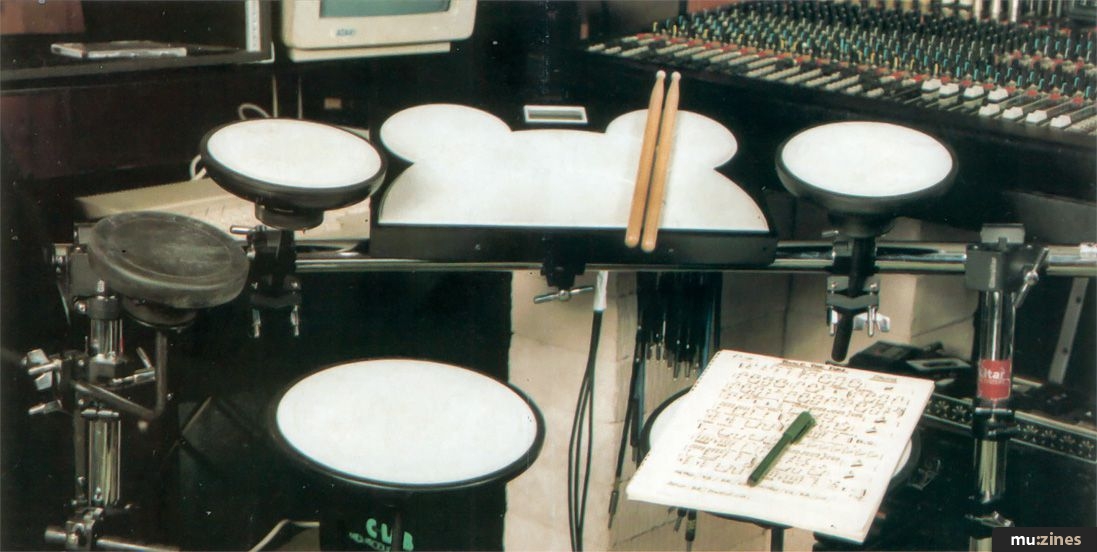
Whilst you can certainly get good results from the RDC kits using a keyboard controller, it's using them with the drumKAT which will interest real drummers. The drumKAT has a 10-zone playing surface, ergonomically designed for drummers. It is around the size of an Octapad, and the pads are arranged on the playing surface in a distinctive shape which is probably best described as a 'half steel drum with Mickey Mouse ears'. It may be augmented with standard pads, which plug into rear panel jacks. Footwork is accommodated by means of kick and hi-hat pedals and/or footswitches. According to Paul Brook, a budget pedal switch called the Mini-kick gives a not unreasonable feel. He also reckons that the hatKAT is another essential drumming accessory — this simulates the action of a hi-hat pedal, allowing up to eight notes to be assigned to one KAT pad.
Most drumpads use piezo-electric devices to convert movement into an electric signal. These have to be mounted under a fairly hard surface, and have a limited dynamic range. The drumKAT uses an advanced force-sensing resistive film, which can be mounted close to a pliant rubber surface, giving greatly enhanced dynamic response and evenness over all pad areas.
Another important property of the force-sensing film is its ability to respond to pressure and not just to velocity, opening up new areas of expression for MIDI drummers.
There are several variations on the basic drumKAT — RDC have married their CD-ROM product with the version 3.0 KAT, which allows for, among others, the following important features: 10 playing surfaces; nine trigger inputs; four footswitch inputs; two MIDI Outs (32 channels); 30 user kits; six program changes per kit; four notes per pad; controller input (for hatKAT); Pad Training (play your loudest and softest hit to set dynamic range); pressure controller. This is not a full-blown review of the drumKAT, however — if you want to know more, write to their UK distributors, Zildjian.
DOES IT GROOVE?
Not being a drummer myself, I have had to rely on auditioning others performing on the system. I have done so on three occasions, most recently when Paul and Skip brought the drumKAT round to my studio. We loaded in the Funk Kit Turnkey (for pads), which is my personal favourite. Paul then played some beats into Cubase. I have never heard programmed drums come anywhere near as close as this to sounding like a real kit. I've worked in studios for 10 years, so I know what a miked up studio kit should sound like. It should sound a lot like this.
THE PROBLEM, THE SOLUTION, AND THE FUTURE
As I see it, one problem here is that non-drummers will not really be able to get good value out of the investment required to get Masterkit 1 up and running. They will instead have to rely on buying in drum patterns (as standard MIDI files) to get maximum realism from the system. This product has been initially targeted by a drummer at drummers. There are many, many more non-drummers out there who would dearly love to get their hands on happening editable beats. Right now they use sampled drum loops.
Having spoken at some length to the Real Drum Company, I have persuaded them that it would be worth producing a library of favourite beats by name drummers. With an expanding range of sequenced patterns and sampled kits, the variety of drum loops that could be generated would multiply.
I can see this becoming a new format for drum loops — the loops are sequences, the drums are samples, and total editing and mixing flexibility is retained. All you'll need is a sequencer, a CD-ROM drive, a sampler, and the CD-ROM itself. Plus floppy disks full of MIDI files. Indeed, there is nothing to stop RDC in future releasing kits on floppies, DAT-RAM or CD-Datafile. Expect third party sequence support to follow. Dance and other programmers: keep your eye on this ball.
RIGHT NOW?
The future aside, however, what of the value of the RDC Masterkits right now? This product is not exactly in the development stage. Already top drummers are getting very excited about its potential (some say that playing drums on the RDC system is positively inspiring). Having a drum kit in a suitcase that can be set up in five minutes and recorded over MIDI has caused several drummers to commission custom-sampled versions of their own kits.
MIDI drums have come of age. If you're a drummer who has been put off MIDI up 'til now, because of a lack of response to the subtleties in your playing, remember that Paul Brook created this product because he feels the same way you do. The Masterkit Volume 1 CD-ROM will be of immediate interest to well-heeled professional drummers, those lucky enough to have the hardware in place already, or chinless wonders with massive inheritances and delusions of pop grandeur. Programmers should wait until a library of loops and grubbier, less pristine drum samples shows clear signs of emerging. When it does, get in there fast!
Further information
Real Drum Co. Masterkits Val 1 £269 inc VAT.
DAC CD-ROM drive £822 inc VAT.
DAC, (Contact Details).
drumKAT 3.0 £1,090 inc VAT.
Zildjian UK, (Contact Details).
Publisher: Sound On Sound - SOS Publications Ltd.
The contents of this magazine are re-published here with the kind permission of SOS Publications Ltd.
The current copyright owner/s of this content may differ from the originally published copyright notice.
More details on copyright ownership...

Sound On Sound - May 1993
Review by Wilf Smarties
Previous article in this issue:
Next article in this issue:
Help Support The Things You Love
mu:zines is the result of thousands of hours of effort, and will require many thousands more going forward to reach our goals of getting all this content online.
If you value this resource, you can support this project - it really helps!
Donations for May 2026
Issues donated this month: 0
New issues that have been donated or scanned for us this month.
Funds donated this month: £0.00
All donations and support are gratefully appreciated - thank you.
Magazines Needed - Can You Help?
Do you have any of these magazine issues?
If so, and you can donate, lend or scan them to help complete our archive, please get in touch via the Contribute page - thanks!
If you're enjoying the site, please consider supporting me to help build this archive...
...with a one time Donation, or a recurring Donation of just £2 a month. It really helps - thank you!

 @mu_zines
 RSS Feed
 Blog
Blog