


Magazine Archive
Home -> Magazines -> Issues -> Articles in this issue -> View
Yamaha BB1100S Bass | |
Article from In Tune, June 1985 | |
Following last month's 'IT' review of the impressive new Yamaha B100 Series III Bass Combo, we decided to check out one of this maker's latest active basses - the BB1100S. A perfect partner for the amp? Read on...
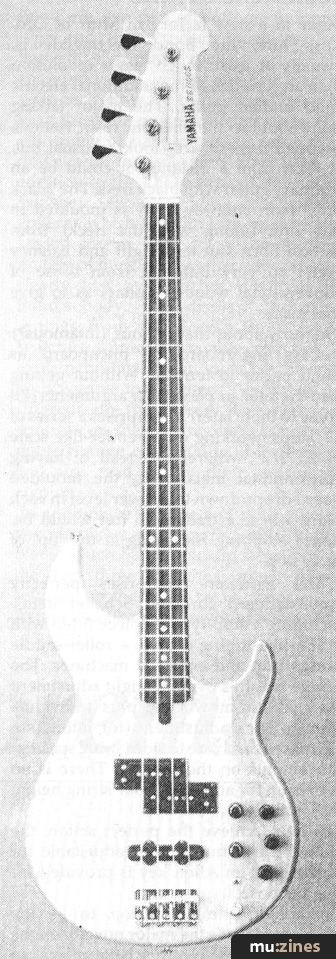
Unlike most other bass makers, Yamaha's entry into the active electronics field has only come about relatively recently. Manufacturers like Aria, Westone and Ibanez have been at the active bass game for some years now, but it's taken Yamaha (probably the most traditional-minded of the Japanese guitar and bass makers) some while before taking the plunge. Even then, they did so with their 'flagship' models, and have only just extended active powered tones down their price range in the form of the new BB1100S.
Happily, this coincides with Yamaha U.K.'s brave price-lowering venture (reported in last month's IN TUNE), and what started out as a £429 instrument now carries a recommended retail price of £399. Take into account the various discount offers one sees, and that makes this a very interestingly priced bass - so what's it like?
The BB1100 we borrowed was, as Yamahas always seem to be, both beautifully finished and set-up. Ours came with the laminated alder body finished in what they call 'Antique Stain' (pity they can't find a less ambiguous name for it!) and looked really handsome. The neck was a maple one-piece type, screwed on with four bolts (very much as per a Precision) to which had been applied a rosewood 22-fret fingerboard of a rewarding quality. Say what you like, finishing standards may not be the most important aspect of any instrument's performance, but a nicely turned-out guitar or bass always inspires extra confidence and, as ever, this Yamaha looked and felt uncompromisingly satisfying.
The impression of high-class manufacture and finishing is borne out as soon as you pick the Yamaha out of its case (which, by the way, is unfortunately extra to the price quoted above). The body is of a comfortable middle weight, well contoured and strangely sensuous to handle. The neck too is very well proportioned: in fact it has to be one of the fastest necks on a mass produced bass that we've had in the office since IT's beginnings. The neck is quite wide but very slim, and seems to have been designed by someone who has an idea of what it feels like to slog through a three hour set!
The BB1100's hardware sticks firmly to tradition, comprising, first of all, four open machines of excellent quality. The bridge, however, is very basic; a screwed-down Precision copy - something which you really shouldn't find on a bass costing nearly £400. The individual saddles are 'tracked' (to prevent saddle slip), but even this feature can't really redeem what is really a very outdated design, from the point of view of its ability to ensure both the maximum amount of sustain, and the best possible transmission of frequencies. Yamaha's innate conservatism in design hasn't helped them here, and a more modern bridge system would be something for them to look at for future updates on this (not to mention their other) basses.
Two pickups are fitted on the BB1100; one a split Precision type, the other a bar Jazz bass unit. These are governed by two controls (one volume, one tone) with the addition of a sensibly placed pickup selector switch plus a metal micro-switch to set the active circuitry on or off. Powering the battery-assisted circuit is a standard PP3 cell which is fairly easily got at, buried inside the body. Flick over the active switch, and what is already a very impressive sound turns into an exceptional one. The BB1100 doesn't have the range of tones of some actives, but this is probably more to its credit than anything else, as it doesn't have those awful 'electronic-squeak' settings which can make some actives very hard to set-up in a hurry - especially when you're in mid-set. In fact its sounds are all very usable, with a range running from a high treble which no-one (save a bat!) would be able to tolerate listening to, right down to an impressively warm, rounded bass, and through middly tones, some of which are both unusual and effective.
By any standards this is a highly impressive bass - and Yamaha have obviously done a lot of development work in figuring out what most bass players want and what they could really do without. The result is one of the best sounding active basses we've had in the office (apart, that is, from the real luxury custom jobs). To better the Yamaha, judging from our experience, you'd have to move up to something like a Wilkes B1 (see our review in Issue 1 of IN TUNE), which will cost you maybe £100 more. This Yamaha is, then, very good value.
At just under the £400 mark, IT's testers were unanimous in their view that this was one of the best new active basses they'd sampled in a long while. If you're in the market for an especially easy instrument to play, not to mention one with a fine sound, then do try and find one to sample - we're certain you'll be as impressed with this newcomer as we were, especially since Yamaha's recent (and highly commendable) price cuts.
RRP £399 Inc VAT
More details from Yamaha-Kemble Music Ltd., (Contact Details).
Publisher: In Tune - Moving Music Ltd.
The current copyright owner/s of this content may differ from the originally published copyright notice.
More details on copyright ownership...

In Tune - Jun 1985
Donated by: Gordon Reid
Review
Ads for Gear in this article:

Help Support The Things You Love
mu:zines is the result of thousands of hours of effort, and will require many thousands more going forward to reach our goals of getting all this content online.
If you value this resource, you can support this project - it really helps!
Donations for August 2026
Issues donated this month: 0
New issues that have been donated or scanned for us this month.
Funds donated this month: £0.00
All donations and support are gratefully appreciated - thank you.
Magazines Needed - Can You Help?
Do you have any of these magazine issues?
If so, and you can donate, lend or scan them to help complete our archive, please get in touch via the Contribute page - thanks!
Please Contribute to mu:zines by supplying magazines, scanning or donating funds. Thanks!
Monetary donations go towards site running costs, and the occasional coffee for me if there's anything left over!

 @mu_zines
 RSS Feed
 Blog
Blog