


Magazine Archive
Home -> Magazines -> Issues -> Articles in this issue -> View
Yamaha PB1 Bass Pre-Amp | |
Article from Music UK, April 1983 | |
A nicely rounded bottom?
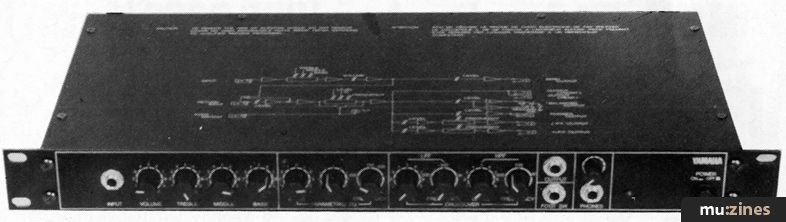
Bass playing readers in search of the ultimate sound may well have already considered a switch over to a bi-amping system of amplification, whereby the output from their guitar is delivered by one power amp to bass speakers, the rest of the output going via another power unit to the top or mid-range units. This, in theory (short of tri-amping; using three power amps!) appears to be very much the way that professional players with sufficient money are going these days, a technique already employed by top professional studio monitor manufacturers, P.A. hire companies and luxury hi-fi buffs. One of the problems facing the bassist who fancies giving this approach a try isn't so much cost (let's face it, this is a luxury approach to bass amplification which most of us can only drool at) as the lack of knowledge about the best way to achieve the correct setup and, peculiarly, a distinct shortage of suitable pre-amps.
Power amps up to the task are pretty common these days. You can pick-up some very capable power units for reasonably low money from a wide, range of makers who have directed their products mainly at the budget P.A. market. In addition, of course, there are the old faithful 'luxury' standbys like Amcrons, BGWs and suchlike.
Makers offering good quality wide-ranging bass pre-amps are, however, a bit like hen's teeth, so all credit to Yamaha, who have their PB-1 unit currently on offer to fulfil just this role.
The PB-1 is a low rack-mounting metal cased unit offering enough facilities to keep even the most hardened knob-twiddler happy for a month of Sundays. The specs look to be very impressive for the price and we borrowed one from Yamaha U.K. for several months during which we did our usual best to strain it to busting point — with a conspicuous lack of success!
To describe the PB-1 as offering a tremendous range of facilities is, frankly, silly — it's capable of satisfying any professional bass player with its abilities, some of which took us quite a while to get round to using.
Starting back to front (as ever!) the rear panel of the Yamaha gives you some clue as to just how capable this unit is. The mains lead is detachable and that's possibly just about the only item which the average bassist will be immediately familiar with on this luxury-class unit. After that you have a twin jack socket send and return facility for outboard effects, each of which carries its own level control, enabling you to govern the amount of signal sent to an outboard effect and received back from it. Next off you find a level control for the three-pin XLR-type output socket which offers a low impedance send of 600 ohms line output, suitable either for a P.A. mixer or a studio desk. Needless to say, this is a balanced output and Yamaha have, thoughtfully, provided a switch to isolate the earth circuit which should, according to the handbook, be left 'on' unless there is an earth-loop hum when you connect this output to other equipment.
Twin jack sockets come next and these send the signals to twin power amps (one for High Pass Filter derived outputs, the other for Low Pass Filtered signals) or the two channels of a stereo amp.
Finally, the back panel features a single jack outlet for connection in parallel with the front panel matching outlet for a power amp. A voltage selector is also provided.
The front end of the Yamaha looks even more sophisticated than the control panel at the back. This features a single input, volume control, treble, middle and bass pots and then a parametric section with a red LED indicator for 'on' plus level, 'Q' and frequency select controls. The operational range quoted by the manufacturers is ±15dB with a 'Q' factor from 0.35 to 3.0 across a frequency sweep from an impressive 50Hz to 2.5 KHz.
"THE FRONT END LOOKS EVEN MORE SOPHISTICATED THAN THE BACK."
Next comes the vital section of the PB-1's controls, a panel which governs the frequencies delivered to each of the twin power amps you can connect for power amplification (or, of course, the individual channels of a single stereo amp). The Low Pass Filter stage enables you to send a variable quantity of power from 100Hz to 5KHz, the High-Pass section, ditto.
Things become more familiar as the panel runs on — you next find an output jack (which can be used in parallel with the output jack on the rear panel), a jack socket for a footswitch (which allows the parametric equaliser to be switched in and out at will — great for bass solos!) a jack socket for headphones plus a level control for send to that output and, glory be, a simple, good old-fashioned power 'on' indicator lamp and an on/off switch.
All joking aside, the Yamaha might seem fairly complex at first sight but, in actual fact, the excellent handbook it comes with and the logical layout of the controls, make it very easy to understand and use.
Bearing in mind how dependent any pre-amp is upon its matching power amp and speakers we tried this fairly recent introduction from Yamaha over several months, using a variety of power amps, ranging from an HH V500 (on long term loan for a test) to Yamaha's own excellent P2200 (which we reviewed in our P.A. test back in Issue 13). Speakers used ranged from 4x12 Fane cabs, to Celestion 2x15 enclosures and others, including R.C.F's. Basses ranged across a tremendously wide selection from the cheapest of Korean copy instruments to the very best custom-made British instruments from manufacturers like WAL. In nearly all cases it was possible to improve upon the natural sound of just about any instruments we tried. In the case of the very best active instruments what the Yamaha did was really enable their class to show, this was especially true with instruments in the WAL league.
The tonal range which the PB-1 will deliver is quite phenomenal. The switchable (in and out) parametric enables the most immense tonal shifts to be set, ranging from a treble response which is, frankly, too high to be practicable to a bass response which threatened the integrity of our speakers' cones!
To a certain extent, the knack in using a pre-amp like this lies in knowing the capabilities of the speakers you are using with it. When you've worked out what your bass units can handle and likewise your treble drivers, then you're in a position to set the crossover points accordingly. Unless you're conversant with the technical specs of your gear then this may be, to some extent, a work undertaken by ear, setting the controls to a suitable distortion-free point. This, in practice, presents no significant problems and allows you to set the Yamaha according to the best sound you can get.
In use the Yamaha is very impressive indeed; the inherent noise levels are low and the ability to accurately govern your effects send and return levels really does enable you to optimise your levels to achieve the best signal to noise ratio, guaranteeing a truly effective use of any decent quality effect you may care to link to this pre-amp.
Given the tremendous ability of the Yamaha PB-1 to deliver just about any sound that you could ask for, plus allow you to cope with any nasties on gigs (bass frequency traps on stages, etc.) this pre-amp would really be the ideal starting-point for any player determined to advance his sound beyond that of the traditional bass guitar.
(RRP £269 inc.VAT)
Publisher: Music UK - Folly Publications
The current copyright owner/s of this content may differ from the originally published copyright notice.
More details on copyright ownership...

Music UK - Apr 1983
Gear in this article:
Review
Help Support The Things You Love
mu:zines is the result of thousands of hours of effort, and will require many thousands more going forward to reach our goals of getting all this content online.
If you value this resource, you can support this project - it really helps!
Donations for April 2026
Issues donated this month: 0
New issues that have been donated or scanned for us this month.
Funds donated this month: £0.00
All donations and support are gratefully appreciated - thank you.
Magazines Needed - Can You Help?
Do you have any of these magazine issues?
If so, and you can donate, lend or scan them to help complete our archive, please get in touch via the Contribute page - thanks!
Please Contribute to mu:zines by supplying magazines, scanning or donating funds. Thanks!
Monetary donations go towards site running costs, and the occasional coffee for me if there's anything left over!

 @mu_zines
 RSS Feed
 Blog
Blog