



Magazine Archive
Home -> Magazines -> Issues -> Articles in this issue -> View
Article Group: | |
Zoom 9001 | |
advanced multi-effects processorArticle from Music Technology, October 1993 | |
Programmable audio effects for the studio or the stage
High quality effects, easy programming and a budget price - Ian Waugh asks who's Zoomin' who?
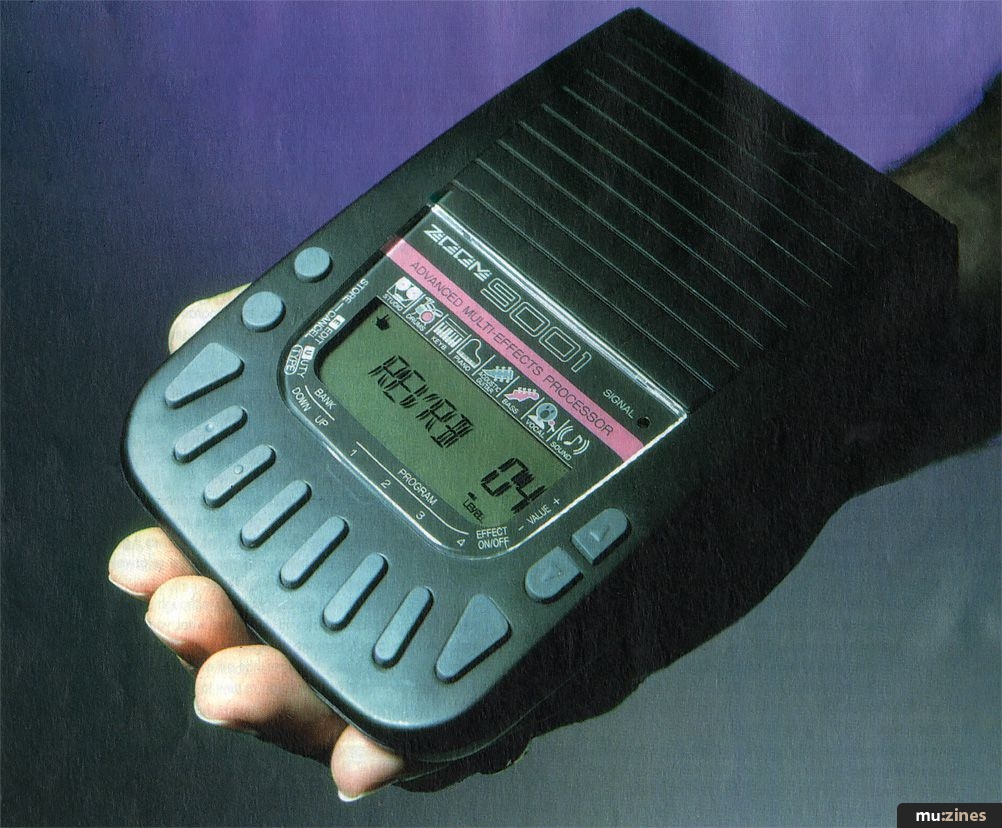
The more sophisticated hi-tech gear becomes, the steeper the learning curve which must be assailed by those trying to get the best out of it. A simple fact of life, this is particularly true of equipment such as FX units which may sport dozens of seemingly inscrutable parameters such as spectrum shift, diffusion and high frequency decay.
It makes a refreshing change, then, to find a multi-FX unit you can use while supping your scrumpy and without getting lost in a hornet's nest of recursive menus looking for the post-FX early reflection pre-delay parameter.
The Zoom 9001 gives you none of this. In fact, it looks more like a foot pedal than a studio FX unit. It doesn't have MIDI (be honest - do you really use MIDI to program your FX unit on the fly, or even use program changes to select new patches?) and it's mercifully short on psychoacoustic parameters, yet still retains a high level of programmability.
For such a small unit, it's surprising to find jack sockets instead of phonos - 10 out of 10, Zoom. There are stereo Ins and Outs on the back - although the Left In can be used as a Mono input - and there's a mini-jack headphone socket on the side. The On/Off button is also on the back along with a socket for a mains adaptor. The unit runs quite happily off batteries, but with a life of only three to six hours you really need to budget for an adaptor too.
Underneath the unit you'll find a Remote socket to which you can connect an optional FC01 foot controller. This has Bank and Patch switches for selecting patches, and it can activate the Bypass function.
The effects are arranged into eight banks and named to give you an indication of the area in which they would be most useful - although, as the manual points out, these are suggestions only. You are encouraged to experiment. In spite of the limited number of effects (compared to the 100-plus typically found on most current FX units), there is a surprisingly broad range. Zoom have obviously tried to cater for all potential users. We're not just talking keyboards here, but drums, guitars and vocals too.
Perhaps because of the limited memory, the effects tend to be quite different from each other - no room for subtle variations here. Of course, the mainstay of any FX unit is its reverb programs, and the 9001 is no exception. While these are generally good for a processor at this price, one has to conclude there aren't enough of them.
The Leslie speaker simulation in the Organ effects is also impressive, and can be switched to slow or fast rotor speeds. Some of the Piano effects add a nice cutting edge to the sound, while the chorus and reverb of the Strings program could sweeten any pad.
I particularly liked the way all of the effects and their parameters were listed in the manual, and the way it showed the signal path through the various effects with the aid of schematic diagrams. This enables the user to see quite clearly how their signals are being effected.
There are also diagrams to illustrate the principles associated with each of the parameters - including those found in reverb programs (level, direct, predelay, early reflection and reverb time), chorus, echo, gate reverb and comb filters - and additional listings of parameters for the 40 additional effects which you can program yourself.
What the manual doesn't give you are any detailed specs on the unit itself, so I can't quote a signal-to-noise ratio or a dynamic range at you. Subjectively, the unit is a touch noisy. Some effects (such as chorus) are worse than others, and even the Effect Off button doesn't mask the noise completely.
This shouldn't prevent you from using the unit in a recording, but you'll need to keep a check on the noise and familiarise yourself with the Direct Mix limitation (if you want to use it with a mixer).
Although a more up-market FX unit would almost certainly be more versatile, it will obviously cost more. But not necessarily that much more, so you need to work out what you want and how much you can bear to part with. The 9001 is certainly easier to program than any rackmounted FX unit, but it's not capable of the subtleties of many such units.
I suspect it will find a home with musos who play live, especially those who only need a handful of different effects throughout a set.
THE LAST WORD
| Ease of use | Easy-peasy |
| Originality | Not much you haven't heard before |
| Value for money | Not bad |
| Star Quality | Meretricious but not unloveable |
| Price | £249.95 inc VAT |
| More from | MCMXCIX, (Contact Details) |
Effective programming
The 9001 has several effect types (reverb, chorus, limiter, EQ and so on) and when these appear in a particular configuration they are in a fixed order. For example, in the Slap Bass effect the signal runs through the Limiter, Enhancer, Mid Booster and Reverb in that order. You cannot create your own configurations - that would detract from the unit's ease of use and go against its basic design philosophy.
Although not much can go wrong, if it does you can recall the presets.
Hard fax
Studio: Reverb, Echo, Chorus
Drums: Gate, Ambience
Keyboard: Strings, Organ, Solo
Piano: Acoustic Piano, Electric Piano
Acoustic Guitar: Steel Guitar, Gut Guitar
Bass: Bass, Slap Bass
Vocal: Vocal 1, Vocal 2, Harmony, Robot
Sound: Wave, Test Tone Oscillator
The 9001 can store 40 presets which are selected using two Bank and four Program buttons.
Only the Studio and Drum FX have a Direct Mix parameter, which allows you to turn off the direct or original sound which appears in the mix. All the other configurations will feed some of the direct signal back to the output. When using an FX unit in the send and return loop of a mixer, you will usually want to turn off the direct signal.
Also featuring gear in this article


Publisher: Music Technology - Music Maker Publications (UK), Future Publishing.
The current copyright owner/s of this content may differ from the originally published copyright notice.
More details on copyright ownership...
Music Technology - Oct 1993
Donated by: Ian Sanderson
Quality Control
Review by Ian Waugh
Ads for Gear in this article:

Help Support The Things You Love
mu:zines is the result of thousands of hours of effort, and will require many thousands more going forward to reach our goals of getting all this content online.
If you value this resource, you can support this project - it really helps!
Donations for June 2026
Issues donated this month: 0
New issues that have been donated or scanned for us this month.
Funds donated this month: £0.00
All donations and support are gratefully appreciated - thank you.
Magazines Needed - Can You Help?
Do you have any of these magazine issues?
If so, and you can donate, lend or scan them to help complete our archive, please get in touch via the Contribute page - thanks!
Please Contribute to mu:zines by supplying magazines, scanning or donating funds. Thanks!
Monetary donations go towards site running costs, and the occasional coffee for me if there's anything left over!

 @mu_zines
 RSS Feed
 Blog
Blog