Akai MIDI Effects
(SOS Feb 86)


Magazine Archive
Home -> Magazines -> Issues -> Articles in this issue -> View
Akai MIDI FX | |
Article from One Two Testing, December 1985 | |
arpeggiator, delay, mixer
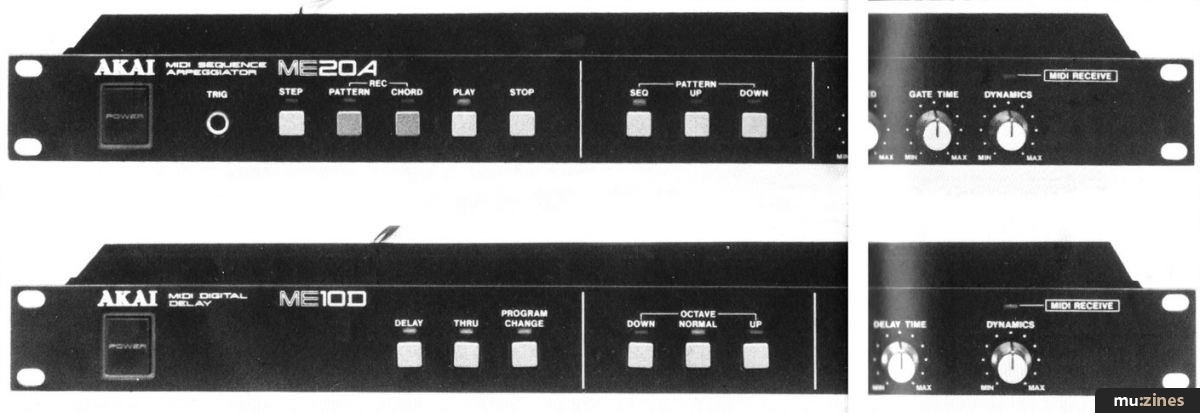
OTHELLO HAD ONE. Hamlet had one. The Akai ME20A MIDI Sequence Arpeggiator has one. We're talking fatal flaws, brothers and sisters.
Now as we all know, Othello's fatal flaw was jealousy, which is why the play ends up with blood all over the stage. Hamlet's was indecisiveness, which he thought he'd got under control but wasn't sure. Like both of the immortal bard's eponymous heroes, the ME20A and the other Akai MIDI Effects have lots of good points, but also like them, the good points tend to be overshadowed by the odd flaw.
First of all, let's look at what MIDI effects in general have to offer. Dave Smith of Sequential and the designers of the MIDI standard tried to cram as much information as they could into its universal format, but even they couldn't have guessed what uses independent designers would find for the system. Computer music transcription, on-screen sound editing and voice library creation are just three of the less obvious applications which are already well established, but Akai, who have only recently entered the MIDI field at all, have come up with three more MIDI applications which either fill existing needs or seek to create new ones.
The effects we're looking at here are the ME20A Sequence Arpeggiator, the ME10D Digital Delay, and the ME15F Dynamics Controller. The applications of the first of these units are fairly obvious — it allows you to add auto-arpeggios and chord sequences to synthesisers which lack that facility. The Digital Delay does just what it says, too, delaying notes by a variable amount, but it works in the MIDI domain rather than as a conventional echo unit and so cannot create any distortion or loss of frequency response.
The Dynamics Controller acts as a sort of mixing desk, with the emphasis on control of keyboard velocity information, but also has a couple of MIDI channel switching effects which I'll describe later.
On to the most interesting of the three units, the ME20A Sequence Arpeggiator. Since the unit's debut at Frankfurt 1985 it's been re-styled into a 19in rack-mounting format, which is much more attractive for studio applications. There are just eight buttons and three knobs on the front panel together with a footswitch socket, and the usual three MIDI sockets (In/Out/Thru) on the rear panel.
At least two of the MIDI sockets, In and Out, need to be connected up to your synth to make the system work, and in this case we tested the unit with a Yamaha DX7 through a Quark 999 MIDI Link which allowed us to tie in the other Akai units simultaneously. The DX7's the ideal test instrument, since (a) it lacks auto-arpeggio or sequence facilities and (b) it responds to velocity information (which the Akai units deal with quite imaginatively).
You can input either single notes (Pattern Record) or groups of notes (Chord Record) to the Akai, and add spaces or ties with the Step button. Capacity is 957 single notes or 128 chords; once you've entered your notes from the synth keyboard, simply press Stop, then select Sequence, or Pattern Up, or Pattern Down, then Play. It's more like pre programming a sequencer than simply holding down a chord for arpeggiation on, say, a Juno 60's keyboard. Speed is controlled from the knob imaginatively marked Speed, which has a handy flashing LED associated with it.
So what comes out? Well, when you've learned your way about the ME20A, you can record a bass line, or a bass line with chords over it, or a pattern of chords with different lengths, spacings and ties. You can get a pattern of notes or a pattern of chords to play up or down repeatedly, you can mix the two and get a pattern of chords to arpeggiate in individual notes, and so on. Some of the most exciting patterns are those you come up with accidentally, when your chords come out as arpeggios or vice versa.
But the really exciting parts of the ME20A are the Gate and Dynamics controls on the right-hand side. The gate adjusts the On time of each note played, and whacking it up and down a little while a pattern plays can be very expressive (pity there isn't a Voltage Control input for modular synth users). The same goes for the Dynamics control, which at maximum transmits velocity signals much higher than the DX7 is used to, giving tremendously twangy effects to whichever notes you apply it on.
The ME20A doesn't allow you to re-edit patterns if you make a mistake while entering them, but it does store the latest pattern entered while the power is off. It doesn't have an Up-and-Down arpeggio option, it doesn't have a random option, and for those who swapped their Juno 60s for Juno 106s and are missing the arpeggiator, you'll be sad to hear that it doesn't have the 1/2/3 octave repeat option either.
But these niggles pale into insignificance compared to the ME20A's Fatal Flaw. What is it? Can you guess? Its all explained in one line on Page 14 of the manual: "The ME20A is not equipped for synchronised playback with other sequencers or rhythm machines."
And they really mean it. No clock in or out of the MIDI port, no SYNC 24, no clicks in or out, not even a tempo display. Nothing. I couldn't work out how to synchronise the bloody thing, and how often do you want an arpeggio or sequence that doesn't run in sync with any other part of your music? The ME20A may be value for money but this omission is inexplicable.
Bad news on the ME10D Digital Delay as well. This one has just two important controls, Delay Time (up to about one second) and Dynamics (up to, or less than, the volume of the original notes). What's missing? Feedback. You can only have one repeat of the notes played into the unit however hard you strain, and there's no way you can fix up your own feedback loop to the input since the keyboard itself occupies that socket. It's impossible at the moment to combine MIDI signals, so there's no way round this little problem at present.
The one "echo" you do get is useful enough, though, and can be set at an octave above or below the original if desired. Connecting a second synth to the MIDI Out allows you to have echoes in a different voice from the original (for instance, strings echoed by brass) and you can select whether or not patch changes are transmitted — but that's about it.
The ME15F MIDI Dynamics Controller comes off relatively well since it has a couple of unexpected features which make it good value for money. Basically, the unit takes a single MIDI input from a master keyboard and controls the level at which this input is responded to by up to eight slave units.
Four units are addressed at a time, but rather awkwardly the Mode switch to select which four is hidden inaccessibly on the rear panel. You can either address units on MIDI channels 1, 2, 3 and 4, or on channels 5, 6, 7 and 8, and information on all the remaining channels comes out of a socket marked "Ext". A front panel LED lights up whenever information comes in on these extra channels.
Each of the four channels in use at any one time has a control knob for dynamic level, from +126 to -126 in MIDI terminology, and you can decide whether dynamics information is transmitted with a left-hand switch. The final control is Channel Separate, which can make all channels exactly retransmit the input, or allow them to operate on their own MIDI channel. The advantage here is that you can allow synths which are only capable of responding to MIDI channel 1 to respond to other MIDI channels. You can even pass information from a sequencer such as Roland's MSQ700 through the Akai to another sequencer, re-editing the velocity information as you go.
No fatal flaws here, then, but if you just wanted to mix keyboard volumes you could do that very easily with a cheap mike mixer. However, the channel select facilities on the Akai are worth looking into.
On the whole, the three Akai MIDI effects are fine examples of Japanese inscrutability. The basic ideas are good, the execution is good, the construction is good. The omission of External Sync from the Arpeggiator, of Feedback from the Delay, and of a bit more sense of purpose from the Dynamics Controller is inexplicable, and if the units weren't so inexpensive they'd have a hard time competing. As it is they'll probably appeal to existing MIDI nuts, but won't make many new conversions.
AKAI MIDI FX: £99
CONTACT: Akai UK, (Contact Details).
Also featuring gear in this article


Akai Midi Effects Units - Effectscheck
(IM Dec 85)

Black Box Secrets - Akai MIDI Effects
(EMM Nov 85)
Browse category: MIDI FX > Akai
Publisher: One Two Testing - IPC Magazines Ltd, Northern & Shell Ltd.
The current copyright owner/s of this content may differ from the originally published copyright notice.
More details on copyright ownership...

One Two Testing - Dec 1985
Donated by: Neil Scrivin
Review by Mark Jenkins
Help Support The Things You Love
mu:zines is the result of thousands of hours of effort, and will require many thousands more going forward to reach our goals of getting all this content online.
If you value this resource, you can support this project - it really helps!
Donations for September 2026
Issues donated this month: 0
New issues that have been donated or scanned for us this month.
Funds donated this month: £0.00
All donations and support are gratefully appreciated - thank you.
Magazines Needed - Can You Help?
Do you have any of these magazine issues?
If so, and you can donate, lend or scan them to help complete our archive, please get in touch via the Contribute page - thanks!
Please Contribute to mu:zines by supplying magazines, scanning or donating funds. Thanks!
Monetary donations go towards site running costs, and the occasional coffee for me if there's anything left over!

 @mu_zines
 RSS Feed
 Blog
Blog