
Bokse SM-9 - SMPTE Events Controller
(HSR May 87)


Magazine Archive
Home -> Magazines -> Issues -> Articles in this issue -> View
Bokse SM-9 | |
Article from Sound Engineer and Producer, November 1986 | |
A versatile time events controller, with a wide variety of recording applications
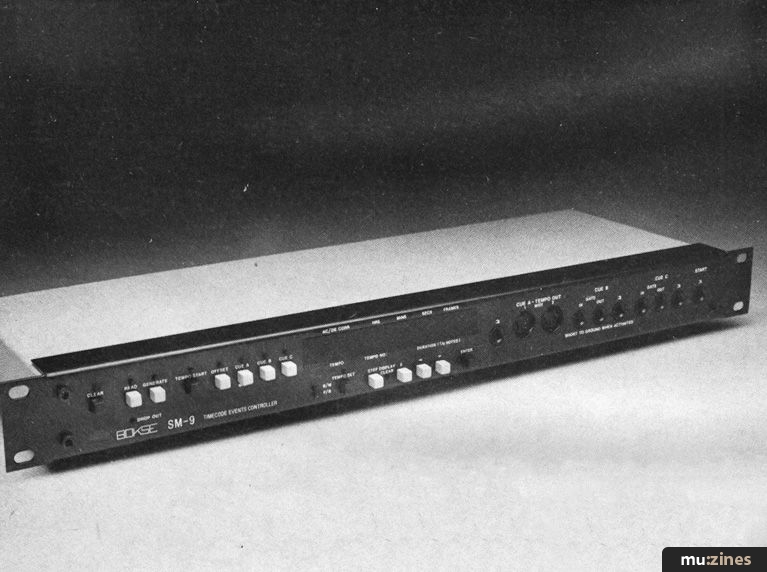
The SM-9 is the flagship of Bokse's range of rackmounting equipment being an SMPTE/EBU time code reader/generator which synchronises MIDI song-pointer and tempo data to tape. It also offers a wide variety of programmable event controllers in the form of contact closure outputs and positive 5V outputs which can be used to fire samplers, remote cartridge or tape machines, or even master controllers for channel mute lines.
The unit reads and generates the four time code standards: 24, 25 (EBU), 30 (SMPTE) and 30 drop frames per second. Selecting different frame rates is easily achieved via its front panel controls, which are then displayed in one of the numeric display's pages. All the data such as cue points, time code read out and tempo information are also visibly shown in the green 10 digit display.
To the left of the display are mainly mode and function selector push buttons and those beneath the display are primarily for altering the parameters. To the right of the display are the cue and MIDI Out sockets which, unfortunately, are not duplicated on the SM-9's rear panel which houses MIDI In and Thru sockets, four 5V Cue outputs and SMPTE In, Out and Thru connections.
The SMPTE Thru connection outputs a clean, sharp-edged SMPTE code which, in the few weeks I spent with the unit, proved to be invaluable in cleaning up codes which have deteriorated through generations of various copying types; from multi track to two track to low-band to VHS, etc.
Being a particularly fast reader of time code it almost instantly displays the current time as soon as it receives a code, and then immediately generates MIDI song pointer, tempo and continue commands. I found that the total time elapsed between starting the tape machine and start-up of MIDI sequencers to rarely be more than one second; more than twice as fast as Roland's SBX-80.
To realise the full potential of the SM-9 synchroniser system, and to achieve similar results to the SBX-80 or SRC synchronisers, the SM-9 is designed to be used in conjunction with other Bokse equipment such as its HM-2 Humaniser and/or US-8 Universal Synchroniser — both cost less than half the price of the SM-9.
Its Humaniser is essentially designed to enable tapping-in of tempo data, while the Universal Synchroniser can offer 30 conversions from 10 different types of sync inputs, either on its own or interfaced with the SM-9.
In isolation the SM-9 is still a very versatile unit. If you are using it to run powerful sequencers such as the Steinberg Pro-24, by merging the MIDI In data through to its MIDI Out socket (which also generates the MIDI sync codes), the SM-9 enables you to record into your sequencers or drum machines in real time along to the multi track. This is a very useful feature in its own right that would usually require a separate MIDI merge box.
MIDI start and stop codes can be programmed into the first bank of cue points. Up to 32 stop and start codes can be programmed into Cue A. These can be programmed either by typing in the data via the selector and increment/decrement keys, or simply stored by hitting the Cue A button at the point at which you want it to start, whilst it is reading time code. This point can then automatically be autocorrected to occur on the quarter note, eighth note or sixteenth note in order to start in time with the track.
The three other sets of Cues operate in much the same way, except that they don't act on the MIDI On/Off codes. Cues B and C have identical sets of connections and features — 32 Activate and 32 Deactivate points to control a contact closure output and a positive 5V output that provides +5 volts for Activate and zero volts for Deactivate.
The Cue D programs are similar except that they are without programmable Deactivate points (Deactivate is fixed at 40 mS after the Activate code) yet the 32 cues can also store MIDI program change information. This makes it possible to use the SM-9 either in studio or live situations for remote patch changing of samplers, synths or drum machines.
The other exciting use for the four sets of contact closure switches would be to control channel mute lines. As it stands, the SM-9's stereo jack sockets are wired to connect a stereo jack's tip and ring connectors together when an Activate cue is generated. This could be easily patched into a channel's send and return jacks on a patch bay for programmable muting of that channel. However, it would not be particularly difficult to have a set of relays controlled from this master contact closure. Then whichever channels are switched to the relays could be programmably muted from the one contact closure. This could prove to be a very inexpensive means of automated channel muting for consoles without automation.
All tempo changes, cue points, program changes, etc. on the SM-9 can be saved to tape. This is essential for a system as complex as this, where you may have programmed dozens of trigger points for samplers, delay lines and sequencers along with SMPTE offsets and tempo data.
CONCLUSION
The BOKSE SM-9 is a well designed and very powerful product. In addition to providing fast and accurate time code reading/generating, it is also packed with features to cater for some very complex set-ups. What is also good about the unit is that if you simply want to synchronise MIDI song pointer/tempo data to time code, then this is very quick to set up, requiring only that you set offset and tempo data.
Being able to offer MIDI merging, programmable program change, tempo change and of course MIDI song pointer data make the SM-9 a viable proposition for the growing number of MIDI studios. The potential for programmable channel muting, remote tape machine triggering and DDL triggering makes the Bokse SM-9 Timecode Events Controller a very powerful and versatile backbone for a very wide number of recording applications.
DATA
| Price | £829 | |
| SMPTE frame rate | 25/30/30drop frames/sec | |
| Tempo range | 30-254 beats/min | |
| Cues: | Cue A | 32 sets MIDI tempo change/contact closures |
| Cues B & C | 32 sets contact closures/5V pulse | |
| Cue D | 32 sets contact closures/5V pulse & MIDI program changes | |
Also featuring gear in this article

Publisher: Sound Engineer and Producer - Media Week Ltd.
The current copyright owner/s of this content may differ from the originally published copyright notice.
More details on copyright ownership...

Sound Engineer and Producer - Nov 1986
Donated by: James Perrett
Gear in this article:
Synchroniser > Bokse > SM-9
Review by Curtis Schwartz
Ads for Gear in this article:

Help Support The Things You Love
mu:zines is the result of thousands of hours of effort, and will require many thousands more going forward to reach our goals of getting all this content online.
If you value this resource, you can support this project - it really helps!
Donations for August 2026
Issues donated this month: 0
New issues that have been donated or scanned for us this month.
Funds donated this month: £0.00
All donations and support are gratefully appreciated - thank you.
Magazines Needed - Can You Help?
Do you have any of these magazine issues?
If so, and you can donate, lend or scan them to help complete our archive, please get in touch via the Contribute page - thanks!
If you're enjoying the site, please consider supporting me to help build this archive...
...with a one time Donation, or a recurring Donation of just £2 a month. It really helps - thank you!

 @mu_zines
 RSS Feed
 Blog
Blog