


Magazine Archive
Home -> Magazines -> Issues -> Articles in this issue -> View
Encore Coaster And Blue Sage | |
GuitarcheckArticle from International Musician & Recording World, March 1985 | |
An electro-acoustic and the cheapest Strat copy this side of War On Want. Review by Dave Burrluck
%image1% A STRAT COPY FOR £89? No I'm not joking, family favourites JHS have delivered another little beauty into the already overpopulated world of the copy guitar. But at £89.00 though it's no real competition for the more expensive Tokais and Squiers, this Encore will appeal to the beginner: it's great value for money.
The Coaster has been manufactured in South Korea and appears to have all the bits in the right places. The body on the guitar is a fair approximation of a Strat shape and is made from 1½" plywood. The neck is surprisingly good, made from Maple and nicely shaped with a flat profile, although there's too much wood around the nut end. A cheaper Rosewood is used for the fingerboard which has a flat camber and is quite rough on the face. As one might expect the fretting is a mite dodgy, though there is a remarkable absence of fret buzz. There is also a truss rod fitted which is adjustable at the nut end via an allen keyed bolt. The peg-head on the Coaster doesn't really bother to follow the Fender-type exactly, but it's close enough I suppose.
One really good point about this guitar is its excellent finish: both the black lacquer on the body and the clear lacquer on the neck, although a little thin are finished to quite a high standard. Definitely better than the price tag would indicate.
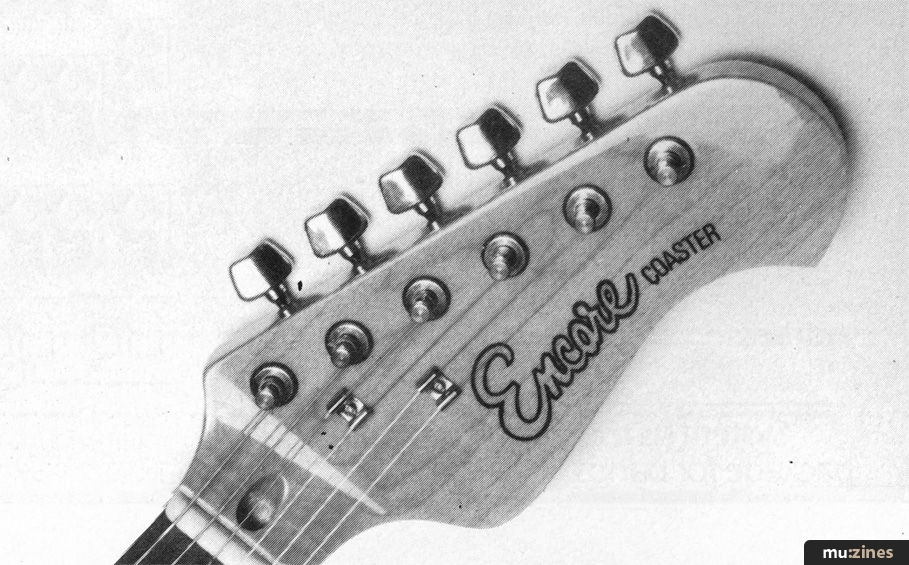
Well, so far so good, but while the woodworking on the guitar is reasonably adequate the hardware dept is a bit lacking. The machine heads are dreadful; obviously very cheap they're all mounted on one bracket and trying to keep this guitar in tune is rather difficult — I doubt a beginner would have much luck at all! One problem contributing to this seems to be the string retainers which are a little on the large side and certainly impede the travel of the strings. A white plastic nut is fitted in a Gibson as opposed to Fender style, which is nicely cut.
The bridge and tremolo assembly fitted here features what appears to be brass saddles adjustable in the usual manner. The bridge base is very thin although it does have a decent chrome plating, and surprisingly enough the guitar is supplied with a chrome cover for the bridge — something Fender have long since stopped bothering about. The biggest disadvantage about the tremolo assembly is that it doesn't work; quite important I would say. I took off the back plate and removed two of the five springs which gave a reasonable amount of downward bend. The next adjustment to be made was to unscrew the spring anchor plate a little which eventually gave me a touch of upward movement to the trem system. However, having set this piece of hardware into motion I was a bit concerned about the screws that actually hold the bridge to the body.
Basically they're too small and I wouldn't be at all surprised if the heads were to shear off after a while! Clearly the trem had received no setting up and I have my doubts about its effectiveness anyway. I think a standard Strat bridge would be a far safer bet all round.

Well the electrics look the part at least. Three single coil pickups are mounted on a three-ply scratch plate with the typical control arrangement of volume and two tone controls plus a three position selector switch.
I didn't really expect much from the guitar before I plugged in, I actually wondered it it would all work to be honest, but I was more than a bit surprised. The Coaster is a very nice sounding guitar, typically Fenderish and with a very wide tonal range. It's very possible to jam the pickup selector to obtain five instead of three sounds and the overall quality of the sound was good. The volume control has a very sharp taper but all the controls work as they should, the only crackles and buzzes coming from the unsoldered earth connection. The neck pickup sounded a bit weak and trebly but not overly so, while the neck and middle pickups were actually very good. The guitar sustains well, all things considered, although I did eventually find a few string rattles, especially at the top of the board. Intonation too, was quite acceptable for such a cheap guitar, although the tuning stability or rather lack of it was a real drag. Needless to say, when I eventually got some downward movement out of the trem the tuning got totally out of hand.
Clearly this Coaster has some good points but suffers, as most very cheap copies do, from trying to put too much on the guitar for the sake of commercial appeal. Certainly the tuners are no good, ditto the trem assembly, but everything else just about cuts it. I wouldn't advise a beginner to buy this guitar — it has too many problems that a beginner doesn't need, but if Encore were to put on some decent machine heads and go for a standard bridge assembly things could be a lot different. Also JHS should really ensure that these guitars leave their warehouse in the best possible condition and check that all wires are soldered and that the action and intonation is of the highest possible standard.
'BLUE SAGE' ELECTRO ACOUSTIC

Encore go classical
This instrument is worlds apart from the Coaster guitar in terms of quality and obviously in price too. Interestingly enough it's made in Italy and goes a long way to prove that the Italians are good at more than making pasta and playing football. The 'Blue Sage' range offers two guitars — a Folk and a Classical — modelled on the popular but very expensive electro-acoustic Gibson Chet Atkins and cheaper Washburn Mirage and Spirit models.
The review concerns the nylon strung classical model which is indeed very attractive, especially with a price tag of £229.
The body on this sample is solid with an undisclosed timber core (probably Ash or similar) with Rosewood back and sides and a Spruce top. The quality of the timber is important in looks only on a guitar of this type, consequently the Rosewood looks very nice while the Spruce front would only find its way onto the cheapest of acoustic classical guitars. The front and back have a plain black binding while the top has a nice black-white-black purfling as well. These guitars have a 'soundhole' — simply a circular recess serving no acoustic purpose, and the rosette around it is a transfer as opposed to an inlay.
Mahogany of good quality is used for the neck which follows a classical shaping very closely. The width of the neck at the nut is 52mm and very wide for anyone not used to playing a classical acoustic guitar. The fingerboard is Rosewood and is perfectly flat with a typical absence of face position markings. The fretting is very good on this sample although the slots cut for the frets are too deep and have not been filled at the ends as is the usual practice. The headstock follows a classical design with a Rosewood facing and simple Encore logo screened as opposed to inlaid.

Overall the carpentry on this guitar is very good, the heel of the neck is unnecessarily bulky, but the general neck shaping is good and the standard of finishing is high both in the timber preparation and lacquer.
The machine heads fitted to this guitar are conventional classical types with pearloid buttons and white plastic rollers fixed to a gold coloured metal base assembly. They work well and seem to keep the guitar in tune.
On the pickup side we have a Shadow transducer pickup fitted into the classical styled Rosewood bridge. In fact the pickup consists of six transducers fed to a pre-amp housed in the top bout of the guitar and powered by a 9 volt PP3 battery. Access to the preamp and battery is gained via a small cover plate on the side of the guitar by the neck heel which has the volume and tone dual pot mounted to it. Unscrewing this reveals the PCB and electronic components, but unfortunately you have to tug the battery wires to actually get the battery itself out. A better arrangement would be to have the PCB and battery mounted on the same plate thus reducing the chance of crucial wires being pulled off.
Acoustically the guitar is surprisingly loud, plenty enough volume to have a quiet strum with, but the neck and high action do take some getting used to. When amplified, the sound, typical with this type of arrangement, is reasonably accurate and certainly sounds 'acoustic'. The overall response is even and sustain and intonation are good.

Quality of timber is important on a guitar of this type
The combined volume and tone arrangement gives more than enough control so in performance any minor adjustments can be taken care of without touching an amp. The tone especially offers a wide range of adjustment.
I finally felt that I'd struggled enough with the action and sought some change. However, there seems to be no way that you can change the action on this guitar at all. Certainly the handy page of notes about setting up the pickup make no mention of action adjustment. Even if the saddle could be lowered the actual height of the bridge would restrict the action to somewhere in the region of 3mm minimum.
Admittedly action is not as critical on a classical guitar as it is on an electric, for example, but that doesn't mean that some adjustment facility should not be included in the bridge design.
A similar disadvantage about this guitar is the width of the neck. Certainly not untypical of a true classical guitar, but the possible applications of this design are surely not meant to be purely for the all-classical guitarist who wants to go electric! The whole guitar design is a cross-over; classical guitars don't usually have cutaways do they? So why not thin the neck down a bit and attract some Rock-orientated players too?
As it stands this Encore acoustic-electric is a generally well made and good sounding instrument hampered by a rather uninspired design.
JHS ENCORE COASTER AND BLUE SAGE — RRP: £89 and £229 respectively
Publisher: International Musician & Recording World - Cover Publications Ltd, Northern & Shell Ltd.
The current copyright owner/s of this content may differ from the originally published copyright notice.
More details on copyright ownership...

International Musician - Mar 1985
Donated & scanned by: Mike Gorman
Gear in this article:
Gear Tags:
Review by Dave Burrluck
Help Support The Things You Love
mu:zines is the result of thousands of hours of effort, and will require many thousands more going forward to reach our goals of getting all this content online.
If you value this resource, you can support this project - it really helps!
Donations for May 2026
Issues donated this month: 0
New issues that have been donated or scanned for us this month.
Funds donated this month: £0.00
All donations and support are gratefully appreciated - thank you.
Magazines Needed - Can You Help?
Do you have any of these magazine issues?
If so, and you can donate, lend or scan them to help complete our archive, please get in touch via the Contribute page - thanks!
If you're enjoying the site, please consider supporting me to help build this archive...
...with a one time Donation, or a recurring Donation of just £2 a month. It really helps - thank you!

 @mu_zines
 RSS Feed
 Blog
Blog