


Magazine Archive
Home -> Magazines -> Issues -> Articles in this issue -> View
Fast Forward | |
All the Fun of the FairArticle from Home & Studio Recording, April 1986 | |
What's new in the way of equipment including the latest from the Frankfurt show.
One increasing tendency in the world of recording much in evidence in Frankfurt was the growth in MIDI-equipped gear. AHB, for instance were showing off their new MIDI-equipped mixer, the Keymix. This is modular, containing three separate modules. The KM1 is an aux send and level module (£785), the KM2 is a power supply and slave unit (£725) and the KM3 is a sweep EQ module (£410). The MIDI information from this mixer can drive a sequencer, with changes in the mixer settings automatically coinciding with the sequencer's patch changes. Details: AHB Ltd, (Contact Details).
RSD Studiomaster were also in on the act, with their new model, which seemed to be the most comprehensive MIDI mixer on show in terms of facilities. Details: RSD Studiomaster Ltd, (Contact Details).
Akai were throwing their weight behind the MPX820 MIDI mixer. This features eight input channels, 3-band EQ and 99 memory locations for storing settings and patch information relating to the mix. Retail price will be £1299. Also displayed at the Akai stand was their new sampler: the S900. This is a 3U rack mounting 8-voice MIDI sampler with a built in disk drive. It can also be used as a harmonic synth. Maximum sample time is 48 seconds (!) at the 20Hz-4kHz bandwidth and up to 32 samples can be stored in memory at once. Retail price is expected to be £1599 mark. Details: Akai (UK) Ltd, (Contact Details).

The Bokse products shown at Frankfurt
Bokse products were in force at Frankfurt. In addition to the US-8 synchroniser, they were showing a new SMPTE events controller, called the SM-9 designed to sync audio and video 'events'. MIDI drum machines and sequencers may be linked to the unit, and auto location, tempo changes, drop-ins and patch changes can be timed to coincide with the control of video information.
Also featured was the MH-2 MIDI Humaniser, a device that converts pulse audio information given manually (for example, from an existing drum track) into a real time clock pulse to drive drum machines and sequencers.
The TS-4 Active Timebase Splitter converts a timebase clock input into several outputs, thus enabling the user to drive several pieces of equipment from one master pulse. MIDI, DIN Sync and square wave clock pulses are all catered for.
Finally, Bokse were displaying the MP-6 MIDI patch which can be used for interfacing different MIDI driven devices. It has six inputs and eight outputs. Details: Sound Technology Ltd, (Contact Details).
Bel also had new products on display. Two new MIDI sampling delays, the BDE2400 and the BDE3200. The BDE2400 has 24 seconds of delay available at a bandwidth of 18kHz and the BDE3200 has 32 seconds at 15kHz. Memory is expandable, however, and there are loop editing, pitch shifting, reversing and sequencing facilities available. Samples can also be stored to disk via an optional computer interface. The units may also be used as flangers. Details: SED, (Contact Details).
MTR are breaking into the signal processing world as manufacturers with the new MTR DNG1 noise gate. It is a dual channel device with variable low and high filters a gate/key listen switch and a hold control. Details: MTR, (Contact Details).
Also from the MTR stable come new products from Vesta. The Vesta Kozo MD-1 is a MIDI/CV gate interface. It's designed for use with CV devices such as the DIG-420 sampler and enables the user to control the DIG-420 from a MIDI keyboard. The Vesta Kozo DG-3 is another dual noise gate, but can give a threshold range from silence up to the +4dB limit, can be controlled internally and externally and has a gate out jack that can send a +5v pulse signal out when the gate is open. When two models are linked via this connection, they can be used as a quad sync gate. A third new model, the SF-100 is a spatial expander combined with a chorus/flanger (like the TC1210 reviewed in this issue). It has five modes, corresponding to five different delay times, and also features phase inversion. Details: MTR, (Contact Details).
New additions to the RAM range were in evidence. The RAM Pico is available in 12:2 or 16:2 formats. It features balanced XLR inputs, 48v phantom powering, 3-band sweep EQ, full PFL monitoring and headphone amplification. The RAM Mega is a modular 24:8:2 affair, with 16-track monitoring. The 24 input modules have separate mic and line inputs and there is a 2-band sweep EQ and variable HP and LP filters. Six aux mixes are also provided, along with PFL monitoring and mute buttons for each input channel. Details: Audio Music Marketing Ltd, (Contact Details).
On the same stand, Dynamix products were also in evidence. The Series 4000 PMR is expandable from 16:4:2 up to 32:16:2 in 4-channel sections. Features include individually switched phantom powering, phase reverse and muting. PFL, Peak LEDs and bargraph metering is provided for monitoring. Details: Audio Music Marketing Ltd, (Contact Details).
Toa 380-SE
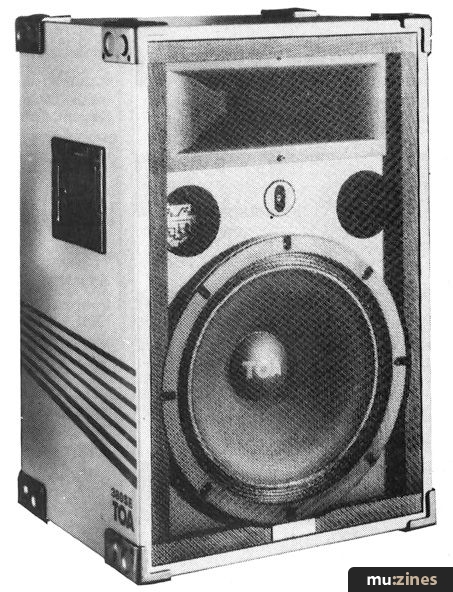
Several new products from Toa were launched at Frankfurt. Three subwoofer systems, the SEB, the SDB and SLB were on display and are all designed to incorporate a clear bass response in to their sound. The SEBs and SDBs are rated at 360W and the SLBs at 240W. Also shown were 480-SE and 380-SE 3-way speaker systems. They're rated at 360W each. Another new product was their D4 mixer: a rack-mounting 4-input mixer incorporating a MIDI patchbay. It may be combined with the D4E, a matching 6-input expander to provide a total of ten input channels. Details: Toa Electronics Ltd, (Contact Details).
Klark Teknik are moving into the mixer business, with their purchase of Dearden Davies Associates Ltd. All existing lines of DDA mixers will be continued, and the company itself will continue to operate from Isleworth in Middlesex. Details: Klark Teknik Plc, (Contact Details).
After no fewer than 25 years working for Shure, former Sales Manager Chris Gilbert is now giving Shuttlesound the benefit of his experience. Information is available from Shuttlesound Ltd, (Contact Details).
Chris Everard is the author of a recently published book on home recording: 'The Home Recording Handbook.' First principles of recording are explained in the book, and some more complex techniques examined. Advice on how to construct your own studio, reviews of the latest studio gear and interviews with producers are also featured. Further information can be obtained from Beer Davies, (Contact Details).
Sound Technology have recently purchased a geostationary communications satellite with a view to offering a unique service to the worlds top studios. Because of growing dissatisfaction with the digital signal processing techniques currently used for creating delay effects, the new system beams analogue encoded audio signals into space and collects them on their return without the need for digitisation. Connection is by telephone land line and delays of up to two seconds can be generated with absolutely no loss in signal quality. There are also plans to open a new link via Mars which will give up to four minutes delay at a reduced bandwidth of 22kHz and the system should be fully operational by the beginning of April. Details: Sound Technology, (Contact Details).

The GEM Sapphire
Graff Electronic Machines recently released two new products at the AES convention in Montreux (4th-7th March). The GEM Ruby is a one to one high speed cassette copier operating at 16 times normal tape speed. Controls are simple and may be operated by non-skilled controllers. The GEM Sapphire is a non-expandable stereo cassette copier that operates at eight times normal tape speed. Their existing high speed cassette copier is being re-launched as the GEM Diamond. This is a modular system comprising a master unit and as many slave units as required. Details: Graff Electronic Machines, (Contact Details).
Seck have brought out a new mixer: the 1282. It features 12 input channels with 3-band EQ and up to six auxiliaries are available at mixdown. For aux returns, in-line monitoring, solo buttons and a headphone amp are incorporated. Details: Bandive, (Contact Details).

Accessit Autopanner
Tenth and newest in the Accessit range of budget effects units is the Autopanner. This sweeps a mono signal across a stereo output. Speed and pan controls and LED indicators are provided. Details: Bandive, (Contact Details).
Omniphonics Research have announced the release of of two new power amplifiers. The OR-240 is a rack mounting 2-channel amp rated at 40W per channel into 80. It is designed as a small amp for the studio and is intended to drive the likes of Yamaha NS-10s or Auratones. The OR-2100 is a rack mounting stereo power amp of 100W per channel, but will not become available until the end of March. Details: Omniphonics Research Ltd, (Contact Details).
The Federation of British Tape Recordists will be holding its annual general meeting on the 9th-11th May at Theobalds College, Enfield, Middlesex. The main subjects covered by the course will be how to record and prepare effects for use with sound, film and live plays. Non-members are welcome, and details and costs can be obtained from Jim Purcell, FBTRC, (Contact Details).
Stirling Audio has recently added Valley People to its range of professional manufacturers. They are hoping to offer their products at a lower price than ever before. Valley People are also bringing out a new range of products under the name of US Audio. The first two products on offer will be the Gate-X (four noise gates in one unit) and the Gain-Leveller stereo limiter. The Lynx system from Time-Line is also now to be sold by Stirling Audio. Available now, it is capable of synchronising a wide range of both audio and video equipment and can handle as many as 32 machines at once. Details: Stirling Audio Systems Ltd, (Contact Details).

The Soundtracs CMS2 interface in action
New from Soundtracs is the CMS2 computer interface for the CM4400 console and Commodore computers. This gives a high degree of automation to mixing (including routing and muting, effects sends and returns and drop-ins). Mix information can be stored on disk and there is a continual visual display of the console's status whilst in operation. The settings of MIDI outboard gear controlled and video synchronisation can also be monitored. There is a built-in SMPTE/EBU time code reader. Details: Soundout Laboratories, (Contact Details).
The EEC has finally made its long awaited decision concerning the decimalisation of music. The first major step will be in the introduction of the equal temperament decimal octave (or 'dectave'). This will necessitate a redesign of the musical stave to make it more easily transferable to computerised media and all six stringed guitars in the shops are due to be recalled for modification to the new ten string standard. For keyboard players, conversion kits are now available that will enable the user to modify his or her synth or piano to the new standard. They include the insertion of two blank keys per octave and retuning instructions.
Though this may sound a little extreme, the department of music in Bruxelles has given assurances that the new standard will cause only minimal difficulties for those accustomed to the old system and will open up whole new areas for computer assisted projects. The ruling comes into force on the 1st of April 1986. Further details may be obtained from Chris Artley, (Secretary), Music Metrification Society, (Contact Details).
Publisher: Home & Studio Recording - Music Maker Publications (UK), Future Publishing.
The current copyright owner/s of this content may differ from the originally published copyright notice.
More details on copyright ownership...

Home & Studio Recording - Apr 1986
Donated & scanned by: Mike Gorman
News
Help Support The Things You Love
mu:zines is the result of thousands of hours of effort, and will require many thousands more going forward to reach our goals of getting all this content online.
If you value this resource, you can support this project - it really helps!
Donations for October 2026
Issues donated this month: 0
New issues that have been donated or scanned for us this month.
Funds donated this month: £0.00
All donations and support are gratefully appreciated - thank you.
Magazines Needed - Can You Help?
Do you have any of these magazine issues?
If so, and you can donate, lend or scan them to help complete our archive, please get in touch via the Contribute page - thanks!
Please Contribute to mu:zines by supplying magazines, scanning or donating funds. Thanks!
Monetary donations go towards site running costs, and the occasional coffee for me if there's anything left over!

 @mu_zines
 RSS Feed
 Blog
Blog