


Magazine Archive
Home -> Magazines -> Issues -> Articles in this issue -> View
Lip Service | |
When, Where, and How to MimeArticle from Sound On Stage, April 1997 | |
Your band might be the greatest live act of all time, with vocals that hit the note every time, but can you fake it? Big George Webley looks into the world of miming.

Consummate performers, Slade on Top Of The Pops in the days, when TOTP made no bones about miming.
There is no getting away from the fact that if you make it, you will have to fake it. I'm talking about miming. Whether it's your umpteenth chart topping appearance on Top Of The Pops, your first TV appearance on an embarrassing cable talent competition, a video shoot in the West Indies, or a personal appearance somewhere out in clubland, at some point you will almost certainly be called upon to mime.
Miming is as old as talking pictures and as valid a part of performance as knowing what key you're playing in or remembering the words to the chorus. Usually, miming is pretending to sing and play. For instance, when an act appears on a programme like Stars In Their Eyes, they will pre-record their version of a once popular entertainer's greatest hit and then lip sync the vocals when they have been transformed into something vaguely resembling the original artist. Lip sync means synchronising your lips to look like they are making the pre-recorded sound of your voice — or someone else's voice as so often happens on pop records or feature films.
BACK TO LIVE
With the growing trend for expensive to produce live music on TV — for example shows like Later With Jools Holland and TFI Friday — it might seem that now is not the best time to be looking into miming. Not so, bands can spend months playing to audiences of millions of TV viewers without ever plugging in an amp or singing a note. Plus with the imminent arrival of dozens of new satellite TV channels providing cheap TV, the need for music which costs little to stage will increase drastically.
In the beginning, everybody knew bands mimed on Top Of The Pops; they even used to show the DJ putting the record on the turntable. Ironically even that was mimed. However, most of the musicians who played on the records weren't actually members of the group. So the Musicians Union — who always have the best interest of the musician at heart, don't they? — forced the BBC to bring in a policy of re-recording all music, which was mimed to. That would stimulate more paid work for real musicians.
The only trouble being that this policy was so completely unworkable, it led to the 'Tape Swap' scenario. First thing every Tuesday morning, the TOTP producer would issue the running order for that Thursday's programme. Then it was full steam ahead for the various record companies to assemble the act and all the musicians who'd actually played on the record in a studio either that evening or the next morning so the tape could be ready to use on Wednesday night when the programme was filmed.
"... lip syncing is a skill that every consummate performer can add to their armoury."
The track had to be re-recorded in a three hour session under the watchful eye of an MU representative. I was a session musician during the final period of this time, and to my knowledge, every single session was bogus. In practice, the musicians and singers went into the studio to do their bit and the engineers would do their bit, and at the end of the session, the finished tape would be swapped with a copy of the original record. The musicians and the studio personnel would get paid for pretending to record. The union rep in attendance was either gullible and didn't realise what was going on — if this was the case, they'd usually been rendered unable to stand up with the help of alcohol — or they knew what was going on and accepted a small token of everyone's appreciation. Many times I turned up to one of these sessions to be sent away, because the union rep understood that it was impossible to re-record a track that might have taken two weeks to record in a three hour session.
ONE SONG AWAY
After the tape swapping fiasco made Top Of The Pops the laughing stock of the record industry, things began to change, and consent forms meant that once again bands could mime to the record. The musicians, who made the records, were then paid for the broadcast, without even being aware of it — a cheque for around £90 would just drop through the door. It came to an end after record company dim wits started booking themselves as musicians and session producers. If only someone had told them at the time that pretending to know what they were doing in the studio didn't qualify them to actually make records for real, the charts wouldn't be in the state they are today.
Nowadays all TOTP lead singing is supposed to be live. Whether it is or not is open to debate.
Never forget that every band, and that includes yours, is only one song away from doing a world tour, miming to the same record in TV studios across the globe. Promoting a biggish first hit single can take as long as two years out of your life. You'll get used to airports, taxis, TV and/or radio studios (talking with people who 'speak the only small English amount please yes'), hotels, taxis, airports...
It can happen after a chance meeting one night with the right person, or it can happen over night after years of solid gigging to build a live following and an industry buzz. There will be false starts to your career, when you think you're on your way but nothing changes. One of these is an appearance on your local TV news programme. Be ready for naffness. But don't think that because you've watched MTV your whole life, you'll know how things should work in a TV studio, you won't! Just do your job and let them do theirs. If you do your side of the process to perfection, there's the chance they might not spoil your image too much.

Hot Chocolate wiggling whatever they wiggled on TOTP.
LIVE PA
Another career move that a lot of bands have to endure is the joy of live PAs (Personal Appearances). Watch out: these can be racked with problems. If singing the lead vocals live is a crucial part of your performance, then it is essential that all the technical arrangements are taken care of by people who you know to be 100% competent. This is extremely important.
I was at one PA where the lead vocal was routed through the in-house sound system, but it couldn't accommodate the backing track so an independent PA (public address system) was hired in to play the track. Consequently, in the toilets, all you could hear through the tiled speakers was the obscure funky soul singer humming and err-ing the chorus line into his headset. The DAT backing track was coming out of a punchy, but small and far away from the bogs, PA so you couldn't hear the track or the chorus backing vocals (BVs) at all. The funniest thing was listening to him wheezing, gasping for breath, and mumbling the steps to himself for his fancy dance routines. The entire toilet found it as hilarious as I did.
"Never forget that every band, and that includes yours, is only one song away from doing a world tour..."
MIC DELAY
Even the most professional singer has trouble with radio mic delay and horrendous acoustics, which amazingly clubs never seem to take the bother of fixing. Coupled with bad monitoring and audiences that stand a millimetre away chewing gum, public appearances can be a nightmare you will never forget. So usually it's preferable to mime and put all your energies into wiggling whatever you wiggle, not bothering about remembering all the little twiddly bits of music, and concentrating on looking sensational.
Unless you want to look like you don't care or that you're terrified, lip syncing is a skill that every consummate performer can add to their armoury. All it takes is a lot of looking in the mirror and miming in front of a few friends, which is a much tougher thing to do than you would think! The same sort of thing applies to guitarists and drummers: throwing shapes, perfecting poses, not looking at your feet, and appearing to be the slickest players around.
KEY BORED
Frankly, it never fails to amaze me how most keyboard players I've seen look like they're at an ironing board — they display the same enthusiastic facial expression. Personally I put it down to all modern keyboards being made out of plastic. It must be awful to have a million mega stereo noises at your finger tips and just a thin piece of plastic to whack them out of.
Being called on to mime is a real probability, and in the circus of having a record out, it can provide moments you will remember for the rest of your life. But it comes naturally to a precious few, so if you're in any doubt as to your date with destiny on the total domination of the music world, it might be worth doing a bit of practice beforehand. Why not do it with a camcorder in your front room and see how stiff you look? It can be a terrible shock looking back at the results. Unless you're a glutton for punishment, whatever you do, don't let anyone get hold of the tapes. It'll be just your luck to become incredibly famous, be held in highest regard by fans and the media worldwide, then just as you're about to embark on a lucrative feature film career, your miming antics appear on You've been framed! or one of those shows geared to make you look a complete idiot. Not cool.
YOU'RE ON TV — SOME HANDY TIPS
• Be aware that if you're not of a statuesque build, you are definitely going to look a fair bit flabbier all over. If you dress in clothes that fit loosely, the damage is limited quite considerably.
• Before filming you'll probably go to the toilet, so remember to check your flies. It's not a matter of whether your flies are open or not; it could even be argued that an open fly could be perceived by some people as quite sexy. No, this is a warning for all little boys — little wet patches on the front of your trousers do not look groovy.
• If you have an energetic routine that will knacker you out, don't go full tilt the moment you walk into the TV studio. You might do as many as five camera rehearsals before they even push the record button.
• Don't look at the TV monitors; they have the same effect on singers and players as car headlights have on rabbits on a busy motorway. Just concentrate on your performance.
• It's a fact that 99% of all performers watch their first TV appearance on video at least a million times. Most can't wait to do it again, if only to make sure that they look better than the first time.
LIP SYNC
I remember seeing a pop band, comprising of a couple of bald singers, cocking up the vocals quite considerably. They apologised to each other and to the camera operator, while the track played merrily on. They regained their composure and started singing again, but in the wrong place so when the chorus music and BVs kicked in, they were only halfway through the second verse. They looked completely fed up with life, the universe, and being up at that time of the morning, but they still managed to scrabble through to the end of the song. As luck would have it, the track faded out slowly, leaving them stranded somewhere in the middle of nowhere, mumbling along, far from happy.
The sofa-bound presenters had obviously taken this musical interlude as an opportunity to put on another layer of make-up and were blissfully unaware of this disastrous piece of breakfast entertainment. They applauded with a vigour that could only be matched by their happy morning smiles. Thanking the boys for a wonderful version of the song, the sensible twinset-clad lady presenter said 'I really do like that one, it's one of those good old fashioned sing-a-longs'!
More from these topics
 Getting The Best From Your P.A. |
 Using Backing Tracks - Pros & Cons of Backing Tape Formats |
 PA Column - Live Aid |
 Truckin' with Mr Shirley |
 Driving For Roadies - lesson one |
 Say It Loud! - Power Amps and Loudspeakers |
 So You Want To Be A... - FOH Engineer |
 Street Sounds - Busking |
 In A Roadie's Pocket - Roadies Unravelled |
 Box Pop |
 Is it Live, or Is It Art? |
 The Worst Job I Ever had - Gig Tactics |
Browse by Topic:
Live
Performing
Publisher: Sound On Stage - SOS Publications Ltd.
The contents of this magazine are re-published here with the kind permission of SOS Publications Ltd.
The current copyright owner/s of this content may differ from the originally published copyright notice.
More details on copyright ownership...
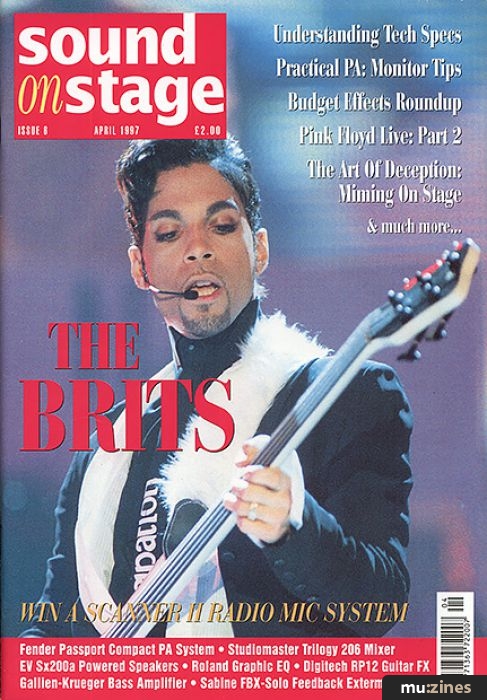
Sound On Stage - Apr 1997
Feature by Big George Webley
Help Support The Things You Love
mu:zines is the result of thousands of hours of effort, and will require many thousands more going forward to reach our goals of getting all this content online.
If you value this resource, you can support this project - it really helps!
Donations for June 2026
Issues donated this month: 0
New issues that have been donated or scanned for us this month.
Funds donated this month: £0.00
All donations and support are gratefully appreciated - thank you.
Magazines Needed - Can You Help?
Do you have any of these magazine issues?
If so, and you can donate, lend or scan them to help complete our archive, please get in touch via the Contribute page - thanks!
Please Contribute to mu:zines by supplying magazines, scanning or donating funds. Thanks!
Monetary donations go towards site running costs, and the occasional coffee for me if there's anything left over!

 @mu_zines
 RSS Feed
 Blog
Blog